 |
|
Showing posts with label poetry. Show all posts
Showing posts with label poetry. Show all posts
Friday, August 14, 2020
Czesław Miłosz


Friday, July 24, 2020
Manhatta
|

Tuesday, May 19, 2020

Saturday, May 16, 2020
Brain Pickings by Maria Popova
 David Byrne's buoyant countercultural hymn of optimism, resistance, and resilience; Sophie Scholl on courage; stunning Great Barrier Reef illustration
One Fine Day: David Byrne Performs His Hymn of Optimism and Countercultural Anthem of Resistance and Resilience with the Brooklyn Youth Chorus
In the spring of 2019, when David Byrne (b. May 14, 1952) took the stage at the third annual Universe in Verse to read a science-inspired love poem to time and chance titled “Achieving Perspective,” I introduced him as one of the last standing idealists in our world — a countercultural force of lucid and luminous optimism, kindred to Walt Whitman, who wrote so passionately about optimism as a mighty force of resistance and a pillar of democracy./.../
Sunday, May 10, 2020
the Cycle of Life
And So It Goes: A Lyrical Illustrated Meditation on the Cycle of Life
“We don’t know when, but those who arrive will leave one day as well.”
BY MARIA POPOVA

“What is it then between us? What is the count of the scores or hundreds of years between us?” asked Walt Whitman in his iconic ode to the unstoppable succession of being as he contemplated the generations who, long after he has returned his borrowed atoms to the universe, would walk the same streets and traverse the same waters and burn with the same human passions. Half a century down this generational river, Rilke insisted that “death is our friend precisely because it brings us into absolute and passionate presence with all that is here, that is natural, that is love.” But even if, long after Whitman and Rilke have gone, the physicists have come to agree with the poets that our mortality is the wellspring of our existential vitality, it remains — and perhaps it shall always remain — a towering triumph for the human animal to view its own existence from this placid cosmic vantage point. To grow up is to learn to manufacture “antidotes to fear of death” — in marriages and mortgages, in products and possessions, in the various illusions of stability and permanence that allow us to go on averting our gaze from our finitude, from the fact that we too will one day be washed into the impartial waters of time./.../
Sunday, May 03, 2020
Pablo Neruda, Leland Melfin, Cosmic Forests
The Cosmic Miracle of Trees: Astronaut Leland Melvin Reads Pablo Neruda’s Love Letter to Earth’s Forests
“Anyone who hasn’t been in the Chilean forest doesn’t know this planet. I have come out of that landscape, that mud, that silence, to roam, to go singing through the world.”
BY MARIA POPOVA

“Today, for some, a universe will vanish,” Jane Hirshfield writes in her stunning poem about the death of a tree a quarter millennium after William Blake observed in his most passionate letter that how we see a tree is how we see the world, and in the act of seeing we reveal what we are: “The tree which moves some to tears of joy is in the eyes of others only a green thing which stands in the way,” he wrote. “As a man is, so he sees.”/.../
Friday, April 24, 2020
Singularity: Marie Howe
Singularity: Marie Howe’s Ode to Stephen Hawking, Our Cosmic Belonging, and the Meaning of Home, in a Stunning Animated Short Film
“For every atom belonging to me as good belongs to you. Remember?”
BY MARIA POPOVA
“We, this people, on a small and lonely planet,” Maya Angelou begins “A Brave and Startling Truth” — her cosmic wakeup call to humanity, which flew into space aboard NASA’s Orion spacecraft and which opened the 2018 Universe in Verse, dedicated to our ecological awakening on the wings of Rachel Carson’s courageous work.
That year, Marie Howe — one of our great living poets, who awakens the creaturely conscience of the next generation in her ecopoetry class at Sarah Lawrence College — premiered a kindred poem that stilled the crowd constellating at Pioneer Works before erupting into a thousand-bodied standing ovation. While inspired by Stephen Hawking (who had just returned his stardust to the universe several weeks earlier) and titled after his trailblazing work on black holes and singularities — work that shines a sidewise gleam on the origin of everything — the poem is at bottom a stunning meditation on the interconnectedness of belonging across space and time, across selves and species, across the myriad artificial unbelongings we have manufactured as we have drifted further and further from our elemental nature. Its closing line is an invocation, an incantation, ending with a timeless word of staggering resonance today: home.

Wednesday, April 22, 2020
50 Earth Day
50 years of Earth Day with Jane Hirshfield's


“I don't think it would have been conceivable to me when I was seventeen that science would ever need defending, let alone by a poet,” the poet Jane Hirshfield says in her beautiful and poignant meditation on her memory of the first Earth Day in 1970, prefacing her reading at the 2020 Universe in Verse, celebrating 50 years of Earth Day. (Tune into the global broadcast at 4:30PM EST on Saturday, April 25, to hear Hirshfield and a constellation of other radiant minds – including Patti Smith, Neil Gaiman, Elizabeth Gilbert, Amanda Palmer, astrophysicists, artists, astronauts, and other seekers of cosmic truth and makers of human meaning – read and reflect on poems celebrating the science and splendor of nature.)
Jane Hirshfield (Photograph: Nick Rozsa)
Hirshfield – one of a handful of living poets elected to the American Academy of Arts and Sciences, an artist who weaves the scientific worldview into her delicate cosmogonies of our inner lives, and an ordained Buddhist – is the founder of Poets for Science, which began when she found herself composing an anthem of resistance amid the strange world of “alternative facts” hammered off the bedrock of reality by the 2016 election.
In the bittersweet archival piece below, reverberating with especial poignancy on this ambivalent 50th anniversary of Earth Day, my beloved friend Emily Levine – who returned her stardust to the universe last year, having kindled my love of poetry and having left “something of substance and sweetness in the mouth of the world” – reads Hirshfield’s poem at the inaugural Universe in Verse.
FROM THE ARCHIVE (2017) | Poetry as Protest and Sanctuary: Jane Hirshfield’s Magnificent Poem Against the Silencing of Science and the Assault on Nature
“The real wealth of the Nation lies in the resources of the earth — soil, water, forests, minerals, and wildlife… Their administration is not properly, and cannot be, a matter of politics,” biologist and writer Rachel Carson admonished in her prescient 1953 letter against the government’s assault on science and nature. She devoted the remainder of her life to this courageous mission of speaking inconvenient truth to power. In writing Silent Spring, which catalyzed the modern environmental movement, Carson was greatly emboldened by a line from a 1914 poem by Ella Wheeler Wilcox: “To sin by silence, when we should protest, makes cowards out of men.”
Poetry, indeed, has always been one of humanity’s sharpest tools for puncturing the shrink-wrap of silence and oppression, and although it may appear to be galaxies apart from science, these two channels of truth have something essential in common: nature, the raw material for both. To impoverish the world of the birds and the bees is to impoverish it of the bards and the biologists.
Nature, with its fragile yet resilient magnificence, models for us what aliveness means and reminds us that we are mortal. Poetry wrests from it images and metaphors that chisel from the bedrock of our humanity a measure of graspable truth, teaching us how to live and how to die. Science mines nature for truth of a different order — it is our mightiest means of communing with reality, probing its mysteries, and gleaning from them some sense of belonging, of locating ourselves in the universe, understanding our place in it, and liberating ourselves from delusion.
That common ground between poetry and science is what poet Jane Hirshfield sows with splendor in her poem “On the Fifth Day,” written for the 2017 March for Science in Washington, D.C., protesting the anti-fact, anti-truth, anti-science political climate of the current American administration.
It is my immense pleasure to share, with Hirshfield’s permission, this gift of a poem, read by comedian, philosopher of science, and my dear friend Emily Levine — the person who first made me fall in love with poetry many moons ago.
ON THE FIFTH DAY
by Jane HirshfieldOn the fifth day
the scientists who studied the rivers
were forbidden to speak
or to study the rivers.The scientists who studied the air
were told not to speak of the air,
and the ones who worked for the farmers
were silenced,
and the ones who worked for the bees.Someone, from deep in the Badlands,
began posting facts.The facts were told not to speak
and were taken away.
The facts, surprised to be taken, were silent.Now it was only the rivers
that spoke of the rivers,
and only the wind that spoke of its bees,while the unpausing factual buds of the fruit trees
continued to move toward their fruit.The silence spoke loudly of silence,
and the rivers kept speaking,
of rivers, of boulders and air.In gravity, earless and tongueless,
the untested rivers kept speaking.Bus drivers, shelf stockers,
code writers, machinists, accountants,
lab techs, cellists kept speaking.They spoke, the fifth day,
of silence.
Join me in supporting Hirshfield’s wonderful #PoetsForScience initiative, a kindred spirit to my own The Universe in Verse project, then revisit Rebecca Solnit on breaking silence as our mightiest weapon against oppression, astrophysicist Jocelyn Bell Burnell on how poetry and science enrich one another, and Hirshfield on the effortless effort of creative work.
Photograph of Emily Levine by John Keatley
RELATED READING/VIEWING:
Thursday, April 16, 2020
Bernadette Mayer’s Memory
Everyday Life, Revisited—with Bernadette Mayer’s Memory
In the poet’s work, the small and ordinary rise to the level of heroic adventures. If we value human life, then we should value what makes up a life.
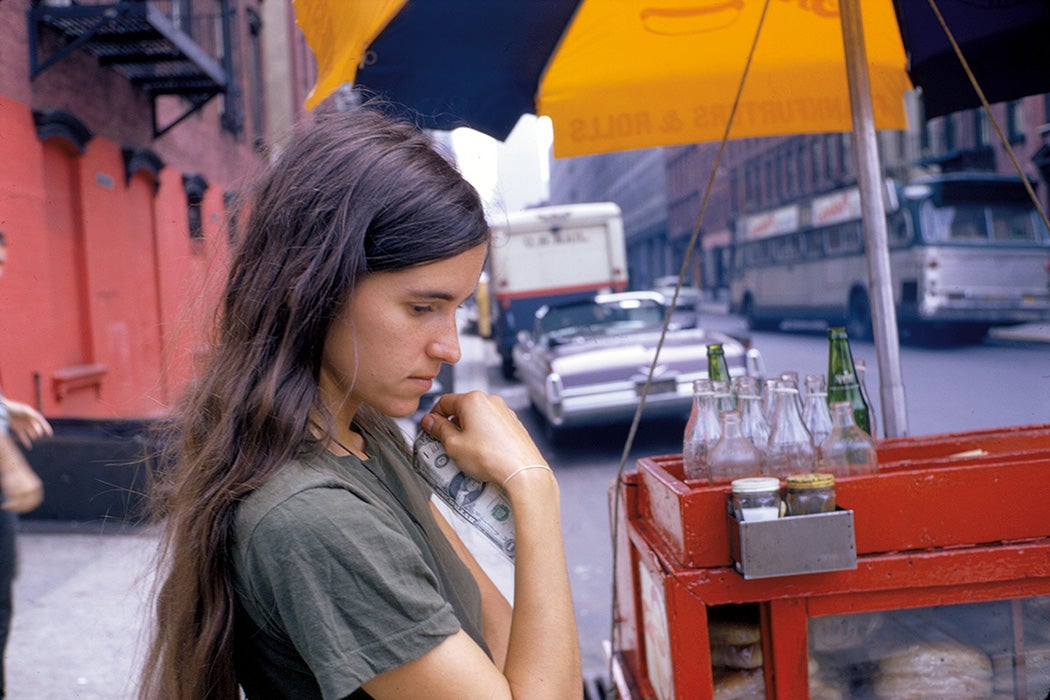
I started working on this article before COVID-19 became a global interruption to everyday life. Now, when we’re asked to stay home as much as possible, Memory serves as both an inspiration and a painful reminder of how full a day could be: parties with friends, trips to the bar or bookstore, busy city streets, casual encounters and road trips. So many aspects of normal life are on hold right now, and it can be useful to be reminded of what we took for granted. But Mayer’s work demonstrates the value in attending to our everyday life, even if it’s confined to smaller square footage. What happens outside the window, the noises we hear from other apartments, the photographs we find on our corkboard or in our phones, the meals we’re cooking, the shows we’re watching, the words we read online or in books—these are all part of life and demonstrate how larger structures of gender, politics, and economics affect even these small moments. They make up our memories too, if we pay attention.
Thursday, April 02, 2020
April
Em nosso hemisfério, passando duas estações para frente ou para trás, podemos colher experiências semelhantes.
"Expectation may amount to prophecy": April - Henry David Thoreau

"Expectation may amount to prophecy": April - Henry David Thoreau
Our monthly foray into Henry David Thoreau's The Journal: 1837–1861, a text perhaps more applicable at this time than ever. For this month, we have a passage from April 2, 1852. Thoreau was thirty-four years old.
April 2. 6 A.M.—The sun is up. The air is full of the notes of birds,—song sparrows, red-wings, robins (singing a strain), bluebirds—and I hear also a lark,—as if all the earth had burst forth into song. A few weeks ago, before the birds had come, there came to my mind in the night the twittering sound of birds in the early dawn of a spring morning, a semiprophecy of it, and last night I attended mentally as if I heard the spray-like dreaming sound of the mid-summer frog and realized how glorious and full of revelations it was. Expectation may amount to prophecy. The clouds are white watery, not such as we had in the winter.
Painting: Songbirds in a Woodland Marsh, Fidelia Bridges, 1879, oil on canvas.
Saturday, March 07, 2020
Te Universe in verse
The Universe in Verse: Western Horizon (April 18, CA)

“We, this people on this mote of matter,” Maya Angelou wrote in her stunning poem “A Brave and Startling Truth” that flew to space aboard NASA’s Orion spacecraft — a poem inspired by Carl Sagan, a poem in which she traces our traversal of space, “past aloof stars, across the way of indifferent suns,” to invite the elemental question: What are we, “this people,” and what is life itself, by measures both human and cosmic?
Sunday, February 23, 2020
The Poetry of Existence
Until the End of Time: Physicist Brian Greene on the Poetry of Existence and the Wellspring of Meaning in Our Ephemeral Lives Amid an Impartial Universe
“From our lonely corner of the cosmos we have used creativity and imagination to shape words and images and structures and sounds to express our longings and frustrations, our confusions and revelations, our failures and triumphs.”
BY MARIA POPOVA

“Praised be the fathomless universe, for life and joy, and for objects and knowledge curious,” Walt Whitman wrote as he stood discomposed and delirious before a universe filled with “forms, qualities, lives, humanity, language, thoughts, the ones known, and the ones unknown, the ones on the stars, the stars themselves, some shaped, others unshaped.” And yet the central animating force of our species, the wellspring of our joy and curiosity, the restlessness that gave us Whitman and Wheeler, Keats and Curie, is the very fathoming of this fathomless universe — an impulse itself a marvel in light of our own improbability. Somehow, we went from bacteria to Bach; somehow, we learned to make fire and music and mathematics. And here we are now, walking wildernesses of mossy feelings and brambled thoughts beneath an overstory of one hundred trillion synapses, coruscating with the ultimate question: What is all this?
Tuesday, February 04, 2020
Maranatha
Abaixo segue o verso de um cartão postal que recebi na década de 80 de um grande amigo - Pe. Ernesto Greiner - Dando notícias de sua estada num sanatório da Alemanha enquanto se recuperava de um infarto. Enviei uma copia para uma grande amiga e vizinha - Da. Marila Fay de Azambuja - em cuja residência ele também morara. O filho dela - Dr. José Inácio Fay de Azambuja teve a gentileza de me enviar um texto poético de nosso amigo que eu ainda não conhecia, permitindo-me que o compartilhasse.
Mais sobre o Ernesto publicado anteriormente:
http://amicorextension.blogspot.com/2013/02/ernest-greiner-07051917-17021987.html
Ernest Greiner.

Mais sobre o Ernesto publicado anteriormente:
http://amicorextension.blogspot.com/2013/02/ernest-greiner-07051917-17021987.html
MARANATHA
A Lenda de uma Flor.
Ernest Greiner.
“Reza antiga lenda que, aos homens expulsos do Paraíso, entregou
Deus uma flor, para que, em terra alheia, recordassem sua Pátria”.
“Esta flor, diz ainda a lenda, é o anseio de felicidade...”
O homem associa sempre a felicidade à Pátria, ao berço, à
infância... Ela é a nascente cristalina, a doçura do olhar... É a firmeza no
andar, som familiar de cantiga materna, solenidade de domingo... Aconchego dos
primeiros hábitos, refúgio do coração assustado... É a encarnação do espírito
que vagueia pelos espaços...
Ter Pátria é ser criança.
Mas o homem é designado a ser adulto. Há de trocar o berço pela
estrada. O pai deixa de ser a rocha inquebrantável. Descobrem-se lacunas na
sabedoria da mãe. A fortaleza do lar passa a mostrar rachaduras. As fronteiras
de cada ser aparecem com crescente nitidez no mapa de nossa juventude. Somos
expulsos do paraíso das alianças absolutas: “minha Mãe é a única... Minha
Terra... Minhas raízes, meu calor e meu lar... Minha gente”.
Chega o dia em que a
madrugada amiga estremece. Aconchegos são sacudidos pela consciência de
distâncias. Confianças são abaladas pela descoberta dolorosa da relatividade.
Agita-se, então, o homem nos preparativos da
viagem. E seguem-se os adeuses dolorosos, mas necessários. Porque o adulto não
tem direito de fixar sua morada na infância. Deve crescer, sofrendo as
amarguras da limitação que lhe inspira o medo. Das distâncias que o mergulham
na solidão...
Com a lâmpada da ansiedade acesa, parte em
busca de novas terras para a sua inteligência... De novas residências para o
seu amor, de novos desafios para seu espírito combativo. Seja-lhe o berço
preciosa recordação. O risco da estrada é a sua vida.
O homem fixado teme a saída de si. Desconfia
de tudo. Evita os encontros. Odeia os outros. Julga inválido tudo o que não
traga a marca do seu coração acorrentado.
Para ser adulto é preciso ser estrangeiro
dentro do mundo. A criança só acredita no seu mundo. O estrangeiro reconhece o
outro como o outro. Sua inteligência não é presunçosa. Seu coração está à
escuta... Sua sensibilidade se comove com a beleza inédita de novas
paisagens...
O estrangeiro é o homem autêntico. Ele não
desconhece a verdadeira fraternidade porque nele o partir e o chegar se saúdam.
É preciso que a flor da ansiedade, que
trazemos do paraíso perdido, não murche. Percorrer com ela a caminhada do
nascedouro até o oceano é entender o verdadeiro sentido das coisas: os berços e
as pátrias deixam de ser prisões ou refúgios. As estradas não são mais rastros
falazes que se perdem nas areias infindas do cansaço. Os outros passam a ser
moradas para os nossos corações.
MARANATHA – o que o homem ama na recordação e
o que ele vive no sonho... O que anima suas andanças e o que não o deixa
perder-se na estrada!
MARANATHA – o que conduz o homem de longo
percurso!

Saturday, January 25, 2020
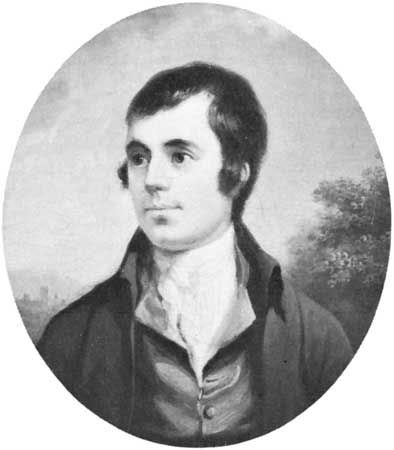
Robert Burns
 |
|
Sunday, January 12, 2020
The Spirit of the Woods: Rebecca Hey
The Spirit of the Woods: Poet and Painter Rebecca Hey’s Gorgeous 19th-Century Illustrations for the World’s First Encyclopedia of Trees
From the weeping willow to the oak, a watercolor serenade to the science and poetics of our ancient silent companions.
BY MARIA POPOVA

“The tree which moves some to tears of joy is in the eyes of others only a green thing which stands in the way… As a man is, so he sees,” William Blake wrote in his most beautiful letter a quarter millennium before scientists began to see the molecular poetry of what trees feel and how they communicate.
Perched partway in time between Blake’s time and ours, and partway in sensibility between the poetic and the scientific, Sylvan Musings, or, The Spirit of the Woods (public library | public domain) is, as far as I am aware, the world’s first encyclopedia of wild trees.

Subscribe to:
Posts (Atom)