Translate AMICOR contents if you like

Showing posts with label sociology. Show all posts

Wednesday, June 03, 2020

BlaCKBIRDERS

#BlackBirdersWeek co-founders talk nature and race

We're currently in the middle of the inaugural #BlackBirdersWeek, an online event created with the goal of promoting and encouraging the inclusion of black people in science and nature communities traditionally dominated by white people.
The event was created in reaction to the news of Christopher Cooper, who was birding in Central Park when a white woman called the police on him after he politely asked her to leash her dog. She became frantic and irate as she told the police "an African American man is threatening my life," as seen in a video of the encounter shared on Twitter. The incident inspired black birders across the country to stand in solidarity with Cooper and share their stories and concerns about #BirdingWhileBlack on social media. 

Tuesday, June 02, 2020

Trust in Sicuety

QUOTE OF THE DAY
"The problem is that once trust is lost, it is very difficult to get it back. Societies can thus get trapped in a feedback loop of corruption, distrust and inequality. Corruption drives inequality and distrust, whereas distrust drives even deeper inequality. Voters may realize they would benefit from policies that reduce inequality, but their distrust of one another and of their institutions prevents the political system from acting in the way they would prefer."

Tuesday, May 26, 2020

Money and Modern Life

Money and Modern Life
Daniel Lopez, Aeon
Sociologist Georg Simmel diagnosed the character of modern city life: finance, fashion and becoming strangers to one another.


Money and Modern LifeGeorg Simmel was born in the heart of Berlin in 1858. That city epitomised the tensions of Germany’s special path to modernity. Rapid urbanisation and financial speculation propelled Berlin to the world stage. An avant-garde cultural elite flourished uneasily alongside central Europe’s aristocracy while a young proletariat fought the state and the bourgeoisie for rights, political and economic. A proliferation of modern technologies generated power and wealth while eroding the landed Prussian Junker nobility, the foundation of Bismarck’s united German Reich. The Hohenzollern dynasty – one of the oldest in Europe – reigned over a volatile empire, intoxicated by the most modern ideas./.../


Daniel Lopez is a contributing editor at Jacobin magazine and an honorary research associate at La Trobe University, with the Thesis Eleven Forum for Social and Political Theory. He is the author of Lukács: Praxis and the Absolute (2019). He lives in Melbourne, Australia.
4,200 words
Edited by Sam Dresser


Saturday, January 25, 2020

Gentrification

Ruth Glass: Beyond ‘Gentrification’

Divya Subramanian

A barman and customers at the Piss House pub on Portobello Road, Notting Hill, London, 1969
In her introduction to London: Aspects of Change (1964), Ruth Glass wrote that the city was “too vast, too complex, too contrary and too moody” to be known entirely. The same could be said about Glass herself, an urban sociologist based at University College London from the 1950s to her death in 1990. She left no archive for scholars to sift through. The term she coined, gentrification, has become ubiquitous, but she remains out of sight. Her longtime friend, the late Marxist historian Eric Hobsbawm, described her as a “tiny, combative, bird-like woman.” Yet even beyond coining gentrification—the term that outlived her—Glass set the agenda for a generation of postwar social scientists, breaking new ground in both the study of race relations and in community studies. 

Wednesday, October 16, 2019

Pandemics

How pandemics shaped society

In his new book, historian Frank Snowden argues that infectious diseases have shaped social evolution no less powerfully than have wars, revolutions and economic crises. Reviewer Laura Spinney notes that we still seem to be repeating many of the mistakes that triggered or exacerbated epidemics in the past.
Nature | 5 min read

Monday, October 07, 2019

World Social Forum

Farewell to the World Social Forum?

By Roberto Savio*
 Opening reflections for the September 2019 GTN forum
 LOOKING BACK
The first World Social Forum in 2001 ushered in the new century with a bold affirmation: “Another world is possible.” That gathering in Porto Alegre, Brazil, stood as an alternative and a challenge to the World Economic Forum, held at the same time an ocean away in the snowy Alps of Davos, Switzerland. A venue for power elites to set the course of world development, the WEF was then, and remains now, the symbol for global finance, unchecked capitalism, and the control of politics by multinational corporations.   
The WSF, by contrast, was created as an arena for the grassroots to gain a voice. The idea emerged from a 1999 visit to Paris by two Brazilian activists, Oded Grajew, who was working on corporate social responsibility, and Chico Whitaker, the executive secretary of the Commission of Justice and Peace, an initiative of the Brazilian Catholic Church. Incensed by the ubiquitous, uncritical news coverage of Davos, they met with Bernard Cassen, editor of Le Monde Diplomatique, who encouraged them to organize a counter-Davos in the Global South. With support from the government of Rio Grande do Sul, a committee of eight Brazilian organizations launched the first WSF. The expectation was that about 3,000 people attend (the same as Davos), but instead 20,000 activists from around the world came to Porto Alegre to organize and share their visions for six days.   

Wednesday, August 14, 2019

Falando em Previdência...

U.S. Social Security card.

Friday, December 28, 2018

Capitalism

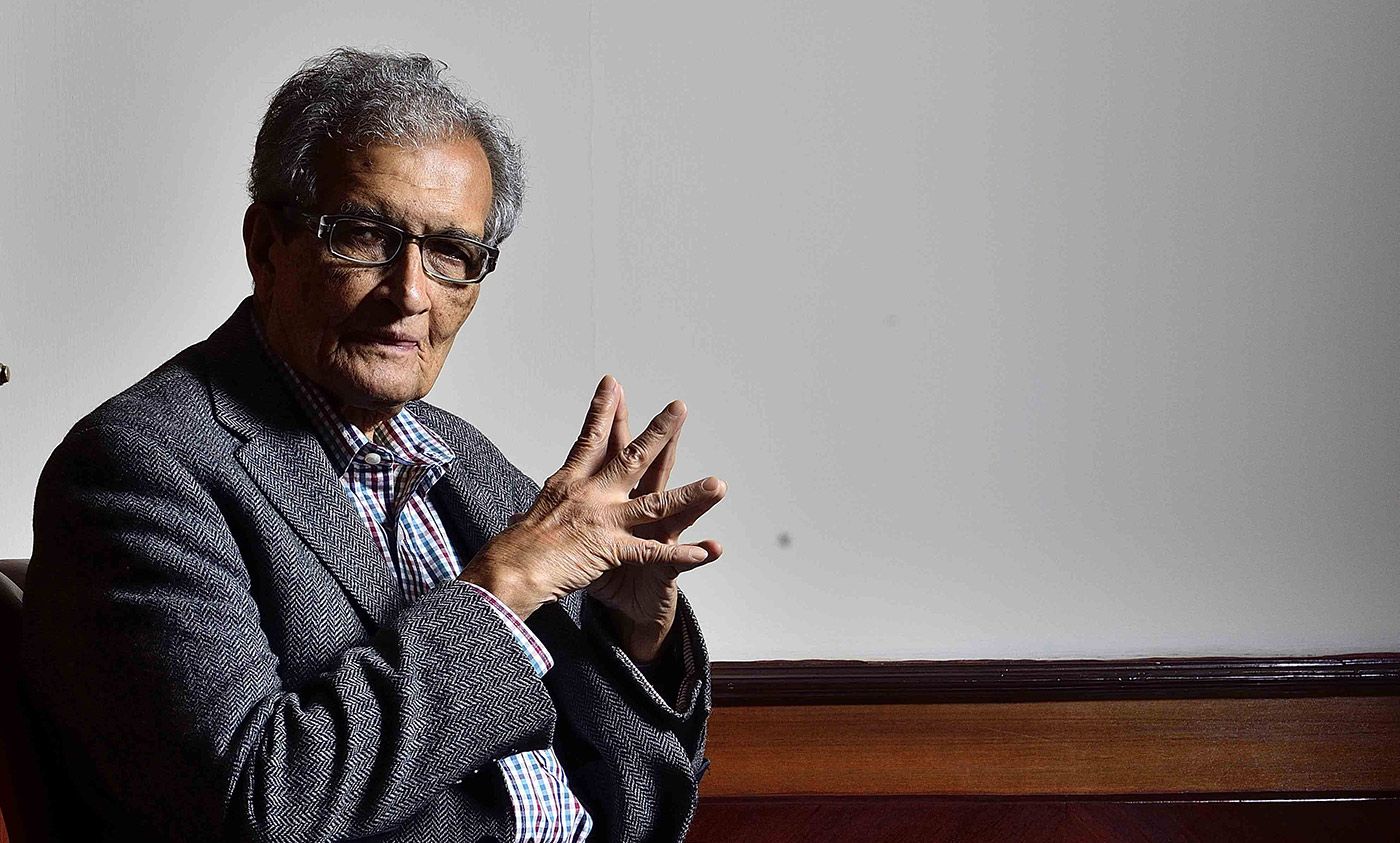
Why Amartya Sen remains the century’s great critic of capitalism Tim Rogan is a fellow of St Catharine’s College, Cambridge,
where he teaches history. He is the author of 
The Moral Economists: R H Tawney, Karl Polanyi,
E P Thompson and the Critique of Capitalism 
(2017

Edited by Sam Haselby

Recomendado pela AMICOR Maria Inês Reinert Azambuja
Amartya Sen photographed in New Delhi, 2017. <em>Photo by Priyanka Parashar/Mint/Getty</em>
Amartya Sen photographed in New Delhi, 2017. Photo by Priyanka Parashar/Mint/Getty
Critiques of capitalism come in two varieties. First, there is the moral or spiritual critique. This critique rejects Homo economicus as the organising heuristic of human affairs. Human beings, it says, need more than material things to prosper. Calculating power is only a small part of what makes us who we are. Moral and spiritual relationships are first-order concerns. Material fixes such as a universal basic income will make no difference to societies in which the basic relationships are felt to be unjust. /.../

Saturday, September 15, 2018

our grip on the truth

Our Shared Reality is Fraying

by Neuroscience Newsa frayed piece of rope
Have we lost our grip on the truth? NeuroscienceNews.com image is adapted from The Conversation news release.
Researchers report truth is key to normal human interactions and consider how society might be losing its sense of shared reality.

Wednesday, June 06, 2018

Sex and Gender


The New Science of Sex and Gender
Gloria Steinem said that a gender-equal society would be one where the word “gender” does not exist. This eBook challenges the assumptions and social construct behind views on gender, examining the latest studies in biology, medicine and psychology and their bearing on issues of healthcare, identity and access.

Sunday, April 29, 2018

Ageing Population Sociology

Andrzej Klimczuk aklimczuk@gazeta.pl por  yorku.ca 

para SDOH
Dear Colleagues,

*** Sorry for cross-posting. Please distribute widely ***

In collaboration with the journals Frontiers in Sociology & Frontiers in Public Health (www.frontiersin.org) we are bringing together a selected group of international experts to contribute to an open-access article collection on:
"Perspectives and Theories of Social Innovation for Ageing Population"

Guest Editors:
Andrzej Klimczuk, Warsaw School of Economics, Warsaw, Poland
Łukaz Tomczyk, Pedagogical University of Kraków, Kraków, Poland

The abstract submission deadline is 27 June 2018.
The manuscript submission deadline is 24 October 2018.

Visit the collection homepage for the full description of the project: https://www.frontiersin.org/research-topics/8000

About this Research Topic:
In recent years we may observe increasing interest in the development of social innovation both regarding theory as well as the practice of responding to social problems and challenges. One of the crucial challenges at the beginning of the 21st century is population ageing. Various new and innovative initiatives, programs, schemes, and projects to respond to negative consequences of this demographic process are emerging around the world. However, social theories related to ageing are still insufficiently combined with these new practices, social movements, organisational models, and institutions. Many scholars are still using notions and tools from classical theories of social gerontology or the sociology of ageing such as disengagement theory, activity theory, and successful and productive ageing. Such theories do not sufficiently explain ageing in the context of, for example, a broad use of the information and communications technologies (ICTs) including robotics and automation, new healthcare and long-term care models, advancements in the development and governance of age-friendly environments, and public engagement of older adults into co-production of services delivered by public, private, non-governmental as well as non-formal entities.

In this Research Topic we welcome papers critically evaluating the existing social perspectives and theories in the field of ageing, introducing innovative approaches and comparative studies. We welcome researchers from areas such as sociology, pedagogy, public policy, economics, management, and public health. The contributions can be based on theoretical studies as well as the implementation of social innovation and programs addressed at ageing and older people. Reviews and papers on philosophical and ethical issues are also welcome.

Keywords: ageing, aging, older adults, older people, social gerontology, sociology of aging, sociology of ageing, ICT, robotics, social innovation, care, caregivers, agefriendly, public health, long-term care, healthcare, governance, NGOs

As a contributing author, you will benefit from:
- High visibility with eBook and our research network
- Rigorous, transparent and fast peer review
- 10% discount on publishing fees
- Advanced impact metrics

More:
- Read about the article collection https://www.frontiersin.org/research-topics/8000
- Publishing fees including institutional memberships and fee-waiver program https://www.frontiersin.org/about/publishing-fees
- Contact the Frontiers editorial office sociology@frontiersin.org

Best regards,

To leave, manage or join list: https://listserv.yorku.ca/cgi-bin/wa?SUBED1=sdoh&A=1