Translate AMICOR contents if you like

Sunday, July 10, 2022

3.093 - AMICOR (25)

 3.093 - AMICOR (25)

#Antônio Achutti Olivé com sua avó em Buenos Aires

Logo após sua apresentação como componente da OSPA, em BA no Teatro Colón

No dia 10/07/2022 a OSPA, com sucesso se apresentou pela primeira vez em 72 anos no Teatro Colón. Nosso neto Antônio, como percussionista da OSPA, fez parte da apresentação, que poderá ser vista através do link. Dra. Mabel Morón é também médica, e reside em BA. Pensando  na data da fundação da OSPA, lembrei-me que a 71 anos, eu conheci a outra avó dele - Dra. Valderês Antonietta Robinson Achutti - que infelizmente não assistiu o espetáculo porque faleceu no ano passado.


                                        (clicar  em Apresentação de Slides)
#MEDPAGEtoday

ADHD Drugs May Treat Alzheimer's Cognitive Symptoms Effectively

— Positive effect on global cognition, apathy in meta-analysis

A computer rendering of a neuron releasing neurotransmitters.

Drugs with principally noradrenergic action -- including ones prescribed for attention deficit-hyperactivity disorder (ADHD) or to treat hypertension or depression -- may effectively treat cognitive symptoms and apathy in Alzheimer's disease, a systematic review and meta-analysis suggested./.../

#ECHOLOGY - From Maira Popova

In 1866, the young German marine biologist Ernst Haeckel — whose exquisite illustrations of single-celled underwater creatures had enchanted Darwin — gave that interdependence a name: He called it ecology, from the Greek oikos, or “house, and logia, or “the study of,” denoting the study of the relationship between organisms in the house of life.

#ASRM

#NASA

The Future Is Gazing Into the Deepest Reaches of the Known Universe's Unmatched Majesty.

12 JULY 2022

TOP STORY

NASA Officially Unveils First Set of Dazzling James Webb Images

We have waited, and now, we've received: The full first set of images from NASA's James Webb Telescope are here. They show the resplendence of the deepest reaches of the universe we can see, in ways you've never seen them before. To look at this imagery is to look at history as it unfolds before us.

READ MORE 

#TWITTER/NASA

Here are five things we learned while seeing those first images from the Webb space telescope

#Mário Maranhão +

Recebi a triste notícia do falecimento hoje pela madrugada do eminente cardiologista, Dr. Mário Maranhão, em Curitiba, onde morava  e exercia a profissão. Teve intensa atividade associativa e científica, tendo sido Presidente da SBC e da Federação Mundial de Cardiologia (WHF) com sede em Genebra.


#NYTIMES

As Y Chromosomes Vanish With Age, Heart Risks May Grow A study of mice might explain why.

A scanning electron micrograph of human X and Y chromosomes. A new study suggests loss of the Y chromosome could explain men’s shorter life spans.
Credit...Biophoto Associates/Science Source

#NATURE

A sequence-based global map of regulatory activity for deciphering human genetics

Nature Genetics volume  54pages 940–949 (2022)

Abstract

Epigenomic profiling has enabled large-scale identification of regulatory elements, yet we still lack a systematic mapping from any sequence or variant to regulatory activities. We address this challenge with Sei, a framework for integrating human genetics data with sequence information to discover the regulatory basis of traits and diseases. Sei learns a vocabulary of regulatory activities, called sequence classes, using a deep learning model that predicts 21,907 chromatin profiles across >1,300 cell lines and tissues. Sequence classes provide a global classification and quantification of sequence and variant effects based on diverse regulatory activities, such as cell type-specific enhancer functions. These predictions are supported by tissue-specific expression, expression quantitative trait loci and evolutionary constraint data. Furthermore, sequence classes enable characterization of the tissue-specific, regulatory architecture of complex traits and generate mechanistic hypotheses for individual regulatory pathogenic mutations. We provide Sei as a resource to elucidate the regulatory basis of human health and disease.

Fig. 5: Disease regulatory mutations are predicted to disrupt promoter, CTCF and tissue-specific enhancer sequence classes.
figure 5

Sequence class-level mutation effects of pathogenic noncoding HGMD mutations were plotted. A polar coordinate system was used, where the radial coordinate indicates the sequence class-level effects. Each dot represents a mutation and mutations inside the circle are predicted to have positive effects (increased activity of sequence class); mutations outside the circle are predicted to have negative effects (decreased activity of sequence class). Dot size indicates the absolute value of the effect. Mutations were assigned to sequence classes based on their sequences and predicted effects (Methods). Within each sequence class, mutations were ordered by chromosomal coordinates. The associated disease and gene name were annotated for each mutation and only the strongest mutation was annotated if there were multiple mutations associated with the same disease, gene and sequence class.

#The Marginalian - Maria Popova
NOTE: This newsletter might be cut short by your email program. View it in full. If a friend forwarded it to you and you'd like your very own newsletter, subscribe here — it's free. Need to modify your subscription? You can change your email address or unsubscribe.
The Marginalian

WelcomeHello Aloyzio Achutti! This is the midweek edition of The Marginalian (formerly Brain Pickings) by Maria Popova — one piece resurfaced from the fifteen-year archive as timeless uplift for heart, mind, and spirit. If you missed last week's archival resurrection — Mary Oliver on happiness, fear, and the sublime interconnectedness of life — you can catch up right here. And if my labor of love enriches your life in any way, please consider supporting it with a donation — it remains free and ad-free and alive thanks to reader patronage. If you already donate: I appreciate you more than you know.

FROM THE ARCHIVE | Love, Kindness, and the Song of the Universe: The Night Jack Kerouac Kept a Young Woman from Taking Her Own Life

In the late 1950s, a young woman named Lois Sorrells Beckwith did what many passionate book-lovers find themselves doing — she fell in love with an author through his work; not with the writing alone, but with the man. That man was Jack Kerouac and the book that tipped Lois over the edge of infatuation was his newly published novella The Subterraneans (public library), a semi-fictional account of a fervid romance.

But then Lois did something few ardent readers would dare to do.

A native New Englander then living in California, she moved back to the East Coast and, one fateful afternoon in 1958, mustered the timid brazenness to drive herself to Kerouac’s home in Northport, Long Island, hoping to meet him. She pulled up to the house and found him sitting under a tree in his front yard, meditating — a practice he had taken up some years earlier as he plunged into Buddhist philosophy./.../

#The Lancet PH

Figure: Distributions of placebo effects and intervention effects on neonatal mortality - Copyright: 2022 The Author(s). Published by Elsevier Ltd

#PsychCentral
PsychCentral | When Does Nail Biting or Skin Picking Become a Medical Condition? | Hosted by Gabe Howard
When Does Nail Biting or Skin Picking Become a Medical Condition?
Hosted by Gabe Howard
When does a “bad habit” become a medical disorder? Join us as Luisa Zettinig explains her own history with body-focused repetitive behaviors (BFRBs), why she believes community can be a powerful tool for healing, and how her company aims to foster mindfulness for people who live with BFRBs.
SEE EPISODE


#
My Bookmarks

GENERAL RELATIVITY | ALL TOPICS


Mass and Angular Momentum, Left Ambiguous by Einstein, Finally Get Defined

By STEVE NADIS

Surprising as it may sound, 107 years after the introduction of general relativity, the meanings of basic concepts are still being worked out.

Read the article

COMBINATORICS


Hypergraphs Reveal Solution to 50-Year-Old Problem

By LEILA SLOMAN

In 1973, Paul Erdős asked if it was possible to assemble sets of “triples” — three points on a graph — so that they abide by two seemingly incompatible rules. A new proof shows it can always be done.

Read the blog

Related: 
Mathematicians Settle Erdős
Coloring Conjecture

by Kelsey Houston-Edwards (2021)

QUANTUM COMPUTING


Quantum Algorithms Conquer a New Kind of Challenge

By MORDECHAI RORVIG

Computer scientists have found a new type of problem that quantum computers can solve dramatically faster than their classical counterparts. Is it the first in a new frontier of computational accomplishments?

Read the blog

Related: 
How Quantum Computers Will
Correct Their Errors

by Katie McCormick (2021)

DEVELOPMENTAL BIOLOGY


Embryo Cells Set Patterns for Growth by Pushing and Pulling

By MONIQUE BROUILLETTE

Patterns that guide the development of feathers and other features can be set by mechanical forces in the embryo, not just by gradients of chemicals.

Read the blog

Related: 
Ancient Turing Pattern Builds
Feathers, Hair — and Now, Shark Skin

by Jonathan Lambert (2019)

THE JOY OF WHY


How Do Mathematicians Know Their Proofs Are Correct?

Podcast hosted by STEVEN STROGATZ

What does evidence look like in the realm of mathematical abstraction? Hear the mathematician Melanie Matchett Wood explain how probability helps to guide number theorists toward certainty.

Listen to the podcast

Read the transcript

Around the Web

Platonic Reasoning
A new model of artificial intelligence called PLATO has taken a step closer to having common-sense knowledge of how objects behave. It does so by focusing on whole objects rather than pixels to learn about the laws of physics, reports Dana G. Smith for Scientific American. While human infants acquire this grasp on reality early in life, the inability to use knowledge about the world to form new inferences has plagued AI for more than 50 years. In 2020 John Pavlus reported for Quanta on a new approach making progress by blending logic and deep learning.


Jumping From Horses to Dragons
The marine creatures called sea dragons look fantastically different from their close relatives, the sea horses. Scientists combing through the their genomes may have found the reason why in sections of repeating DNA code called transposons, reports Kate Golembiewski for The New York Times. These “jumping genes” could have copied and pasted themselves into the spots where the sea dragons were missing key growth genes. In 2021, Max Kozlov reported for Quanta on how the fusion of jumping genes can have major impacts throughout genomes. Transposons are often lumped in with other non-coding regions of the genome as “junk DNA.” Most of that DNA is truly nonfunctional but some, like transposons, can evolve genomic significance, as Jake Buehler explained for Quanta in 2021.


Thursday, July 07, 2022

3.092 AMICOR (25)

 3.092 - AMICOR (25) No dia 09/07, estamos a 65 anos de nosso casamento (1957). Há um ano passado do falecimento dela, encerrando um convívio de 70 anos, - pouco mais de um dia depois que ela havia completado 90 anos de uma vida bem vivida, deixando muito amor, amizades, admiradores, clientes, alunos e colegas. Encerro aqui o ciclo no qual sempre abri o blog AMICOR com uma imagem dela.

#Dra. Valderês Antonietta Robinson Achutti (*13/06/1931+15/06/2021) 

                                        (clicar  em Apresentação de Slides)

#NASA

James Webb Space Tele

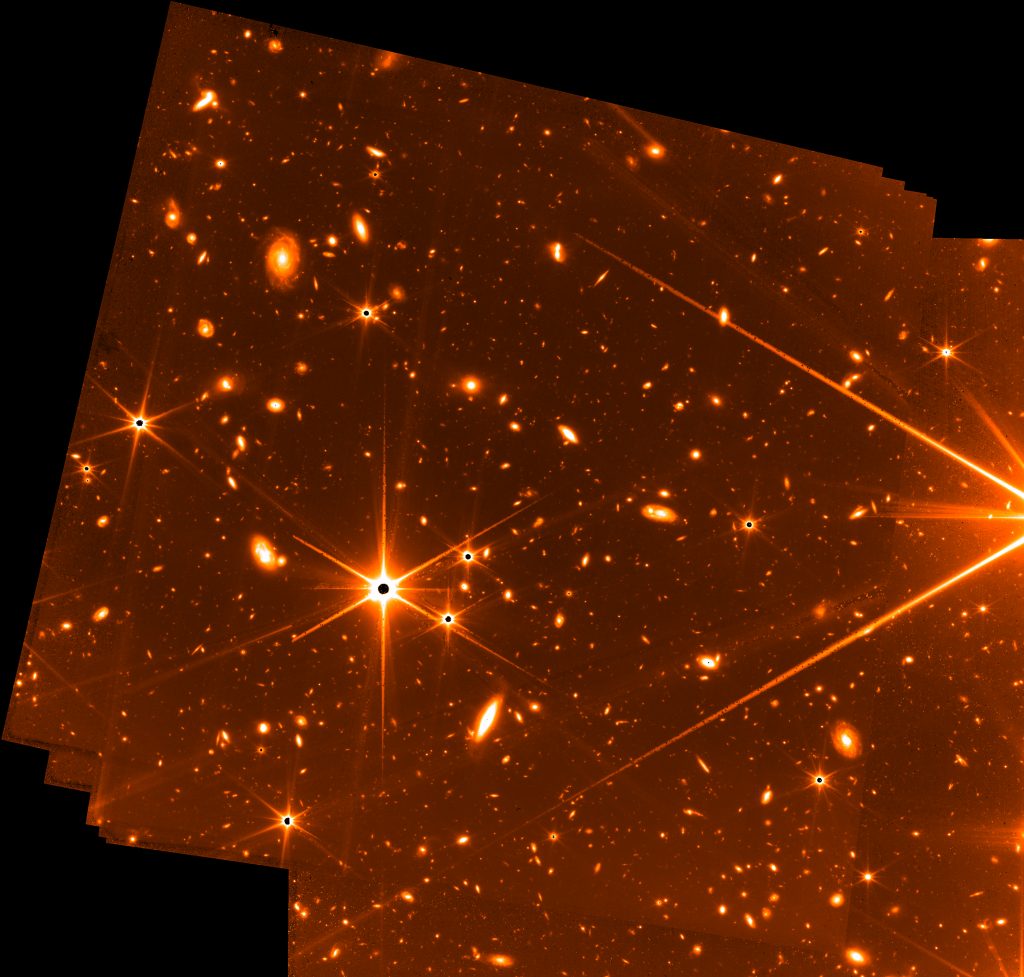
The result – using 72 exposures over 32 hours – is among the deepest images of the universe ever taken, according to Webb scientists.

The James Webb Space Telescope won’t release its first full-colour science images until 12 July — but has just teased us with another mind-blowing calibration image. Webb scientists say the result — using 72 exposures over 32 hours — is among the deepest images of the universe ever taken.

This Fine Guidance Sensor test image was acquired in parallel with NIRCam imaging of the star HD147980 over a period of eight days at the beginning of May. This engineering image represents a total of 32 hours of exposure time at several overlapping pointings of the Guider 2 channel. The observations were not optimized for detection of faint objects, but nevertheless the image captures extremely faint objects and is, for now, the deepest image of the infrared sky. The unfiltered wavelength response of the guider, from 0.6 to 5 micrometers, helps provide this extreme sensitivity. The image is mono-chromatic and is displayed in false color with white-yellow-orange-red representing the progression from brightest to dimmest. The bright star (at 9.3 magnitude) on the right hand edge is 2MASS 16235798+2826079. There are only a handful of stars in this image – distinguished by their diffraction spikes. The rest of the objects are thousands of faint galaxies, some in the nearby universe, but many, many more in the distant universe. Credit: NASA, CSA, and FGS team.
......

#Science

IN THE SKY


July's full moon — nicknamed the Buck Moon — will charge across Earth's skies on Wednesday, July 13. The moon will reach its peak at about 2:38 p.m. EDT (18:38 UTC) on Wednesday, but the Buck doesn't stop here; the moon will appear bright and full on Tuesday and Thursday night (July 12 and July 14), as well.

Avid skywatchers may notice that the moon looks even larger and brighter than normal. That's because, for the third month in a row, the full moon will rise as a supermoon — or a full moon that occurs while the moon is around or at its closest point to Earth, also known as its perigee. This month, the moon reaches perigee at about 5 a.m. EDT (09:00 UTC) on July 13, just 10 hours before the full moon rises.
 Full Story: Live Science (7/7) 
#Fronteiras do Pensamento
#JAMA
ORIGINAL INVESTIGATION
Changes in the Relationship Between Income and Life Expectancy Before and During the COVID-19 Pandemic, California, 2015-2021
Hannes Schwandt, PhD; Janet Currie, PhD; Till von Wachter, PhD; et al.
Conclusions and Relevance  This retrospective analysis of census tract–level income and mortality data in California from 2015 to 2021 demonstrated a decrease in life expectancy in both 2020 and 2021 and an increase in the life expectancy gap by income level relative to the prepandemic period that disproportionately affected some racial and ethnic minority populations. Inferences at the individual level are limited by the ecological nature of the study, and the generalizability of the findings outside of California are unknown.
#
My Bookmarks

So Far This Season on
The Joy of Why Podcast

Explore the first eight episodes of Quanta’s newest podcast hosted by Steven Strogatz.
New episodes premiere every other Thursday wherever you get your podcasts.

QUANTUM PHYSICS


Where Do Space, Time and Gravity Come From?

With SEAN CARROLL


Listen to the episode

Read the transcript

NEUROSCIENCE


Why Do We Die
Without Sleep?

With DRAGANA ROGULJA 
and ALEX KEENE


Listen to the episode

Read the transcript

IMMUNOLOGY


Why Is Inflammation a Dangerous Necessity?

With SHRUTI NAIK


Listen to the episode

Read the transcript

ASTROPHYSICS


Will the James Webb Space Telescope Reveal Another Earth?

With MARCIA RIEKE and NIKOLE LEWIS

Listen to the episode

Read the transcript

TOPOLOGY


Untangling Why Knots Are Important

With COLIN ADAMS
and LISA PICCIRILLO


Listen to the episode

Read the transcript

BIOLOGY


What Is Life?

With ROBERT HAZEN
and SHEREF MANSY


Listen to the episode

Read the transcript

ORIGINS OF LIFE


How Could Life Evolve From Cyanide?

With JACK SZOSTAK
and BETÜL KAÇAR


Listen to the episode

Read the transcript

ARTIFICIAL INTELLIGENCE


Can Computers Be Mathematicians?

With KEVIN BUZZARD


Listen to the episode

Read the transcript


#NOEMA

July 9, 2022


PUBLISHED BY THE BERGGRUEN INSTITUTE


View the roundup in your browser here. Visit Noema Magazine at noemamag.com

The United States Is On A Bleak Trajectory

Will American democracy commit suicide like all others before it?


Nathan Gardels, Noema Editor-in-Chief

At the end of June in Madrid, America led what was once considered a brain-dead NATO to newfound unity in the defense of democracies against an aggressive Russia and “the challenge of China.” In those very days, back home, the place was coming apart.

Hearings in the U.S. Congress revealed stunning details of the Jan. 6, 2021, assault on the Capitol aimed at overturning Donald Trump’s defeat at the polls, including the former president’s awareness that some of the mob were armed. Then the U.S. Supreme Court unleashed a series of rulings that came down to regulating a person’s private space (women’s bodies) while deregulating public space (guns, climate)./.../