This Blog AMICOR is a communication instrument of a group of friends primarily interested in health promotion, with a focus on cardiovascular diseases prevention.
To contact send a message to
achutti@gmail.com
http://achutti.blogspot.com
Era tempo de Natal!...Ela estaria também festejando, se ainda estivesse por qui.
Feliz Natal e Saúde a todos os AMICOR.
#The British Library
Thank you for a brilliant 2022
What a year it’s been here at the Library. This month we’re pausing to look back at some of our favourite moments of 2022, none of which would have been the same without all of you. Thank you for continuing to inspire us over the last 12 months and we look forward to seeing you back here in 2023 to celebrate with us as we reach a milestone 50th year in our history. Until then, happy holidays!
Putting the focus on our collection
You’re curled up in your comfiest chair, got your warmest layers on and a hot cuppa in your hands – now all you need is something to watch. Our Collection in Focus film series highlights some of the most fascinating items in our collection, their stories told by our curators. Discover tales of Alexander the Great’s lovers, or feast your eyes on the spectacular Lindisfarne Gospels.
Somehow we’ve managed to shortlist just eight of our favourite Library moments of 2022 – but there are so many more we could mention! Get a taster of the brilliant things achieved this year thanks to our users, staff and community.
Protect and restore 30% of the world’s land and seas globally by 2030
Reduce the extinction rate by tenfold for all species by 2050
Critics note that the deal lacks mandatory reporting requirements and fails to call out the most ecologically damaging industries, such as commercial fishing and agriculture.
There was controversy as the gavel fell at the event in Canada, which was co-hosted by China (because it was originally scheduled to take place in Kunming in 2020). Negotiators from several African countries said that China’s presidency ran roughshod over their concerns that they need funding to preserve some of the planet’s most crucial biodiversity hotspots.Nature | 6 min read Reference: Kunming-Montreal Global Biodiversity Framework
We’ll probably never know for sure whether dinosaurs cooed like doves or boomed like cassowaries, but one thing is clear: they almost certainly didn’t roar. Researchers have yet to find any fossilized evidence of sound-producing organs like those of modern birds or mammals, so Tyrannosaurusrex probably resorted to closed-mouth vocalization — low-frequency sounds that are made by inflating the throat. Computer simulations of a hadrosaur’s hollow head-crest showed that it could double as a resonating chamber, producing a sound that palaeontologist Tom Williamson called “otherworldly”.
One hundred years ago, at the end of December 1922, the Union of Soviet Socialist Republics (USSR) was born. Vladimir Lenin, the creator and first leader of the Soviet Union, had denounced Tsarist Russia for holding Russians and non-Russians in a “prison of nations.” His new Soviet Union would unite the exploited masses of the old Tsarist lands in a country that was “national in form, socialist in content.” The Russification of the Tsarist era was over, as was the Russian chauvinism that Lenin despised.
However, as was so often the case in Soviet history, the reality of this new way of life didn't live up to the promises made by the Party bosses in Moscow.
Momentum for new ideas in Alzheimer’s research joined advances in neuroscience, developmental biology and origin-of-life studies to make 2022 a year of insights.
Puzzling particles, quirky (and controversial) quantum computers, and one of the most ambitious science experiments in history marked the year’s milestones.
Four Fields Medals were awarded for major breakthroughs in geometry, combinatorics, statistical physics and number theory, even as mathematicians continued to wrestle with how computers are changing the discipline.
Computer scientists this year learned how to transmit perfect secrets, why transformers seem so good at everything, and how to improve on decades-old algorithms.
While the internet is awash in the noise of unmoderated comments, Quanta has attempted to provide a quiet, information-rich spot where readers, listeners and viewers can contemplate the complexity of nature.
The buckminsterfullerene revolution never came, but some researchers are eagerly exploring the properties of newfound carbon crystals known as fullertubes.
#Fronteiras do Pensamento(Postado em nov. de 2022)
Como reinventar a humanidade na era digital?
Assistimos ontem, eu e minha irmã Dra. Maria Helena. Recomendamos!
Não há dúvida de que estamos mudando enquanto seres humanos, cada vez mais integrados com tecnologias que determinam, em grande parte, o rumo de nossas vidas, constata o físico astrônomo brasileiro Marcelo Gleiser. Durante sua conferência, ele propõe responder como podemos reinventar a Humanidade na Era Digital.
E reflete sobre essa integração humano-tecnológica de que fala: ela traz muitas promessas mas, também, muitas ameaças sociais, emocionais, e éticas. Portanto, como desenhar nosso futuro usufruindo dessas tecnologias, mas mantendo nossa humanidade, nossa independência intelectual, nossa possibilidade de escolher o rumo e o sentido de nossas vidas? E como essas transformações alteram e ameaçam nosso projeto de civilização? Esses são alguns dos temas que aborda na sua apresentação. Assista à sua conferência e, ao final, a conversa do físico com a plateia, mediada pelo professor Rualdo Menegat.
People around the world celebrate the birth of Jesus Christ on December 25. Here’s why—and the history of its iconic symbols from Christmas trees to Santa Claus.
No mesmo Sítio Primavera (Viamão): Uma flor, no meio da folhagem...
#IHMA
Cardiovascular disease remains leading cause of death worldwide
Central Asia and Eastern Europe were estimated to have the highest rates of cardiovascular disease mortality, according to a new report produced by IHME, the National Heart, Lung, and Blood Institute, and the Journal of the American College of Cardiology.
The risk factors contributing the most to global cardiovascular deaths in 2021 were high systolic blood pressure and dietary risks, accounting for 10.8 million and 6.6 million cardiovascular deaths, respectively.
“Over 80% of cardiovascular disease is preventable. With this update, we are measuring some alarming global trends and reviewing the current interventions that can help countries make good, evidence-based choices for their health systems,” said Dr. Gregory A. Roth, IHME professor and the paper’s senior author.
An unseasonal rise in group A Streptococcus (strep A) infections has killed 13 children in England and made many more ill. Strep A infections usually cause just a mild sore throat, but occasionally they can lead to scarlet fever and, rarely, to even more serious conditions, such as meningitis. Some researchers theorize that the off-season outbreaks are a result of past surges that spawned new strep strains, which happened before the pandemic. Public-health rules brought in to stop COVID-19 might have protected children from strep A, too. Now that kids are back in school, and fewer are immune to strep A, it’s surging again. A similar pattern of off-season strep A infections is being observed in other countries, too: in the Netherlands, physicians have been urged to treat suspected cases with antibiotics immediately.
Nine candidate sites are in the running to be the location for the ‘golden spike’ of the Anthropocene, a physical marker for a site that defines a geological epoch. The term Anthropocene informally refers to the current time interval, which is marked by pollution and other signs of human activity — but it isn’t a formal epoch yet. Each spot is being considered for how reliably its mud, ice or sediment preserves markers such as radioactive isotopes from nuclear-bomb tests, ash from fossil-fuel combustion or microplastics. If one is accepted within the next six months, it would end the 12,000-year-old Holocene and officially acknowledge that humans have profoundly changed the planet. Some scientists are opposed to defining an ongoing epoch simply by seeking out the lower boundary of undefined geological layers.
A climate revolutionary, a monkeypox watchman and an abortion fact-finder are some of the fascinating people behind the year’s big research stories. One of them is Kyiv-based climate scientist Svitlana Krakovska, who became a campaigner both for climate action and for Ukraine. “This human-induced climate change and war against Ukraine have direct connections and the same roots: they are fossil fuels and humanity’s dependence on them,” she told the United Nations Intergovernmental Panel on Climate Change (IPCC) while missiles landed kilometres from her home. IPCC vice-chair Ko Barrett praises Krakovska’s decision to speak up: “We’re scientists, but we’re humans,” she says. “There’s nobody who stands where she stands who can tell the same story.”
#NEWSLETTER da Academia SR MedicinaEDIÇÃO 5 SETEMBRO/OUTUBRO/NOVEMBRO/DEZEMBRO DE 2022MENSAGEM DO PRESIDENTEAo concluirmos mais um período desafiador e repleto de realizações no âmbito de nossa gestão, compartilho com confreiras e confrades os registros jornalísticos dos desfechos positivos em todas as áreas institucionais de nossa Academia, graças à participação de notáveis colegas da diretoria.#Biblioteca Pública de Porto Alegre
Neural circuits that label experiences as “good” or “bad” and the emotional meaninglessness of facial expressions are some standouts among 2022’s mind and brain breakthroughs
Mathematicians predicted that if they imposed enough restrictions on how a shape might tile space, they could force a periodic pattern to emerge. But they were wrong.
She Turns Fluids Into ‘Black Holes’ and ‘Inflating Universes’
By THOMAS LEWTON
By using fluids to model inaccessible realms of the cosmos, Silke Weinfurtner is “looking for a deeper truth beyond one system.” But what can such experiments teach us?
More Magma A new measurement of Yellowstone National Park’s underground magma reservoirs reveals that they hold more than expected. But this doesn’t mean Yellowstone is more likely to erupt, explains Robin George Andrews for The New York Times. “Hot spot tracks” like Yellowstone are thought to be caused by giant plumes that bring magma up from Earth’s mantle. In 2021 Andrews wrote for Quanta about how the plumes’ treelike structures are formed by complex dynamics in the mantle.
Who Will Build the First True Quantum Computer? The race for the first useful, “fault-tolerant” quantum computer is underway. For TheNew Yorker, Stephen Witt explains the premise and pitfalls of quantum computing, and describes the current state of the race. Quantum computing derives its capabilities from uniquely quantum properties like superposition and entanglement. In 2021 Scott Aaronson wrote for Quanta about why quantum computing is so hard to explain.
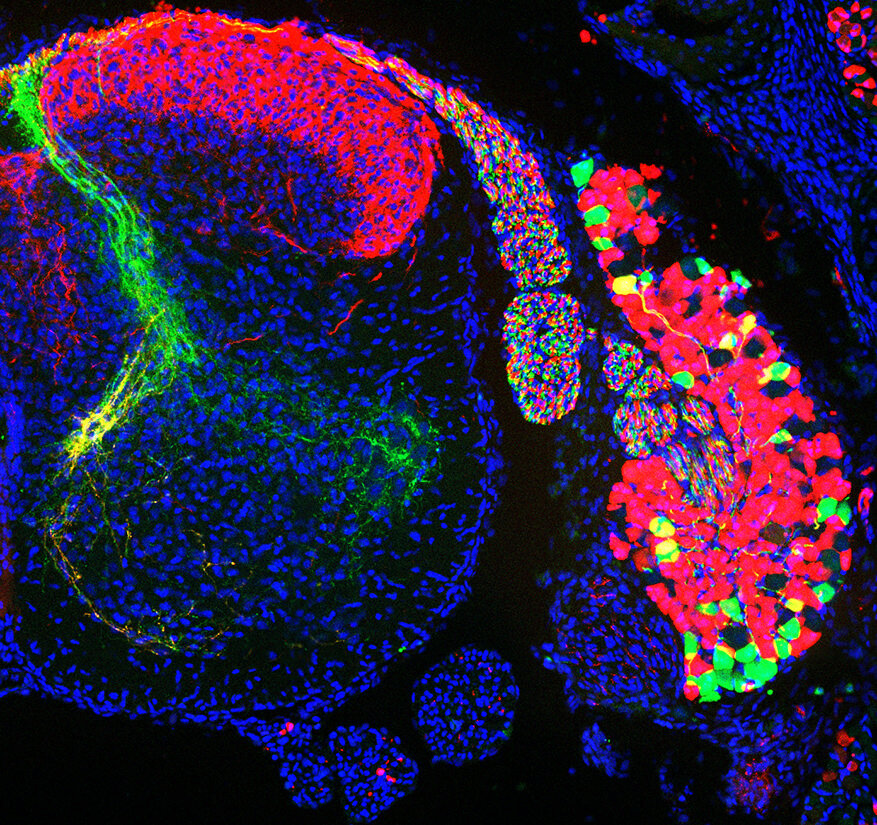
Diferentes populações de corpos celulares de neurônios sensoriais em um gânglio da raiz dorsal (à direita) e seus axônios na medula espinhal (à esquerda): as células em verde detectam informações proprioceptivas, enquanto as células em vermelho detectam informações térmicas e táteis. Crédito: Stephan Dietrich, Zampieri Lab, Centro Max Delbrück
Visão, audição, olfato, paladar, tato: todos nós estamos familiarizados com os cinco sentidos que nos permitem experimentar o que nos rodeia. Igualmente importante, mas muito menos conhecido, é o sexto sentido: “Sua função é coletar informações dos músculos e articulações sobre nossos movimentos, nossa postura e nossa posição no espaço, e depois transmiti-las ao nosso sistema nervoso central”, disse o dr. Niccolò Zampieri, chefe do Laboratório de Desenvolvimento e Função de Circuitos Neurais no Centro de Medicina Molecular Max Delbrück em Berlim (Alemanha). “Esse sentido, conhecido como propriocepção, é o que permite que o sistema nervoso central envie os sinais certos através dos neurônios motores aos músculos para que possamos realizar um movimento específico.”




 No mesmo Sítio Primavera (Viamão): Uma flor, no meio da folhagem...