Translate AMICOR contents if you like

Showing posts with label Health Promotion. Show all posts

Thursday, May 21, 2020

Dia Mundial da Diversidade Cultural para o Diálogo e o Desenvolvimento

O texto a seguir, do Blog Saúde e Você do Hospital Moinhos de Vento, resultou de conversa com Shirley Manteufel e Lisiane de Assis, a quem agradeço pela oportunidade de tentar elaborar o que emerge em situações inusitadas pelas quais atravessamos e esperamos poder aprender, e sair melhores para um mundo melhor.

A importância da Diversidade Cultural para o Diálogo e o Desenvolvimento em um momento de pandemia

Dia Mundial da Diversidade Cultural para o Diálogo e o Desenvolvimento foi criado pela UNESCO e, desde 2001, é celebrado no dia 21 de maio. Nas palavras de Koichiro, Matsuura, Diretor-Geral da UNESCO na época do surgimento da data: “A recorrência deste evento nos fornece a oportunidade de medirmos a nossa capacidade de promover, com base no que é hoje uma fundação estabelecedora de padrões coerentes, uma visão integrada da cultura nas complexas áreas de desenvolvimento, inovação, diálogo e coesão social”. Em outras palavras, a data foi idealizada para que houvesse uma maior integração e troca de culturas, ideias e propostas entre todos os países, promovendo um maior diálogo e descoberta de ações coletivas.
Quando pensamos no panorama atual, na pandemia de Covid-19 pela qual passamos, fica ainda mais nítido que ações de diálogo e atitudes colaborativas no cenário global são de grande importância, não apenas para o avanço da sociedade como um todo, mas também para sua manutenção, preservando a saúde e bem-estar de todos nós. Porém, como este cenário tem se desenrolado? Existem atitudes colaborativas que podem ser realmente eficazes em situações como esta em que vivemos? Quais os entraves político-culturais devem ser considerados no momento de pensar soluções? Na tentativa de responder essas e algumas outras questões, desenvolvemos este artigo em colaboração com o Dr. Aloyzio Achutti, cardiologista no Hospital Moinhos de Vento.

Somos seres interligados e interdependentes

Antes da análise de qualquer panorama, é importante compreendermos que no universo estamos todos interligados, mesmo que não consigamos, ou não queiramos, aceitar a realidade. Somos interdependentes mergulhados numa sopa ecológica na qual tudo necessariamente se relaciona e se interconecta, mantendo um equilíbrio necessário. Nós somos formados de um conjunto de órgãos que têm que funcionar harmonicamente (não dá certo, por exemplo, se o fígado resolve brigar com o coração). Cada órgão é formado de células que contém organelas e moléculas que precisam funcionar harmonicamente para haver vida.
Estima-se maior do que dez trilhões o número de células de nosso corpo e dez vezes maior o número de bactérias, com as quais convivemos e das quais dependemos no intestino de cada um de nós. Com vírus estamos em permanente interação e em número ainda maior do que o das bactérias.
Até aqui nos detivemos em nosso próprio corpo, mas cada um de nós é dependente das outras pessoas com as quais convivemos, e todas as outras existentes na terra, mesmo que não tenhamos consciência dessa ligação. Estamos inter-relacionados com todos os outros seres vivos existentes através dos quais nos alimentamos e nos informamos. Somos produtos de nossos ancestrais – ninguém nasceu do nada, e a história da evolução da vida na Terra se perde no passado.
Mencionamos somente seres vivos, mas todo o universo está também interdependente e interagindo, mesmo que não tenhamos condições de apreciar as dimensões ecológicas universais. A sobrevivência e o sucesso na evolução das espécies depende de capacidade de adaptação e do desenvolvimento conseguido através da interação no conjunto.

Diversidade enquanto incentivo ao desenvolvimento social

A cultura surge enquanto forma de expressão daquilo que há de mais idôneo no comportamento humano, linguagem, música, religião são fatores que ditam as formas de atuação em grupo, independente do lugar do mundo. Grupos diversos proporcionam uma enorme heterogeneidade cultural e, assim, principalmente da modernidade até então, apareceu como um dos principais elementos de incentivo ao desenvolvimento enquanto sociedade.
As diferenças trazem esperanças da existência de grupos mais sensíveis, capazes de compreender os valores positivos e encontrar caminhos para o desenvolvimento não somente material e intelectual-cognitivo, mas também emocional. Estes fatores são fundamentais para que, enquanto sociedade, possamos superar crises como a que vivemos atualmente. A diversidade influi sempre nas relações entre as nações, pois os modelos da sociedade atual são produtos de experiências anteriores e não é possível modificar comportamentos de forma abrupta, esta questão pode propiciar alguns entraves, principalmente em questões políticas, da mesma forma que é um grande mar de possibilidades.

Ações colaborativas na luta contra o vírus: possíveis entraves político-culturais

Quando tratamos de ações colaborativas, falamos de comportamento com motivações agregadoras, e com um objetivo comum. Tais atitudes se referem a nações numa perspectiva de sociedade e, consequentemente, também política e coletiva.
O atual momento têm proporcionado o surgimento de narrativas, incriminando em geral, grandes potências econômicas e políticas mundiais enquanto responsáveis pelo início e disseminação da crise atual. Com isso, vemos o surgimento e disseminação de hipóteses compatíveis com síndrome conspiratória, e se exacerbam idiossincrasias e partidarismos doentios. Mas, o que espera-se é que, frente a um real e inequívoco risco, esqueçam-se rixas e interesses secundários que possam atrapalhar o instinto gregário e de defesa da espécie.
Afinal, em uma situação onde milhões de pessoas são afetadas, a principal ação que as nações devem tomar é a de superar quaisquer diferenças, independente de sua natureza. A data de hoje surgiu exatamente para que possamos usar nossa diversidade enquanto uma ferramenta capaz de oferecer soluções plurais para solucionar os mais diferentes problemas globais.

Fator econômico: elemento crucial nos contextos ocasionados pela pandemia

pandemia atinge todas as camadas da sociedade, porém algumas mais do que outras. Como em muitas outras situações, os setores mais afetados são os mais pobres, com menor acesso à educação e com menos recursos para se defender. O objetivo do Dia Mundial da Diversidade Cultural para o Diálogo e o Desenvolvimento, principalmente neste ano, é pensar em soluções que cheguem até essas pessoas mais vulneráveis, pensando em ações colaborativas a fim de diminuir o contágio e acometimentos, tanto por meio de práticas econômicas, quanto de saúde, buscando, através de pesquisa integrada, soluções como remédios e vacinas.
Em momentos de crise, quando as barreiras de privilégio se quebram é quando temos a oportunidade para reformular a maneira de ver a vida e a história. São momentos oportunos para reflexão e reformulação de conceitos, consciência e condutas para agir de forma mais inteligente e nos defendermos como um todo, cuidando em especial dos mais carentes, em maior risco ou incapazes de compreender e colaborar.

A relação da população com a comunidade médica e científica em tempos de pandemia

Conforme os dias e semanas de pandemia vão avançando, podemos notar reações diversas da população: alguns têm entrado em pânico, outros resistem em acreditar ou negam, há gente que prefere se arriscar e arriscar os outros. Há pessoas que tentam tirar proveito da crise e da necessidade de adotar medidas restritivas.
Há um inequívoco aumento do respeito e reconhecimento do papel dos profissionais da saúde, mas, embora estejamos longe de conseguir que os médicos e médicas, enfermeiros e enfermeiras, junto da população, tenham uma visão completa da interdependência entre nós e o meio ambiente, é preciso falar e discutir o assunto para que, progressivamente, se incorpore às nossas culturas, para que as novas gerações já se preparem e se formem numa visão mais adequada.
Certamente, momentos como este de crise, de sofrimento, de perdas e de choque cultural, podem servir como ponto de reajuste da perspectiva para contemplar a diversidade e dar chance ao desenvolvimento integral, desejável em todas as esferas: material, orgânico, biopsicossocial-ecológico.

A diversidade cultural, junto de ações colaborativas enquanto saída para superarmos a pandemia

Uma das coisas mais importantes a se pensar neste panorama é que, temos, enquanto sociedade, um grande potencial para superarmos esta pandemia. O Dia Mundial da Diversidade Cultural para o Diálogo e o Desenvolvimento vem para que nós lembremos do poder da diversidade na descoberta de soluções para quaisquer problemas, pois, apenas juntos, progrediremos enquanto grupo, enquanto humanos.

Sunday, April 19, 2020

Spring and Autumn in a Pandemic

Happily, our world is a sphere while it is Spring in one half it is autumn in the opposite(AA)

From: Brain Pickings by Maria Popova

Mary Shelley, writing 200 years ago about a pandemic-ravaged world, on what makes life worth living and nature's beauty as a lifeline to sanity

Spring in a Pandemic: Mary Shelley on What Makes Life Worth Living and Nature’s Beauty as a Lifeline to Regaining Sanity


thelastman_maryshelley.jpg?fit=320%2C480
Half a century before Walt Whitman considered what makes life worth living when a paralytic stroke boughed him to the ground of being, Mary Shelley (August 30, 1797–February 1, 1851) placed that question at the beating heart of The Last Man (free ebook | public library) — the 1826 novel she wrote in the bleakest period of her life: after the deaths of three of her children, two by widespread infectious diseases that science has since contained; after the love of her life, Percy Bysshe Shelley, drowned in a boating accident.
************************************************

In consonance with Whitman — “After you have exhausted what there is in business, politics, conviviality, love, and so on — have found that none of these finally satisfy, or permanently wear — what remains?” the American poet would ask across space and time, then answer: “Nature remains.” — Shelley’s protagonist finds the meaning of life not in the whirlwind of the human-made world with its simulacra of living but in the simple creaturely presence with nature’s ongoing symphony of life:
2e292385-dc1c-4cfe-b95e-845f6f98c2ec.pngLet us… seek peace… near the inland murmur of streams, and the gracious waving of trees, the beauteous vesture of earth, and sublime pageantry of the skies. Let us leave “life,” that we may live.
FirstSignal_byMariaPopova.jpg?resize=680%2C680
First Signal by Maria Popova
At the height of the deadly pandemic, nature seems all the more quietly determined to affirm the resilience of life — spring arrives with its irrepressible bursts of beauty, untrammeled by human suffering and a supreme salve for it. It is by observing nature’s unbidden delirium in its littlest expression, by surrendering to its sweep, that Lionel regains his faith not only in survival but in the beauty, the worthiness of life.

Saturday, April 11, 2020

Ressurgindo para um mundo melhor. Feliz Páscoa.

Grande amiga do Ticcino, Marianne Burle de Figueredo - enviou-os belo presente de Páscoa que temos o prazer de compartilhar com todos os AMICOR e visitantes.
Área de anexos

Sunday, March 22, 2020

Back to work

Some experts say it can be done in weeks, not months — and the economy and public health are at stake.
Opinion Columnist
https://www.nytimes.com/2020/03/22/opinion/coronavirus-economy.html?smid=nytcore-ios-share

Monday, December 30, 2019

Jeremiah Stamler

Jerry Stamler

At age 100, the father of preventive medicine is still going strong — as living proof that he was right all along

By CINDY DAMPIER
CHICAGO TRIBUNE |
DEC 26, 2019 | 5:00 AM
Recomendado por AMICOR Flávio Kanter, através de seu irmão Nelson Kanter que atualmente vive nos EEUU.
Dr. Jeremiah Stamler at Northwestern University Feinberg Medical School at a celebration for his 100th birthday in the fall.
Dr. Jeremiah Stamler at Northwestern University Feinberg Medical School at a celebration for his 100th birthday in the fall. (Teresa Crawford/Northwestern University)/.../

O Jerry foi muito importante para mim, desde sua participação na  2nd. National Conference on Cardiovascular Diseases, na área de Community Services & Education que usei como informação epidemiológica pela inexistência de informações nossas, para a Análise Institucional da SS da qual participei em 1971-72. Vim a conhecer pessoalmente o Professor Stamler posteriormente, mas suas informações relacionadas com os EEUU deram-me respaldo para dizer ao recém empossado Secretário da Saúde - dr Jair Soares, que eu queria licença para deixar meu posto, e assumir a disciplina de Cardiologia na PUCRS, porque onde eu estava não havia programa preventivo e de saúde pública na  área Cardiovascular - somente fazíamos assistência, o que eu poderia continuar fazendo na nova instituição. Foi quando ele me surpreendeu com a pergunta desafiadora: "porque não fazes uma proposta?"
Assim começou a abordagem preventiva de doenças cardiovasculares e outras doenças crônicas no Rio Grande do Sul, depois no Brasil e em muitos países pelo mundo afora com o apoio da Organização Panamericana da Saúde/Organização Mundial da Saúde, abordando Fatores de Risco, chegando à Promoção da Saúde.

Do The Lancet OBITUARY| VOLUME 399, ISSUE 10329P1044, MARCH 12, 2022

Jeremiah Stamler

Published:March 12, 2022DOI:https://doi.org/10.1016/S0140-6736(22)00421-4Figure thumbnail fx1
Pioneer in cardiovascular disease prevention. He was born in Brooklyn, NY, USA, on Oct 27, 1919 and died in Sag Harbor, NY, USA, on Jan 26, 2022 aged 102 years.
Seldom has a person's life offered more compelling support to the value of his own convictions than that of Jeremiah Stamler, founding chair and Professor Emeritus of Preventive Medicine at Northwestern University's Feinberg School of Medicine in Chicago, IL, USA. He spent his career helping to identify risk factors for cardiovascular disease and campaigning to have them recognised—he also enjoyed the Mediterranean diet he advocated and lived to become a centenarian. “He was one of a small group of people who really founded the discipline of cardiovascular epidemiology”, says Donald Lloyd-Jones, Chair of Feinberg's Department of Preventive Medicine and Eileen M Foell Professor of Heart Research. Paul Elliott, Professor of Epidemiology and Public Health Medicine at Imperial College London, UK, agrees: “Jerry was a colossus in cardiovascular epidemiology and prevention.”
The circulatory system dominated Stamler's research from the outset. After a bachelor's degree at New York's Columbia University he went on to study medicine at what is now SUNY Downstate Health Sciences University in Brooklyn. He graduated in 1943 and served as an army radiologist before taking a job at the Michael Reese Hospital in Chicago. “He started in the late 1940s in the laboratory of [cardiologist] Louis Katz, whose research included feeding cholesterol-rich chow to chickens,” says Lloyd-Jones, who is also President of the American Heart Association. The birds developed a build-up of atherosclerotic plaque. Stamler himself studied the effects on the cardiovascular system not only of lipids, but of hormones, blood pressure, and diet more generally. In 1958 he moved to Chicago, where he joined the Board of Health and organised its first heart disease control programme, as well as Northwestern's Department of Medicine.
Before the 1960s and 1970s, heart disease was still not much related to risk factors and behaviour. Stamler set out to challenge that view. In 1972 he was appointed chair of Feinberg's newly created Department of Community Health and Preventive Medicine and began organising or taking part in national and later international trials that identified the risk factors for heart disease. “He and others demonstrated through animal studies and in human population studies that these risk factors were likely causing atherosclerosis and heart attacks”, says Philip Greenland, Harry W Dingman Professor of Cardiology and of Preventive Medicine at Northwestern. But the possibility of intervening to prevent heart attacks was still considered radical. “Stamler was a pioneer of optimal assessment techniques in diet”, says Lloyd-Jones. “He did some of the best studies ever.” One such was Intersalt, a 1988 study of more than 10 000 people aged 20–59 years from 32 countries that showed a clear link between salt intake and blood pressure. Paul Elliott, a junior research fellow at the time of the study, helped in its design. The US salt industry's trade body, the now defunct Salt Institute, was unhappy with its findings. “The Salt Institute demanded a reanalysis of data to their specification, which the investigators willingly carried out”, Elliott recalls. “The publication of the reanalysis in 1996 showed, if anything, stronger findings on salt and rise in blood pressure with age than the original analysis.”
Some of Stamler's fellow doctors had joined the chorus of dissent. As Greenland recalls: “There were editorials by prominent cardiologists…saying…it's time to give up on this crazy idea that heart disease can be prevented”. But Stamler was undeterred. “One of the things that characterised him was his sense of what is right and what is true, and if you believe something is right and true you fight for it,” says Greenland. This outlook extended beyond matters of health. In 1965, Stamler was summoned to appear before the US Government House Un-American Activities Committee (HUAC), accused of having been a member of the Communist Party. The accusation was false, but Stamler refused to testify, argued that the HUAC was unconstitutional, was charged with contempt of Congress, and filed a lawsuit against the HUAC. The contempt charge was dropped, but not until 1973.
Stamler “was rigorous and intensive in his work, and persistent”, says Greenland. “You never doubted he was a towering intellect when you were in his presence”, says Lloyd-Jones. “But he was gentle and good at listening…He really valued the people he worked with. He was intensively collaborative, and he understood that everybody on the team had something to offer.” Stamler is survived by his son, Paul, and stepsons, Jonathan and Michael.

Saturday, November 16, 2019

Food: Health

How Certain Foods Affect Cognition, Seizures, and Cardiometabolic DiseaseFood for Thought

JAMA. 2019;322(18):1753-1754. doi:10.1001/jama.2019.16477

Food for Thought periodically reports on nutrition research aimed at improving health and well-being.
The science behind food’s effects on human health is discovering some tasty benefits.
Berries and Grapes Linked With Memory Boost
As the world’s elderly population races toward an estimated 2 billion by 2050, memory loss is expected to take a substantial toll. But recent research shows that polyphenols from grapes and blueberries combined may help boost declining memory among some older adults.

The study by investigators in France and Canada built not only on their own work in mice, but also on other preclinical and clinical studies showing that blueberries and grapes or their extracts may offer benefits for age-related cognitive decline. Their previous animal research also showed a synergistic effect—grape extract enhanced the absorption of polyphenols in the blueberry extract.

Tuesday, November 12, 2019

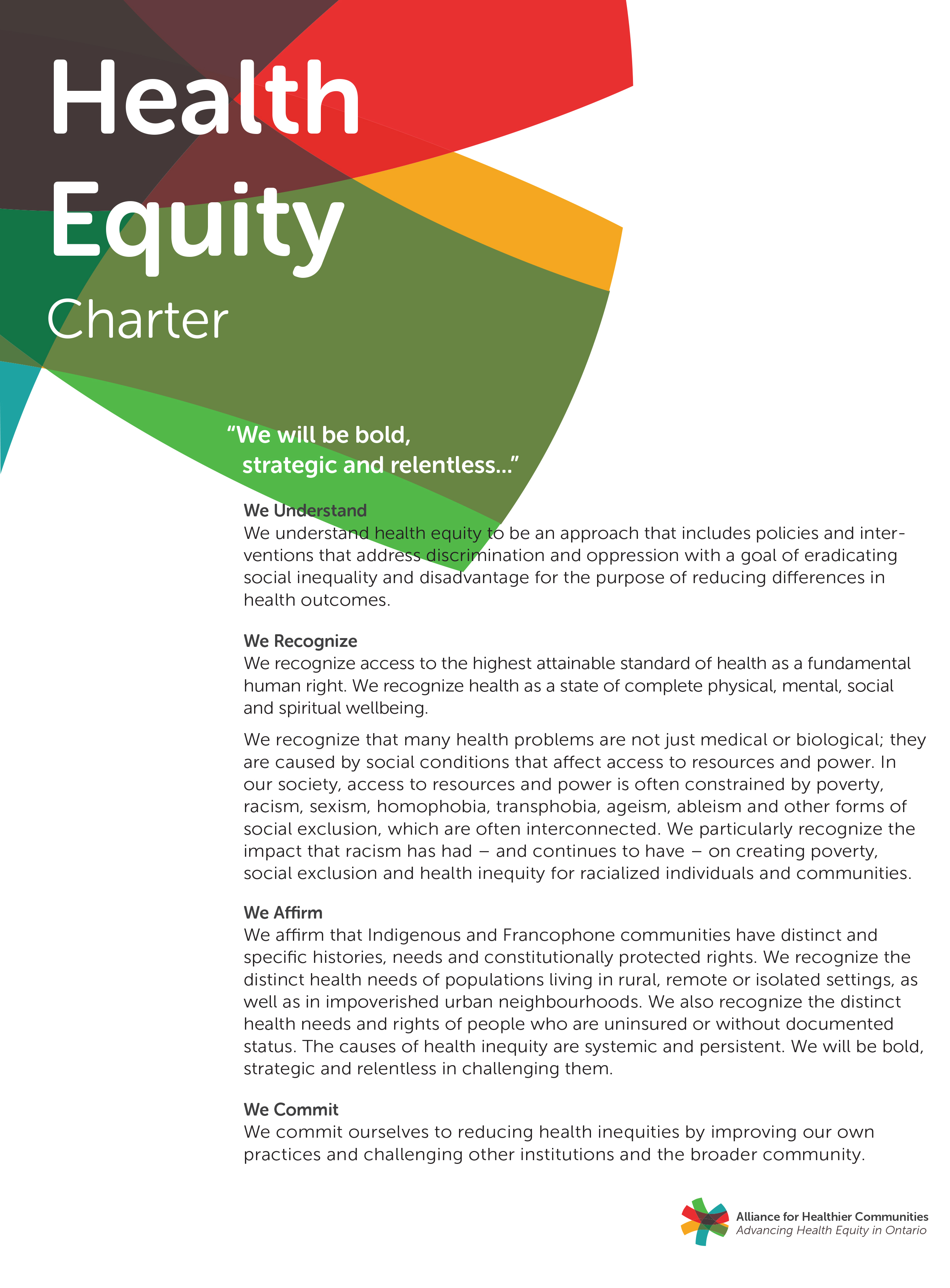
Health Equity Charter

Health Equity Charter

Health Equity Charter

Health Equity Charter

Wednesday, October 23, 2019

Health inequities


Upcoming webinar

October 31, 2019
1:00–2:30 p.m. (ET)

Webinar presented in partnership with Health Promotion Canada
This webinar (in English) will explore the status of health inequities in Canada and the implications for both health promotion practice and policy-level decisions. Speakers will reflect on seven key approaches in health promotion practice directed towards reducing health inequities, with a focus on the influence of public policy and power structures.

Speakers:
·         Dianne Oickle, Knowledge Translation Specialist, NCCDH
·         Dennis Raphael, Professor, School of Health Policy and Management, York University 
·         Sionnach Lukeman, Assistant Professor, Elizabeth and Thomas Rankin School of Nursing, St. Francis Xavier University


Webinaire à venir (en anglais)

Implications of health inequities for health promotion and public health policy (conséquences des iniquités en santé sur la promotion de la santé et les politiques de santé publique)
31 octobre 2019

Sunday, October 13, 2019

Meat Guidelines

Meat Guidelines Are Exposing the Fault Lines in Nutrition Advice

The Skeptical Cardiologist has one important reminder

  • by 
The Skeptical Cardiologist was recently greeted by headlines announcing that an international panel of 14 unbiased researchers had concluded that it was OK for humans to continue eating red meat and processed meat at current levels.
The startling news was a reversal of what the Dietary Guidelines for Americans, the American Heart Association, and the American Cancer Society have been telling us for years and threw the nutritional world into a tizzy. The bottom line recommendation, written in language suggesting a lack of certainty in the evidence and lack of confidence in the advice reads as follows:
"The panel suggests that adults continue current unprocessed red meat consumption (weak recommendation, low-certainty evidence). Similarly, the panel suggests adults continue current processed meat consumption (weak recommendation, low-certainty evidence)."/.../