Translate AMICOR contents if you like

Showing posts with label Universe. Show all posts

Sunday, October 04, 2020

42


Image for post

The Biggest Fundamental Questions That ‘42’ Really Is The Answer To

We’re still not sure what the ultimate question is. Here are 5 excellent candidates.

Touted as the answer to the ultimate question about life, the Universe, and everything, 42 plays an important role not only in popular culture, specifically through Douglas Adams’ Hitchhiker’s Guide to the Galaxy, but in physics and mathematics as well. Too bad we’re still not sure what the question is. (MARTINULTIMA & HABITATOR TERRAE / WIKIMEDIA COMMONS)

We’re still not sure what the ultimate question is. Here are 5 excellent candidates.

Ethan Siegel
Oct 1 · 9 min read


Saturday, September 26, 2020

Universe Beginning


It wasn’t the birth of space and time. But it was truly essential to our cosmic story.


Saturday, August 22, 2020

The Viral Universe

Recomendado pela AMICOR Maria InĂªs Reinert Azambuja


The viral universe

Viruses have big impacts on ecology and evolution as well as human health

They are ubiquitous, diverse and very powerful


I The outsiders inside
Humans are lucky to live a hundred years. Oak trees may live a thousand; mayflies, in their adult form, a single day. But they are all alive in the same way. They are made up of cells which embody flows of energy and stores of information. Their metabolisms make use of that energy, be it from sunlight or food, to build new molecules and break down old ones, using mechanisms described in the genes they i nherited and may, or may not, pass on.

It is this endlessly repeated, never quite perfect reproduction which explains why oak trees, humans, and every other plant, fungus or single-celled organism you have ever seen or felt the presence of are all alive in the same way. It is the most fundamental of all family resemblances. Go far enough up any creature’s family tree and you will find an ancestor that sits in your family tree, too. Travel further and you will find what scientists call the last universal common ancestor, luca. It was not the first living thing. But it was the one which set the template for the life that exists today./.../

Tuesday, August 04, 2020

Universe end


Cosmologist Katie Mack explains the leading theories — from heat death to the Big Crunch — on how the universe will cease to exist
Katie MackMember only content9 min read

Monday, June 29, 2020

Black Holes

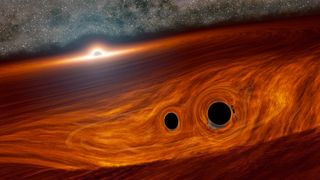
Scientists spot flash of light from colliding black holes. But how?

An artist's depiction of two black holes merging within the disk of a supermassive black hole, later releasing a burst of light.
(Image: © Caltech/R. Hurt (IPAC))
Black holes aren't supposed to make flashes of light. It's right there in the name: black holes.
Even when they slam into each other, the massive objects are supposed to be invisible to astronomers' traditional instruments. But when scientists detected a black hole collision last year, they also spotted a weird flash from the crash.
On May 21, 2019, Earth's gravitational wave detectors caught the signal of a pair of massive objects colliding, sending ripples cascading through spacetime. Later, an observatory called the Zwicky Transient Facility (ZTF) caught a blast of light. As scientists looked at the two signals, they realized both came from the same patch of sky, and researchers started wondering whether they had spotted the rare visible black hole collision.

Sunday, June 21, 2020

Sunday, June 07, 2020

Back To Our Starting Point

If you traveled in a straight line for far enough, would you come back to where you started?

Ethan Siegel
Ethan Siegel
May 26 · 8 min read
If you were to set out on a journey from anywhere on Earth’s surface, and traveled in a straight line for far enough, you’d eventually wind up right back where your journey began. After traversing approximately 40,000 kilometers (25,000 miles) — crossing mountains, oceans, deserts, etc. — you’d have completed one entire journey around the surface of our planet. The eventual destination you’d arrive at would be unambiguous: it’s the same as your starting point.
Could it work the same way in space? If you got into a starship, set off in one direction, and traveled as far as you liked, would you eventually return to your starting point? It’s a fascinating question to explore. Even though all signs seem to point towards “probably not,” there are actually two ways that the answer might turn out to be yes, after all.

Wednesday, June 03, 2020

Common elements origin


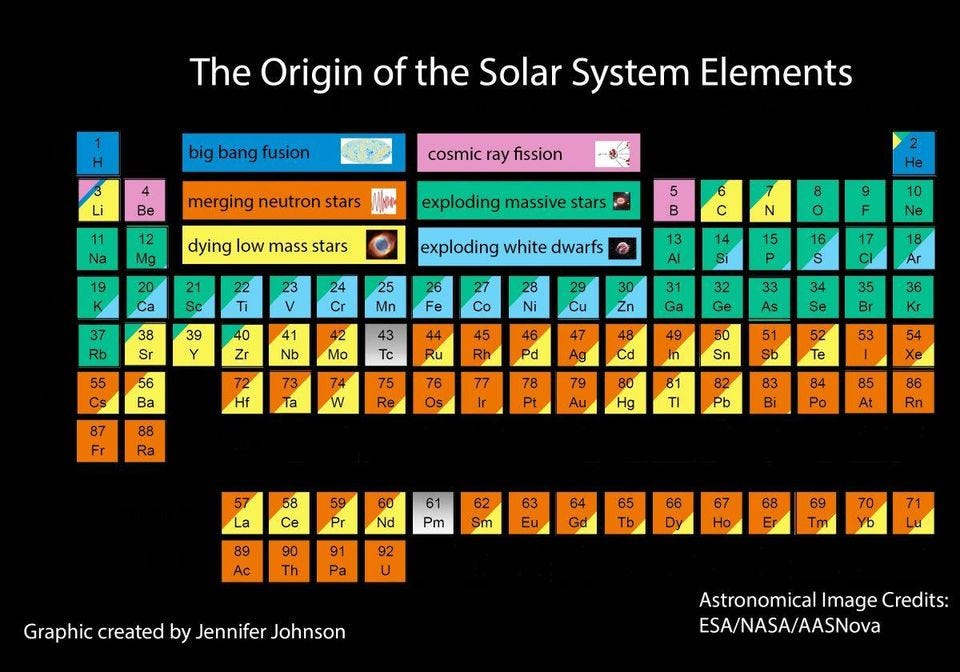
In order, they go: hydrogen, helium, oxygen, carbon, neon, nitrogen, magnesium, silicon, iron, sulfur. Here’s…

Tuesday, June 02, 2020

Decoding the Universe

Decoding the Universe

An insider’s look at the history and sociology of modern cosmology
Peebles at a news conference after winning the Nobel Prize in Physics. Credit: Mike Makela Getty Images

This essay is adapted from the book Cosmology’s Century (Princeton University Press).
Robert Dicke came out of war research, specifically radar and other microwave technology, at the Radiation Laboratory at MIT. He would eventually establish a productive research group—one of the many scientists to do so after the end of World War II.
Dicke liked astronomy; his early publications include the radial distribution of stars in a globular cluster and a report of the detection of microwave radiation from the Sun and Moon. After the war, he spent a productive decade of research on what might be termed “quantum optics.” In the late 1950s, he decided to apply the great advances in the technology of laboratory physics to the neglected subject of empirical gravity physics: classical gravity experiments that could be done better and new ones that had become possible./.../

Thursday, May 28, 2020

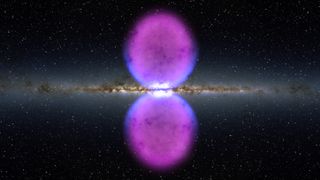
'Fermi Bubbles'

Mysterious 'Fermi Bubbles' may be the result of black hole indigestion 6 million years ago

The gargantuan Fermi Bubbles are only visible in gamma-ray light. Where did they come from?
(Image: © NASA Goddard)

The center of the Milky Way is a puzzle of invisible, interconnected blobs. There are swooping tendrils of energy visible only in radio wavelengths, hourglass-shaped scars of X-ray light and — towering over it all — the mysterious Fermi Bubbles.
These twin orbs of gas, dust and cosmic rays emerge from the galactic center like two wings of an enormous moth, one on either side of the galaxy's central black hole. From tip to tip, the bubbles stretch about 50,000 light-years across (that's about half the diameter of the Milky Way itself), yet are visible only in high-energy gamma-ray light./.../

Saturday, May 23, 2020

Universe


As time goes on, every galaxy beyond our local group will speed away from us faster and faster. And yet, more…

Friday, May 22, 2020

Black Holes

Today’s highlights
The strongest tests of curved space are only possible around the lowest-mass black holes of all.
A material so dark and black that it makes the surface of objects seemingly disappear.