Translate AMICOR contents if you like

Showing posts with label infection. Show all posts

Monday, July 27, 2020

LES SUPERBACTÉRIES,


LES SUPERBACTÉRIES, NOUVELLES BÊTES NOIRES DES HÔPITAUX

Une enquête de Marie Maurisse et Karine Pfenniger

Des bactéries résistant à la plupart des antibiotiques causent de plus en plus de décès dans le monde, y compris en Suisse. Les pharmas, en sous-traitant la fabrication de ces molécules à des usines hautement polluantes, aggravent le phénomène. «Le Temps» a remonté le fil de ces bactéries tueuses, des hôpitaux suisses aux usines d’Hyderabad/../

Texte: Marie Maurisse et Karine Pfenniger   •  Illustrations: Stefan Schlageter et Stefan Sekulic, Rivenord Studio   •   Photos: Harsha Vadlamani pour Le Temps   •   Image d’ouverture: Getty Images/Science Photo Library   •   Webdesign et animation: César Greppin   •   Coordination et réalisation Web: Paul Ronga

Tuesday, May 12, 2020

Rat Hepatitis

People are catching hepatitis from rats in Hong Kong. But scientists don't know how.
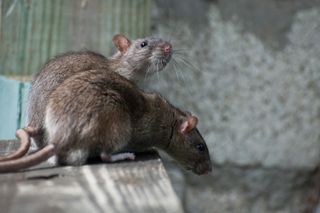
Two brown rats.
(Image: © Shutterstock)
A new strain of the hepatitis E virus that usually only infects rats is now sickening people in Hong Kong, with nearly a dozen human cases reported so far, according to news reports. But exactly how the virus jumps from rats to people is a mystery.
The first case of a human contracting rat hepatitis E virus, or rat HEV, was reported in Hong Kong in 2018. Since then, 10 more people in the area have tested positive for rat HEV, according to CNN. The most recent case was reported on April 30, in a 61-year-old man who was hospitalized with abnormal liver function, CNN reported.
Scientists still don't know how people are getting infected. The latest case is particularly baffling because no rats or rat feces were seen in the 61-year-old man's home, and he had not recently traveled anywhere./.../

Tuesday, March 17, 2020

Smoking/Vaping risk

Public Health
Though few studies have investigated the connection specifically, cigarette smoke and vaping aerosol are linked to lung inflammation and lowered immune function
By Tanya Lewis

Friday, March 13, 2020

virus


Woman sneezing behind a window, using a tissue.This symptom chart will help you determine which virus ails you
Robert Roy Britt in ElementalMember only content8 min read

Thursday, March 12, 2020

Fecal Microbiota for Transplantation

MedWatch - The FDA Safety Information and Adverse Event Reporting Program
MedWatch Safety Alert was added to the FDA [MedWatchRecalls, Medical Device Recalls or Medical Devices] webpage. 


AUDIENCE: Patient, Health Professional

ISSUE: FDA is informing health care providers and patients of the potential risk of serious or life-threatening infections with the use of fecal microbiota for transplantation (FMT).  The FDA is now aware of infections caused by enteropathogenic Escherichia coli (EPEC) and Shigatoxin-producing Escherichia coli (STEC) that have occurred following investigational use of FMT that it suspects are due to transmission of these pathogenic organisms from FMT product supplied by a stool bank company based in the United States.  The stool bank provides FMT product manufactured from pre-screened donors to healthcare providers and researchers.

Wednesday, March 11, 2020

Mycoplasma

How Mycoplasma Contamination Affects Results and Reproducibility
As one of the most common, yet elusive, contaminants of cell cultures, mycoplasma is a pervasive microorganism that often remains undetected by scientists from around the world.
Join experts from WiCell and Wiley as they discuss the adverse effects mycoplasma has on results and reproducibility of cell culture research:
Basic mycoplasma characterization and its biological effects on cells
Detection, elimination, and prevention of mycoplasma contamination
Impact of mycoplasma on scientific data generated from contaminated cells
The need for monitoring cell line health for cell banking or clinical applications
 
Register now to learn more!
 

Tuesday, February 25, 2020

"The final Plague"

Waiting for "The Final Plague"
A Talk with Nathan Wolfe [1.30.09]
[ED. NOTE: In January 2009, I sat down in Los Angeles with virologist Nathan Wolfe for a wide-ranging discussion on his studies concerning the biology of viral emergence. Within a few months, the world was in a panic about the H1N1 swine flu epidemic that lasted most of 2009. Several months later in "How to Prevent a Pandemic," he wrote:
"The swine flu outbreak seems to have emerged without warning. Within a few days of being noticed, the flu had already spread to the point where containment was not possible. Yet the virus behind it had to have existed for some time before it was discovered. Couldn’t we have detected it and acted sooner, before it spread so widely? The answer is likely yes—if we had been paying closer attention to the human-animal interactions that enable new viruses to emerge.
"While much remains unknown about how pandemics are born, we are familiar with the kinds of microbes—like SARS (severe acute respiratory syndrome), influenza and HIV—that present a risk of widespread disease. We know that they usually emerge from animals and most often in specific locations around the world, places like the Congo Basin and Southeast Asia.
"By monitoring people who are exposed to animals in such viral hotspots, we can capture viruses at the very moment they enter human populations, and thus develop the ability to predict and perhaps even prevent pandemics." 
Unfortunately, that eleven-year-old conversation, reprised below, is evermore relevant today. —JB]
NATHAN WOLFE is the Lorry Lokey Visiting Professor of Human Biology at Stanford University and directs the Global Viral Forecasting Initiative. His research combines methods from molecular virology, ecology, evolutionary biology, and anthropology to study the biology of viral emergence. 

WAITING FOR "THE FINAL PLAGUE"
In a general sense what I'm interested in is very much a biological universe parallel to our own, which is the universe comprised of microorganisms. Of particular interest to me are viruses, but also bacteria—fascinating organisms—and a range of parasites.
These exist in the same moment in history that we exist, in the same space that we occupy, but inhabit a very different world. Yet, they respond to many of the exact same pressures we do, but in a much shorter time span. Of course, they are subject to natural selection. They are incredibly important to our planet, to us as a species, and the reality is that we understand very little about them. We are actually in a very interesting space with respect to the technologies that we have now, and these are some of the things that have come about through molecular biology.

Wednesday, February 19, 2020

Coronavirus Structure

Coronavirus 'spike' protein just mapped, leading way to vaccine
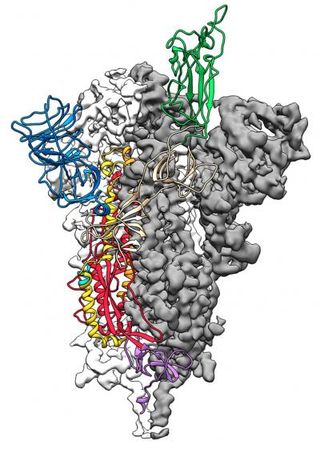
This is the 3D atomic scale map or molecular structure of the SARS-2-CoV protein "spike" which the virus uses to invade human cells.
(Image: © Jason McLellan/Univ. of Texas at Austin)
Researchers worldwide are racing to develop potential vaccines and drugs to fight the new coronavirus, called SARS-Cov-2.  Now, a group of researchers has figured out the molecular structure of a key protein that the coronavirus uses to invade human cells, potentially opening the door to the development of a vaccine, according to new findings.

Monday, February 10, 2020

Flu x Coronavirus

How Does the New Coronavirus Compare with the Flu?

PUBLIC HEALTH
The flu has already caused about 10,000 deaths this season in the U.S. alone
By Rachael Rettner,LiveScience

Tuesday, January 21, 2020

Toxoplasma Gondii

A parasite that makes mice unafraid of cats may quash other fears too

Toxoplasma gondii can mess with all sorts of mice behaviors, a new study shows
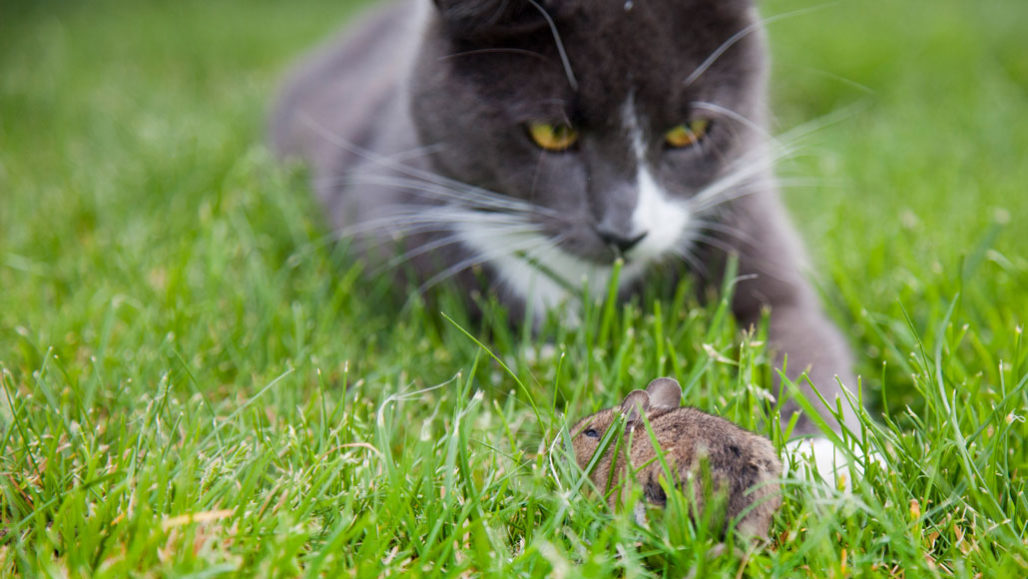
Cat on grass
The parasite Toxoplasma gondii turns mice’s fear of cats into curiosity. The parasite emboldens mice in other situations too, a new study finds.
FIRMAFOTOGRAFEN/GETTY IMAGES PLUS
A parasite common in cats can eliminate infected mice’s fear of felines — a brain hijack that leads to a potentially fatal attraction. But this cat-related boldness (SN: 9/18/13) isn’t the whole story.
Once in the brain, the single-celled parasite Toxoplasma gondii makes mice reckless in all sorts of dangerous scenarios, researchers write January 14 in Cell Reports. Infected mice spent more time in areas that were out in the open, exposed places that uninfected mice usually avoid.
Infected mice also prodded an experimenter’s hand inside a cage — an intrusion that drove uninfected mice to the other side of the cage. T. gondii–infected mice were even unfazed by an anesthetized rat, a mouse predator, the researchers from the University of Geneva and colleagues found. And infected mice spent more time than uninfected mice exploring the scents of foxes and relatively harmless guinea pigs.
The extent of mice’s infections, measured by the load of parasite cysts in the brain, seemed to track with the behavior changes, the researchers report.  
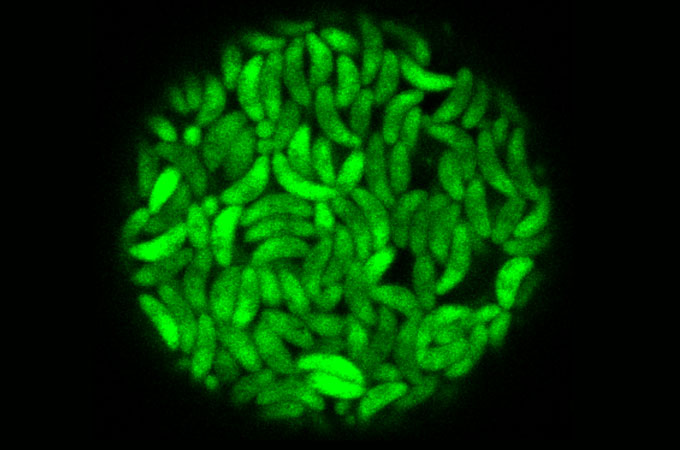
Toxoplasma gondii
Toxoplasma gondii, tweaked to glow green, was isolated from the brain of an infected mouse.PIERRE-MEHDI HAMMOUDI, DAMIEN JACOT
The parasite needs to get into the guts of cats to sexually reproduce. Other animals can become infected by ingesting T. gondii through direct or indirect contact with cat feces. The parasite can then spread throughout the body and ultimately form cysts in the brain.
People can become infected with T. gondii, though usually not as severely as mice. Some studies have hinted, however, at links between the parasite and human behaviors such as inattention and suicide, as well as mental disorders such as schizophrenia.