Translate AMICOR contents if you like

Tuesday, November 30, 2010

Your brain on culture

Referred by the AMICOR Dr. Maria Inês Reinert Azambuja

When an American thinks about whether he is honest, his brain activity looks very different than when he thinks about whether another person is honest, even a close relative. That’s not true for Chinese people. When a Chinese man evaluates whether he is honest, his brain activity looks almost identical to when he is thinking about whether his mother is honest.
That finding — that American and Chinese brains function differently when considering traits of themselves versus traits of others (Neuroimage, Vol. 34, No. 3) — supports behavioral studies that have found that people from collectivist cultures, such as China, think of themselves as deeply connected to other people in their lives, while Americans adhere to a strong sense of individuality.
The study also shows the power of cultural neuroscience, the growing field that uses brain-imaging technology to deepen the understanding of how environment and beliefs can shape mental function. Barely heard of just five years ago, the field has become a vibrant area of research, and the University of Michigan, the University of California, Los Angeles, and Emory University have created cultural neuroscience centers. In addition, in April a cultural neuroscience meeting at the University of Michigan attracted such psychology luminaries as Hazel Markus, PhD, Michael Posner, PhD, Steve Suomi, PhD, and Claude Steele, PhD, to discuss their work in the context of cultural neuroscience./.../

Mortality Resulting From Congenital Heart Disease Among Children and Adults in the United States, 1999 to 2006

Suzanne M. Gilboa, PhD; Jason L. Salemi, MPH; Wendy N. Nembhard, PhD;David E. Fixler, MD; Adolfo Correa, MD, PhD From the National Center on Birth Defects and Developmental Disabilities, Centers for Disease Control and Prevention, Atlanta, Ga (S.M.G., A.C.); Department of Epidemiology and Biostatistics, College of Public Health, University of South Florida, Tampa (J.L.S., W.N.N.); and Division of Cardiology, Department of Pediatrics, University of Texas Southwestern Medical Center, Dallas (D.E.F.). Correspondence to Suzanne M. Gilboa, PhD, National Center on Birth Defects and Developmental Disabilities, Centers for Disease Control and Prevention, Mail Stop E-86, 1600 Clifton Rd, Atlanta, GA 30333. E-mail sgilboa@cdc.gov


Background— Previous reports suggest that mortality resulting from congenital heart disease (CHD) among infants and young children has been decreasing. There is little population-based information on CHD mortality trends and patterns among older children and adults.
Methods and Results— We used data from death certificates filed in the United Statesfrom 1999 to 2006 to calculate annual CHD mortality by age at death, race-ethnicity, and sex. To calculate mortality rates for individuals ≥1 year of age, population counts from the US Census were used in the denominator; for infant mortality, live birth counts were used. From 1999 to 2006, there were 41 494 CHD-related deaths and 27 960 deaths resulting from CHD (age-standardized mortality rates, 1.78 and 1.20 per 100 000, respectively). During this period, mortality resulting from CHD declined 24.1% overall. Mortality resulting from CHD significantly declined among all race-ethnicities studied. However, disparities persisted; overall and among infants, mortality resulting from CHD was consistently higher among non-Hispanic blacks compared with non-Hispanic whites. Infant mortality accounted for 48.1% of all mortality resulting from CHD; among those who survived the first year of life, 76.1% of deaths occurred during adulthood (≥18 years of age).
Conclusions— CHD mortality continued to decline among both children and adults; however, differences between race-ethnicities persisted. A large proportion of CHD-related mortality occurred during infancy, although significant CHD mortality occurred during adulthood, indicating the need for adult CHD specialty management.

Associations Between Childhood Risk Factors and Carotid Intima-Media Thickness in Adulthood

Influence of Age on, 

The Cardiovascular Risk in Young Finns Study, the Childhood Determinants of Adult Health Study, the Bogalusa Heart Study, and the Muscatine Study for the International Childhood Cardiovascular Cohort (i3C) Consortium. Markus Juonala, MD, PhD*; 


Background— Atherosclerosis has its roots in childhood. Therefore, defining the age when childhood risk exposure begins to relate to adult atherosclerosis may have implications for pediatric cardiovascular disease prevention and provide insights about the early determinants of atherosclerosis development. The aim of this study was to investigate the influence of age on the associations between childhood risk factors and carotid artery intima-media thickness, a marker of subclinical atherosclerosis.
Methods and Results— We used data for 4380 members of 4 prospective cohorts—Cardiovascular Risk in Young Finns Study (Finland), Childhood Determinants of Adult Health study (Australia), Bogalusa Heart Study (United States), and Muscatine Study (United States)—that have collected cardiovascular risk factor data from childhood (age 3 to 18 years) and performed intima-media thickness measurements in adulthood (age 20 to 45 years). The number of childhood risk factors (high [highest quintile] total cholesterol, triglycerides, blood pressure, and body mass index) was predictive of elevated intima-media thickness (highest decile) on the basis of risk factors measured at age 9 years (odds ratio [95% confidence interval] 1.37 [1.16 to 1.61], P=0.0003), 12 years (1.48 [1.28 to 1.72],P<0.0001), 15 years (1.56 [1.36 to 1.78], P<0.0001), and 18 years (1.57 [1.31 to 1.87], P<0.0001). The associations with risk factors measured at age 3 years (1.17 [0.80 to 1.71], P=0.42) and 6 years (1.20 [0.96 to 1.51], P=0.13) were weaker and nonsignificant.
Conclusions— Our analyses from 4 longitudinal cohorts showed that the strength of the associations between childhood risk factors and carotid intima-media thickness is dependent on childhood age. On the basis of these data, risk factor measurements obtained at or after 9 years of age are predictive of subclinical atherosclerosis in adulthood.

Aprendendo a esquecer

Estudos com ratos sugerem que é possível eliminar de modo mais eficaz a memória de um evento desagradável
© EDUARDO CESAR
Ratos ajudam a desvendar esquecimento
Eliminar um fato da memória não significa apagá-lo, mas aprendê-lo de outra forma, propôs no início do século passado o fisiologista russo Ivan Pavlov, o mesmo que condicionou cães a salivar sempre que ouviam o toque de uma sineta. Quase cem anos mais tarde experimentos com ratos feitos por pesquisadores do Brasil e da Argentina indicam que Pavlov aparentemente estava certo. Ao menos no que se refere ao esquecimento de eventos desagradáveis ou aterrorizantes, como deparar na esquina com um assaltante portando uma arma./.../

Monday, November 29, 2010

Health professionals for a new century

Health professionals for a new century: transforming education to strengthen health systems in an interdependent world

Prof Julio Frenk MD a ‡Corresponding AuthorEmail Address, Dr Lincoln Chen MD b ‡Corresponding AuthorEmail Address, Prof Zulfiqar A Bhutta PhD c, Prof Jordan Cohen MD d, Nigel Crisp KCB e,Prof Timothy Evans MD f, Harvey Fineberg MD g, Prof Patricia Garcia MD h, Prof Yang Ke MD i, Patrick Kelley MD g, Barry Kistnasamy MD j, Prof Afaf Meleis PhD k, Prof David Naylor MD l, Ariel Pablos-Mendez MD m, Prof Srinath Reddy MD n, Susan Scrimshaw PhD o, Jaime Sepulveda MD p, Prof David Serwadda MD q, Prof Huda Zurayk PhD r
Click to toggle image size

Executive summary

Problem statement

100 years ago, a series of studies about the education of health professionals, led by the 1910 Flexner report, sparked groundbreaking reforms. Through integration of modern science into the curricula at university-based schools, the reforms equipped health professionals with the knowledge that contributed to the doubling of life span during the 20th century.
By the beginning of the 21st century, however, all is not well. Glaring gaps and inequities in health persist both within and between countries, underscoring our collective failure to share the dramatic health advances equitably. At the same time, fresh health challenges loom. New infectious, environmental, and behavioural risks, at a time of rapid demographic and epidemiological transitions, threaten health security of all. Health systems worldwide are struggling to keep up, as they become more complex and costly, placing additional demands on health workers.
Professional education has not kept pace with these challenges, largely because of fragmented, outdated, and static curricula that produce ill-equipped graduates. The problems are systemic: mismatch of competencies to patient and population needs; poor teamwork; persistent gender stratification of professional status; narrow technical focus without broader contextual understanding; episodic encounters rather than continuous care; predominant hospital orientation at the expense of primary care; quantitative and qualitative imbalances in the professional labour market; and weak leadership to improve health-system performance. Laudable efforts to address these deficiencies have mostly floundered, partly because of the so-called tribalism of the professions—ie, the tendency of the various professions to act in isolation from or even in competition with each other.
Redesign of professional health education is necessary and timely, in view of the opportunities for mutual learning and joint solutions offered by global interdependence due to acceleration of flows of knowledge, technologies, and financing across borders, and the migration of both professionals and patients. What is clearly needed is a thorough and authoritative re-examination of health professional education, matching the ambitious work of a century ago.
That is why this Commission, consisting of 20 professional and academic leaders from diverse countries, came together to develop a shared vision and a common strategy for postsecondary education in medicine, nursing, and public health that reaches beyond the confines of national borders and the silos of individual professions. The Commission adopted a global outlook, a multiprofessional perspective, and a systems approach. This comprehensive framework considers the connections between education and health systems. It is centred on people as co-producers and as drivers of needs and demands in both systems. By interaction through the labour market, the provision of educational services generates the supply of an educated workforce to meet the demand for professionals to work in the health system. To have a positive effect on health outcomes, the professional education subsystem must design new instructional and institutional strategies./.../

poluição por material particulado inalável

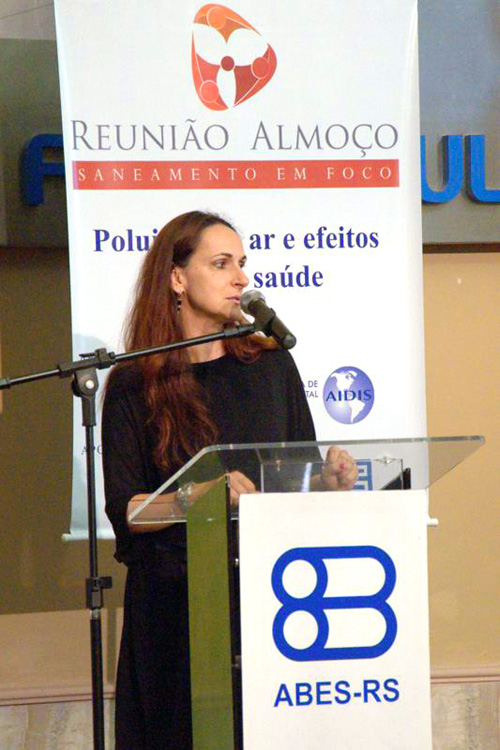
No inverno, Porto Alegre é a segunda capital brasileira mais poluída por material particulado inalável
Clique para abrir ampliadaNo inverno, depois de São Paulo, Porto Alegre é a capital que tem o ar mais poluído por material particulado inalável. Essa informação foi dada pela professora Cláudia Rohden durante reunião-almoço Saneamento Ambiental em Foco, promovida pela Abes-RS (Associação Brasileira de Engenharia Sanitária e Ambiental – seção Rio Grande do Sul) no salão nobre da Federasul, nesta sexta-feira (26), com o tema “Poluição do ar e efeitos sobre a saúde”.
Depois de um breve relato sobre a situação mundial em relação à poluição atmosférica, a drª Rohden apresentou os resultados dos trabalhos que sua equipe vem realizando em parceria com a equipe do dr. Paulo Saldiva, da USP, a maior autoridade brasileira no setor. Com tecnologia simples – tendo como bioindicador uma planta de jardim chamada Tradescantia pallida – a equipe da professora investigou a qualidade do ar em diferentes pontos de Porto Alegre, identificando no bairro Humaitá uma área crítica no verão, possivelmente por estar sobre um lixão aterrado.
Numa pesquisa que durou um ano e meio, feita também em outras cinco capitais brasileiras, monitorando apenas um poluente (o material particulado inalável, que se instala na parte baixa do pulmão), Porto Alegre se situou no nível de Belo Horizonte e Curitiba, mas durante o inverno a qualidade do ar da capital gaúcha foi considerada a pior do Brasil depois da de São Paulo.
A drª Cláudia Rhoden é professora adjunta da Universidade Federal de Ciências da Saúde de Porto Alegre (UFCSPA), onde coordena o Laboratório de Estresse Oxidativo e Poluição Atmosférica, e é pesquisadora associada ao Departamento de Patologia da Faculdade de Medicina da Universidade de São Paulo (USP).
Foto: Felipe Gaieski
Assessoria de Imprensa da ABES-RS
Contato: (51) 3212-1375
E-mail: imprensa@abes-rs.org.br

São Paulo's smoke-free legislation on carbon monoxide concentration

 This article has been Unlocked 
Free via Creative Commons:  OPEN ACCESS


Results The CO concentration pre-ban and pot-ban in hospitality venues was indoor area 4.57 (3.70) ppm vs 1.35 (1.66) ppm (p<0.0001); semi-open 3.79 (2.49) ppm vs 1.16 (1.14) ppm (p<0.0001); open area 3.31(2.2) ppm vs 1.31 (1.39) ppm (p<0.0001); smoking employees 15.78 (9.76) ppm vs 11.50 (7.53) ppm (p<0.0001) and non-smoking employees 6.88 (5.32) ppm vs 3.50 (2.21) ppm (p<0.0001). The average CO concentration measured in the city was lower than 1 ppm during both pre-ban and post-ban periods.
Conclusion São Paulo's smoking-free legislation reduced significantly the CO concentration in hospitality venues and in their workers, whether they smoke or not/.../