|
And how it overcame device constraints to bring it to your device
|
Showing posts with label world. Show all posts
Showing posts with label world. Show all posts
Saturday, February 08, 2020


Tuesday, January 07, 2020
world’s newest country?
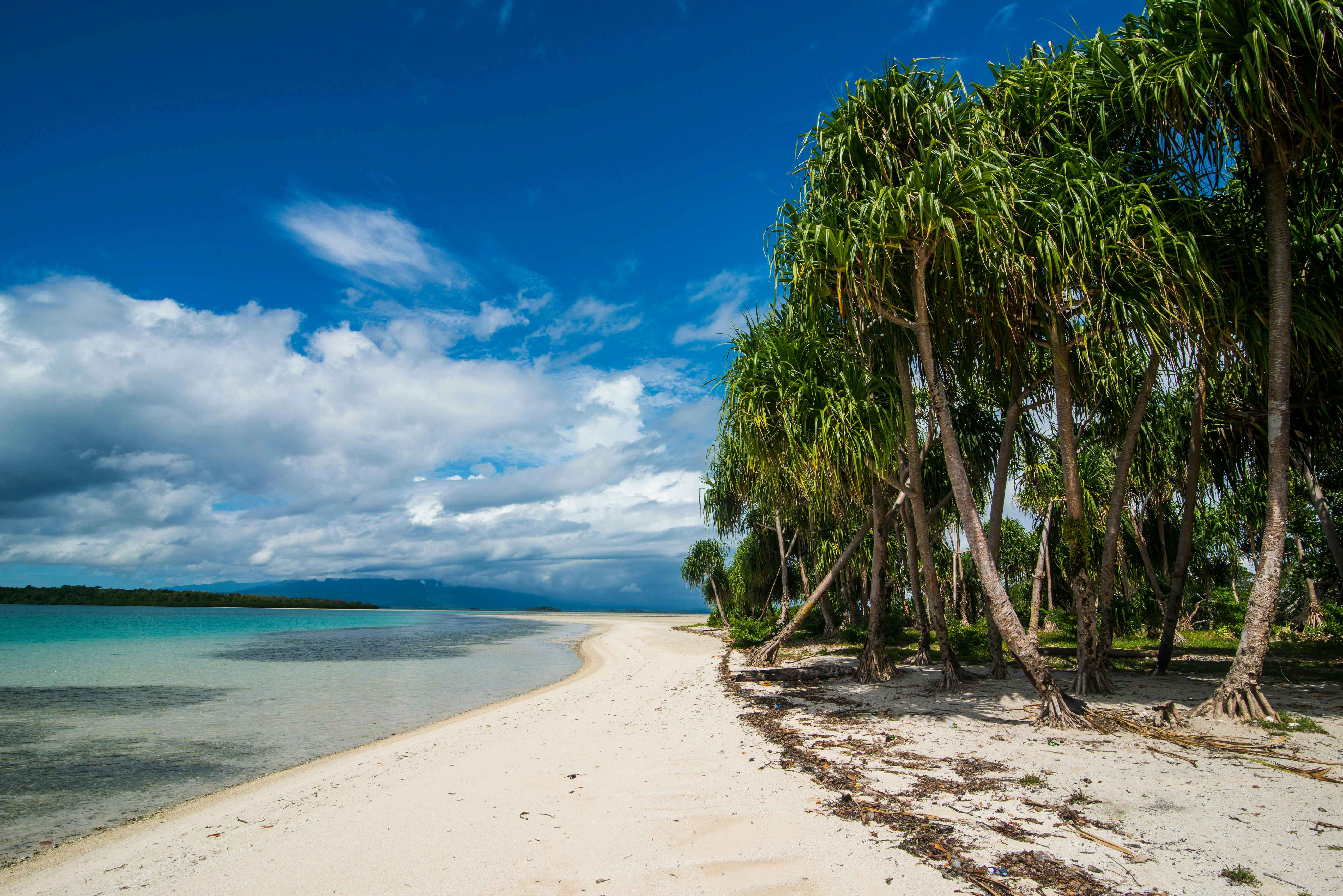 The world’s newest country? That could be the South Pacific’s Bougainville island group, whose 25,000 residents voted overwhelmingly last month for independence from Papua New Guinea. The volcanic islands and atolls are about half the size of Fiji. Lonely Planet tells you how to get there.
Tuesday, October 22, 2019
World Bank
2019 Annual Meetings Live

That's a wrap! Thank
you for watching the
2019 Annual Meeting's
events! You can watch the replays of the events here or the replays
of our Global Voices interviews here. This year we live streamed
for three full days on this page, interspersing interviews, videos.
event previews and high-level panels. Check out the full replays
of our Live Show from Day 1, Day 2 & Day 3.
you for watching the
2019 Annual Meeting's
events! You can watch the replays of the events here or the replays
of our Global Voices interviews here. This year we live streamed
for three full days on this page, interspersing interviews, videos.
event previews and high-level panels. Check out the full replays
of our Live Show from Day 1, Day 2 & Day 3.
SCHEDULE OF EVENTS
October 16th-19th


Wednesday, May 29, 2019
Human Population evolution
Human Population Through Time
Check out this week’s video blog! It took 200,000 years for our human population to reach 1 billion—and only 200 years to reach 7 billion. But growth has begun slowing, as women have fewer babies on average. When will our global population peak? And how can we minimize our impact on Earth’s resources, even as we approach 11 billion?
Tuesday, September 18, 2018
global living conditions
The map we need if we want to think about how global living conditions are changing
Our World in Data presents the empirical evidence on global development in entries dedicated to specific topics.
Friday, September 07, 2018

Tuesday, June 26, 2018
UN Charter
Today in
Lembro que ao ler a notícia no jornal - recém terminada a II guerra - enviei uma carta para um endereço das NU dizendo que gostaria de ter uma cópia, e recebi algum tempo depois um livretinho de capa azul com o documento que guardei por muito tempo. Tenho esperança ainda de encontrá-lo. Na época pensei até em seguir a carreira diplomática. Morando numa colônia alemã de 1939 a 1941 a guerra foi algo que mexeu sempre muito comigo.
| 1945: |  |  The Charter of the United Nations was signed in San Francisco. The Charter of the United Nations was signed in San Francisco. |
No dia 08 de maio de 1945, quando soube do fim oficial do conflito, gravei a data em números romanos no tronco de uma árvore no pátio de nossa casa em Santa Maria, na rua Venâncio Ayres. Tenho vontade de voltar lá e ver se a tal árvore com as marcas ainda existem (era um abacateiro em cuja casca é fácil escavar caracteres, mas que também desaparecem fácil).

Esta é a casa, mas não se vê árvore nenhuma ao fundo, o que me deixa pouca esperança de encontrar minha relíquia...(As garagens do primeiro plano, também não existiam na época, havia somente um muro alto)
Esta é a casa, mas não se vê árvore nenhuma ao fundo, o que me deixa pouca esperança de encontrar minha relíquia...(As garagens do primeiro plano, também não existiam na época, havia somente um muro alto)
Friday, February 23, 2018
Tempo de deslocamento
 |
Um mundo desigualmente conectado por rios e estradas
Mapa global permite estimar o tempo de viagem de qualquer ponto em terra firme do planeta à cidade mais próxima com cerca de 50 mil habitantes
|
Sunday, May 07, 2017
the Invention of Nature
Alexander von Humboldt and the Invention of Nature: How One of the Last True Polymaths Pioneered the Cosmos of Connections
“In this great chain of causes and effects, no single fact can be considered in isolation.”
BY MARIA POPOVA

No thinker has shaped our understanding of the astounding interconnectedness of the universe more profoundly than the great Prussian naturalist, explorer, and geographer Alexander von Humboldt (September 14, 1769–May 6, 1859), who pioneered the notion that the natural world is a web of intricately entwined elements, each in constant dynamic dialogue with every other — a concept a century ahead of its time. His legacy isn’t so much any single discovery — although he did discover the magnetic equator, invented isotherms, and came up with climate zones — as it is a mindset, a worldview, a singular sensemaking sublimity./.../
Tuesday, April 25, 2017
Sunday, April 23, 2017


Saturday, April 22, 2017
Earth Day
| Dia da Terra 2017! #GoogleDoodle https://g.co/doodle/5zz736
|


Thursday, February 23, 2017
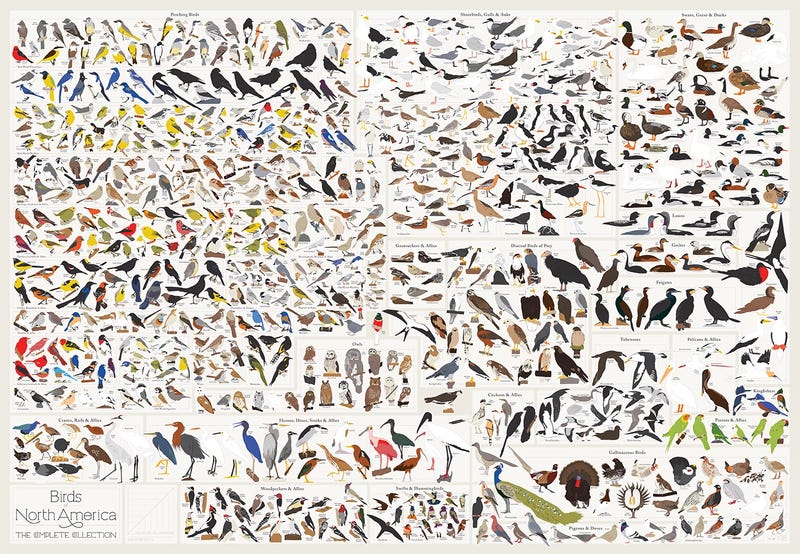
All US Birds
This Gorgeous Poster Contains Every Single Bird You'll See in North America

Subscribe to:
Posts (Atom)