Translate AMICOR contents if you like

Sunday, December 10, 2023

3.166 AMICOR (26)

 3.166 AMICOR (26)

#com Dra. Valderês A. Robinson Achutti (13/06/1931+15/06/2021)
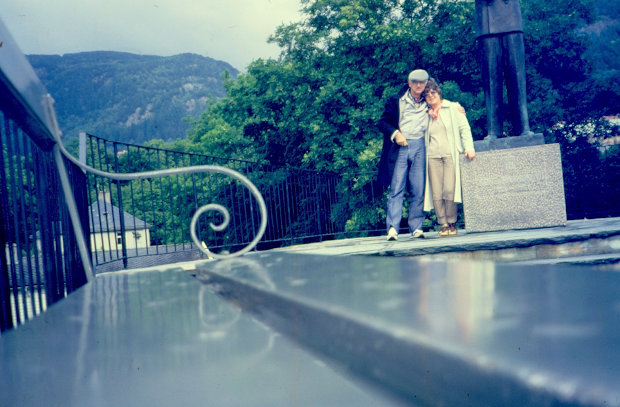


Em Bergen, na Noruega, em junho de 1993

#Re-Publicando artigos antigos meus...  (16/06/2010)

“ ENGANA-ME...”

Aloyzio Achutti. Médico.

“Engana-me que eu gosto...”: ditos populares também podem lidar com importantes questões. Estamos mergulhados em mensagens enganosas ou de meias verdades na propaganda comercial, no discurso político, na fé religiosa, nas juras de amor, em muitos prazeres fugazes, na embriaguês da voracidade, em nossos sonhos, e até nas tais evidências científicas.

O disfarce, o drible, a artimanha, a estratégia, o esconde-esconde, a surpresa, fazem parte do jogo, e a vida precisa nos ensinar o que convém e o que deve ser evitado. Precisamos nos conformar: a dúvida, a incerteza, e a dificuldade de reconhecer o falso e o verdadeiro são desafios permanentes. A filosofia e a religião desde sempre tentaram encontrar saídas, e a ciência surgiu para minimizar as dúvidas, mas a expansão do conhecimento traz mais novas perguntas do que respostas definitivas...

A segunda parte da expressão - é ao menos - curiosa: gostar de ser enganado?!... Pela frequência e liberdade com que os limites do razoável são ultrapassados, é realmente muito provável ser a responsabilidade não somente do enganador, mas haver algum gozo ou vantagem em ser enganado. Existe gente ingênua que facilmente cai no “conto do vigário”, mas não existe tamanha ignorância assim no mundo para se subestimar tanto a audiência.

Frente às dificuldades, a fuga da realidade é uma saída bem conhecida: drogar-se, dormir, negar, iludir-se, fazer de conta para não enfrentar o sofrimento ou ter que tomar uma decisão de risco. E não é uma raridade. Quantos jogam dinheiro fora em vários tipos de jogos e sorteios com quase nenhuma chance, a não ser a da banca? Fanatismo político, paixão pelo time, fidelidade à marca, fazem-nos cegos porque preferimos jogar no que gostaríamos que fosse verdade.

A virtualidade da literatura, das artes, e da mídia, fornece-nos recursos eficazes para criar e viver numa realidade paralela. A companhia - principalmente se for de muitos, em massa - pode nos liberar de tomar uma decisão pessoal, e em consequência, nos deixarmos levar...

Seres racionais: não somos tão racionais assim. Há caminhos alternativos em nossa mente, assim como aquele da dependência química ou psicológica, se alguma vez deu certo, ou trouxe algum tipo de prazer. A informação é essencial, mas pode ser mal conduzida por um conluio tácito entre a esperteza de quem veicula a mensagem, e a pouca lucidez de quem a recebe. A boa educação pode estruturar a personalidade, tornando-a menos suscetível, mas o equilíbrio emocional é crítico na escolha da opção mais acertada, em vez da efêmera e enganosa ilusão. 

Recomendado pela AMICOR Maria Inês Reinert Azambuja

#Dec. 9, 2023


PUBLISHED BY THE  BERGGRUEN INSTITUTE


View the roundup in your browser here. Visit Noema Magazine at noemamag.com

When To Stop AI

Drawing redlines where the ‘capability ladder’ of intelligent machines can’t be allowed to go further.


Nathan Gardels, Noema Editor-in-Chief

In dramatic fashion, the recent rift at OpenAI laid bare the core concern over where and when to draw the line at that point beyond which frontier technologies designed to enhance human well-being become a threat to it. For the moment, the incentives behind rapid commercialization of AI, which will drive its diffusion throughout all aspects of society, appear to have won out over precaution. Competition, in turn, will further accelerate the pace of developing ever more powerful capabilities among companies and nations alike.

The pattern so far, as illustrated in this chart, suggests that intelligent machines latched to unleashed animal spirits will bring the moment of reckoning sooner than we may be ready for. AI does not advance gradually, but in leaps and bounds:

/../

#Região Metropolitana de POA 1973-2023
#
Just Published the latest from Quanta Magazine
View this email in your browser
 

ABSTRACTIONS BLOG, PHYSICS

The (Often) Overlooked Experiment That Revealed the Quantum World

By ZACK SAVITSKY
A century ago, the Stern-Gerlach experiment established the truth of quantum mechanics. Now it’s being used to probe the clash of quantum theory and gravity.

Read article

#Our World in Data

What were the death tolls from pandemics in history?


Pandemics have killed millions of people throughout history. How many deaths were caused by different pandemics, and how have researchers estimated their death tolls?


Recent articles, updates, and announcements

Period versus cohort measures: what’s the difference?
Why do women live longer than men?
The Human Development Index and related indices: what they are and what we can learn from them
Redesigning our interactive data visualizations
How does the risk of death change as we age – and how has this changed over time?

The mission of Our World in Data is to make data and research on the world’s largest problems understandable and accessible.

#QUORA

 · 
Follow

There are the last identified, and the last words of Albert Einstein. As he lay dying, he reportedly spoke in German. The attending nurse, Johanna Fantova, didn’t speak a lick of German. So she was unable to identify what he was saying in his final moments.

What we do know, is that Einstein had fully made peace with his upcoming death. He was offered an operation to try and prolong his life, and declined it, saying:

I want to go when I want. It is tasteless to prolong life artificially. I have done my share; it is time to go. I will do it elegantly.

The aging scientist suffered from a ruptured vein in his stomach, causing internal bleeding. It had previously been restored surgically in the 1930s. He did not, however, wish to undergo another procedure and opted instead to die gracefully.

We’ll never know what Albert Einstein’s final words were on earth. Like so many others before him, and so many others after him, he reverted back to his original mother tongue in his last moments. And died in the presence of someone who did not speak that native tongue.

Saturday, December 02, 2023

3.165 AMICOR (26)

 3.165 AMICOR (26)

 #Com Dra. Valderês A. Robinson Achutti (*13/06/1931+15/06/2021)

          Nordeste, na praia, em cima de uma jangada, provavelmente na década de 70

#Re-Publicando artigos antigos meus

O MODELO MAIS INEFICAZ DO MUNDO...

Aloyzio Achutti. Médico e Professor Universitário.

Conforme foi noticiado na imprensa, o presidente dos EEUU, ao apresentar ao Congresso sua proposta para um novo plano de saúde no dia 22 de setembro último, designou o sistema assistencial Norteamericano (tido como modelo para muitos que lá tem completado sua formação) como o "mais ineficaz do mundo"!

A casualidade de ter sido  tumultuada sua apresentação pela troca do discurso por outro já feito, sobre o orçamento do país, não deixa de ser interessante, já que existe uma forte motivação econômica na proposta de mudança, possivelmente tão importante quanto possam ser os seus objetivos humanitários.

E não é para menos: do total equivalente a 1,7 trilhões de dólares gastos no mundo todo em 1990 no setor saúde (dinheiro público e privado) 41% correspondem aos americanos!  Eles têm gasto no setor, o equivalente do que gastam em educação e  defesa somado, ou seja, mais de 12% do Produto Interno Bruto; o que também equivale a duas vezes a soma de tudo o quanto o Brasil produz num ano inteiro.

Este dinheiro todo (quase 60% de origem privada), deixa de fora mais de 30 milhões de Americanos que não tem cobertura nenhuma, nem condições de pagar pela assistência.

A expressão muito usada  "ou paga ou dança" bem retrata a radicalização das posições numa discussão que já se prolonga por mais de 30 anos, sem conseguir reverter a  tendência (a rubrica quase triplicou no perído).  Do total, quase 40% tem ficado nos hospitais, menos de 20% com os médicos e 10% com medicação e outros suprimentos.

Noutro documento de análise, gerado também nos Estados Unidos no ano passado, o sistema de saúde é qualificado como perverso "pelos incentivos que remuneram os serviços em vez dos resultados, onde o mais é confundido com o melhor e onde o eficiente e o ineficiente são pagos de forma equivalente. Preconiza a mesma análise a organização de um sistema para atender populações bem definidas,  possiblitando assim a avaliação dos resultados através da verificação do estado de saúde dos indivíduos e das comunidades servidas.

Nós também estamos tentando construir um sistema de saúde, cujos características econômicas vão determinar seu funcionamento e tendências. É ilusão  achar que  competência científica e habilidade técnica sejam suficientes para melhorar a saúde da população.  Não será também na base da caridade que vamos conseguir assistir adequadamente os desvalidos num mundo capitalista. Na medida em que tivermos poder político e possibilidade de discutir prioridades e orçamentos, precisamos considerar seriamente onde vamos colocar nosso dinheirinho. Não dá para acompanhar as loucuras que nem rico aguenta mais.

Clinton quer reduzir cerca de 200 bilhões de dólares na despeza e universalizar a assistência, dando cobertura para os 30 milhões que não tem como pagar. Ele espera conseguir fazer o milagre visando o "desperdício, a fraude e o abuso", e aumentando os impostos sobre o cigarro (um dolar a mais por maço) para financiar o setor. 

As companias  que exploram o vício e que já alardeiam sua parcela na arrecadação de impostos, agora vão querer que se acrescente ao aviso estampado nas carterias de cigarro: "O fumo produz cancer, mas faz bem para a saúde através dos impostos que arrecada..."

#Medscape - Cardiology

Alessia De Chiara November 21, 2023

Excess consumption of red meat, whether processed or not, is linked to a greater risk for developing type 2 diabetes. This association was confirmed by a new study published last month in The American Journal of Clinical Nutrition, a data analysis of nearly 217,000 people who were monitored for three decades as part of several cohort studies. "Our study supports the current dietary recommendations of limiting consumption of red meat and highlights the importance of different alternative sources of protein in preventing type 2 diabetes," the researchers write.


#MEDIUM

“Mathematics is, in its way, the poetry of logical ideas. ”

— Albert Einstein

#Maria Popova

The Majesty and Mystery of Night Migration, in a Stunning Poem Turned to Music

“Night, when words fade and things come alive,” Little Prince author Antoine de Saint-Exupéry wrote in his love letter to the hours of darkness, composed while flying alone over the Sahara Desert.

No aliveness animates the nocturne with more grandeur than the migration of birds. Every spring and fall, in the starlit corridor between the trees and the clouds, flocks of millions soar over dark deserts and oceans, cities and continents — feathered pilgrims of purpose and resilience, governed by senses we don’t have, guided by voices we are only just beginning to hear.

#Neurosciences

Exercise Boosts Brain Power Amidst Sleep Deprivation

Summary: New research reveals that moderate exercise improves cognitive performance (CP) even under conditions of sleep deprivation and low oxygen levels.

The study involved two experiments with 24 participants in total, examining the effects of partial and total sleep deprivation, as well as hypoxia, on CP. Results consistently showed that a 20-minute cycling session significantly enhanced CP regardless of sleep status or oxygen levels.

This groundbreaking study adds to the understanding of how physical activity can mitigate the cognitive deficits caused by common stressors.

Key Facts:

  1. The study demonstrates that moderate intensity exercise improves cognitive performance even after full or partial sleep deprivation and in hypoxic conditions.
  2. In the first experiment, participants, limited to five hours of sleep per night, showed inconsistent CP at rest but improved performance post-exercise.
  3. The second experiment revealed that despite an entire night without sleep and reduced oxygen levels, participants’ CP improved after exercising.

Source: University of Portsmouth

#Quanta Magazine

COMPUTATIONAL COMPLEXITY | ALL TOPICS


P vs. NP - The Greatest Unsolved Problem in Computer Science

Video by CHRISTOPHER WEBB YOUNG;
Story by BEN BRUBAKER

Is it possible to invent a computer that computes anything in a flash? Or could some problems stump even the most powerful of computers? How complex is too complex for computation? Watch our new computational complexity explainer.

Watch the video | Read the article

Quanta is conducting a series of surveys to better serve our audience. Take our newsletter subscriber survey and you will be entered to win free Quanta merchandise.

CONDENSED MATTER PHYSICS


Meet Strange Metals: Where Electricity May Flow Without Electrons

By CHARLIE WOOD

For 50 years, physicists have understood current as a flow of charged particles. But a new experiment has found that in at least one strange material, this understanding falls apart.

Read the article


Related: 
The Near-Magical Mystery
of Quasiparticles

By Thomas Lewton (2021)

MATHEMATICAL PHYSICS


A Century Later, New Math Smooths Out General Relativity

By STEVE NADIS

Two mathematicians have proved that, according to general relativity, a version of space-time with successively small amounts of mass will eventually converge to a flat space with zero curvature.

Read the article


Related: 
Math Proof Draws New Boundaries
Around Black Hole Formation

By Steve Nadis

EVOLUTION


Evolving Bacteria Can Evade Barriers to ‘Peak’ Fitness

By VERONIQUE GREENWOOD

Mathematical ‘fitness landscapes’ help biologists predict how organisms might evolve. One of the largest landscapes ever created has revealed secrets behind the hardiness of a common bacterium.

Read the blog


Related: 
Evolution ‘Landscapes’ Predict
What’s Next for COVID Virus

By Carrie Arnold (2022)

QUANTIZED COLUMNS


Inside Biologists’
New Quest to Control Evolution

By C. BRANDON OGBUNU

Agriculture was invented by humans who carefully honed desired traits in certain organisms, then bred them to amplify these traits. We now have more advanced methods for tilting evolution in our favor.

Read the column


Related: 
How Genetic Surprises
Complicate the Old Doctrine of DNA

By C. Brandon Ogbunu
 

#OUR WORLD IN DATA

Do governments worldwide have the ability to implement their policies and achieve their goals?

State capacity is the ability of governments to effectively implement their policies and achieve their goals.

The goals of governments vary a lot, and some governments are much more ambitious than others. However, they typically include protecting their citizens against internal and external threats and encouraging economic activity.

The policies they pursue to achieve these goals range from keeping other governments from interfering in their actions, disarming other violent actors within their territory, upholding the rule of law, and providing infrastructure and other public goods.

To do that, states must sustainably raise sufficient resources – usually by collecting taxes –, hire skilled and impartial security forces and public servants, and gather accurate information about their populations, among other things.

Understanding state capacity is crucial because it shapes a country's ability to address its many challenges. On this page, you can find related data and visualizations on how state capacity differs around the globe and how this has been changing over time.

Explore our new page

Recent articles, updates, and announcements


#EMIL ACHUTTI BERED nosso primo
Artigo de um ex-aluno, também meu primo por outro costado, José Antônio Brenner, publicou em jornal de SM. CLICANDO AQUI também pode-se ver coleção de fotos do evento. Tia Emilia, a mãe do Emil era irmã de meu pai, Bortolo Achutti.