Person of the Year 2008
The Interview: Person Of the Year Barack Obama
 CALLIE SHELL / AURORA FOR TIMECALLIE SHELL / AURORA FOR TIME
IDH do Brasil cresce; país é 70º no ranking
Educação foi principal razão da melhora no Índice de Desenvolvimento Humano; Brasil está entre nações de alto padrão de desenvolvimento
Ranking do IDH
Veja a lista de 179 países e territórios, classificados segundo o Índice de Desenvolvimento Humano calculado com dados relativos a 2006
You can receive email updates for almost any web site, even if the site itself does not offer an email service. Simply enter the address of the web site, blog or page that you want to track in the form below, and FeedBlitz will keep you up to date automatically.
Cardiac imaging is an integral part of the evaluation and management of patients with known or suspected heart disease. These techniques offer insight into morphologic features and physiologic functioning of the myocardium, valves, pericardium, coronary arteries, and great vessels. Substantial advances in technology have occurred within the past decade, advancing clinical applications and enhancing diagnostic accuracy.
Many options for imaging the heart and adjacent structures are available such as, echocardiography, single-photon emission computed tomography (SPECT) myocardial perfusion imaging (MPI), positron emission tomography (PET), cardiac magnetic resonance (CMR), cardiac computed tomography (CCT), invasive coronary angiography (ICA), and left ventriculography (LVG). Major specialty societies, such as the ACC, the AHA, the Radiological Society of North American (RSNA), and the American College of Radiology (ACR) have demonstrated leadership in promoting research and written guidelines and practice standards for the performance of cardiac imaging. In many cases, each modality has developed rather independently and has strong advocacy by dedicated clinicians/researchers and their own subspecialty societies, including the American Society of Nuclear Cardiology (ASNC), the American Society of Echocardiography (ASE), the Society for Atherosclerosis Imaging and Prevention (SAIP), the Society for Cardiovascular Computed Tomography (SCCT), the Society for Cardiovascular Magnetic Resonance (SCMR), the Society for Cardiovascular Angiography and Interventions (SCAI), the Society of Interventional Radiology (SIR), the North American Society for Cardiovascular Imaging (NASCI), and the Heart Rhythm Society (HRS).
Cardiac imaging is included in patient decision-making and is often referenced in guidelines and other data standards. However, differing definitions abound, leading to misunderstanding and confusion. Furthermore, structured reporting is becoming commonplace and imaging data fields are increasingly being used within registries and clinical databases. The ACC has led a multisocietal effort that culminated in the development of a document that recommends the use of structured reporting for cardiovascular imaging as an essential component of improved cardiovascular health care (1); that article is being published simultaneously with these data standards. These two writing efforts were coordinated with each other and underscore the importance for capturing and reporting clear, consistent and complete information for patients undergoing cardiovascular imaging./.../
Ontem comemoramos os 50 anos de formados pela UFRGS, juntamente com os que completavam 60 e 25 anos.
Convidaram-me para falar em nome dos de 1958 e abaixo segue a minha mensagem:
MEIO SÉCULO DE PROFISSÃO (1958-2008)
Motivo para celebração, para agradecimentos, para retrospecto, e para reflexão.
Sinto-me honrado falando também em nome de colegas de outras profissões, tentando não me restringir à medicina, mas buscando a perspectiva que deveria estar nos fundamentos de nossa universidade.
Cada um de nos terá histórias e experiências que não cabem no exíguo tempo deste encontro. Atuamos no mesmo palco, com papéis específicos, mas com um roteiro comum. Alimentamos sonhos, paixões, fantasias, ilusões. Tivemos frustrações e muitas realizações.
A universidade nos ajudou a caminhar pelo reino da ciência, da tecnologia e das artes. Incentivou-nos a perseguir o belo e a verdade, e a questionar as certezas de hoje e os projetos de amanhã. Equipados com o que recebemos há mais de meio século, aprendemos, ensinamos, pesquisamos, descobrimos, criamos, construímos, desenvolvemos.
Nesse tempo muita coisa mudou, tinha de mudar, nós mudamos. Ficamos 50 anos mais velhos? Ou foi o mundo que ficou mais novo?!...
Alguns de nossos colegas ficaram pelo caminho. Quase todos os professores já se foram, e muitos dos familiares presentes em 1958 não estão mais aqui.
A população mais do que dobrou, a terra esquentou, regimes e governos mudaram, o mundo enriqueceu, as diferenças sociais aumentaram, a expectativa de vida espichou, a mortalidade infantil caiu, as cidades incharam para os lados e para cima, o campo encolheu. A comunicação explodiu, fomos parar na lua e continuamos viajando para mais longe, olhando para mais além, e enxergando para trás, vendo fenômenos que aconteceram até antes de haver vida nesta terra. As drogas se disseminaram, o cigarro foi proibido, ficamos mais gordos, sedentários, mais nervosos e deprimidos. A família se sacudiu, as torres caíram, a cortina de ferro enferrujou, acordaram-se os tigres asiáticos, descobrimos que o comunismo nunca existiu, e o capitalismo está em perigo. Órgãos são transplantados e a clonagem recria a vida, células tronco, as doenças infecciosas caíram de moda e voltaram junto com as crônicas. Ficamos campeões de futebol, dos maiores exportadores de grãos e de carne, industrializados e auto-suficientes
Recém havíamos presenciado duas grandes guerras - como todas – absurdas. Consolidava-se a revolução Cubana, sucederam-se genocídios, pretextos para violência, para o desenvolvimento do mercado de armas e para a dominação pela força bruta e econômica.
Com toda nossa cultura e poder, não conseguimos dominar a violência nem a corrupção, nem controlar a poluição e a destruição progressiva de nossa própria casa.
Nessa corrida de revezamento cumprimos já com a maior parte de nossa etapa, e vai chegando a hora de passar adiante o bastão, mesmo sem compreender o sentido profundo de nossa missão.
Cada vez fica mais difícil saber quantos de nos poderemos participar da comemoração dos sessenta anos, mas aí estão os formados de 1983e os recém egressos, ainda com bastante tempo para conquistar e assumir posições, para que ao chegar sua vez, possam celebrar suas realizações e festejar um mundo melhor, em paz, mais saudável, mais estável, menos desigual, mais justo e mais feliz.
| Epidemiologia | ||
| Mortalidade Precoce por Doenças Cardiovasculares e Desigualdades Sociais em Porto Alegre: da Evidência à Ação | ||
| Sérgio Luiz Bassanesi, Maria Inês Azambuja, Aloyzio Achutti | ||
| Universidade Federal do Rio Grande do Sul, Academia Sul-Riograndense de Medicina, Porto Alegre, RS – Brasil | ||
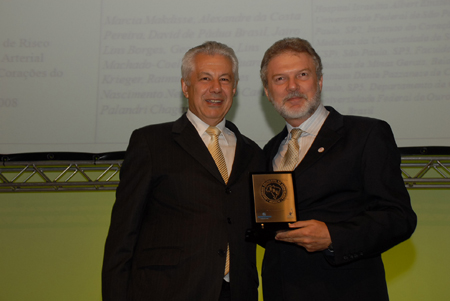
| » Vol. 90, Nº 6, Junho 2008 O AMICOR Sérgio Luiz Bassanesi, primeiro autor do artigo dos Arquivos Brasileiros de Cardiologia premiado na área de Epidemiologia em 2008. |
Sydney, Australia
Readers shared their thoughts on this article.
TEN years ago, in settling the largest civil lawsuit in American history, Big Tobacco agreed to pay the 50 states $246 billion, which they’ve used in part to finance efforts to prevent smoking. The percentage of American adults who smoke has fallen since then to just over 20 percent from nearly 30 percent, but smoking is still the No. 1 preventable cause of death in the United States, and smoking-related health care costs more than $167 billion a year.
To reduce this cost, the incoming Obama administration should abandon one antismoking strategy that isn’t working.
A key component of the Food and Drug Administration’s approach to smoking prevention is to warn about health dangers: Smoking causes fatal lung cancer; smoking causes emphysema; smoking while pregnant causes birth defects. Compared with warnings issued by other nations, these statements are low-key. From Canada to Thailand, Australia to Brazil, warnings on cigarette packs include vivid images of lung tumors, limbs turned gangrenous by peripheral vascular disease and open sores and deteriorating teeth caused by mouth and throat cancers. In October, Britain became the first European country to require similar gruesome images on packaging.
But such warnings don’t work. Worldwide, people continue to inhale 5.7 trillion cigarettes annually — a figure that doesn’t even take into account duty-free or black-market cigarettes. According to World Bank projections, the number of smokers is expected to reach 1.6 billion by 2025, from the current 1.3 billion./.../
born March 30, 1135, Córdoba [Spain]died Dec. 13, 1204, Egypt
![Moses Maimonides, engraved portrait and autograph, c. 1190.[Credits : The Granger Collection, New York]](http://media-2.web.britannica.com/eb-media/69/8469-003-235A84AC.gif)
Jewish philosopher, jurist, and physician, the foremost intellectual figure of medieval Judaism. His first major work, begun at age 23 and completed 10 years later, was a commentary on the Mishna, the collected Jewish oral laws. A monumental code of Jewish law followed in Hebrew, The Guide for the Perplexed in Arabic, and numerous other works, many of major importance. His contributions in religion, philosophy, and medicine have influenced Jewish and non-Jewish scholars alike./.../
2:16 PM (1 hour ago) |
12:14 PM (12 minutes ago) |
New Cancer Cases and Overall Disease Mortality Rates Decline
| ||
| ||
ATLANTA, Nov. 25 -- Both cancer incidence and overall death rates are edging down in the U.S., driven largely by declines in some of the most common malignancies, according to an annual national report. Action Points
Cancer mortality rates dropped an average of 1.8% per year from 2002 through 2005, while the number of new cases fell an average of 0.8% per year from 1999 through 2005, according to the Annual Report to the Nation on the Status of Cancer, published in the Dec. 3 issue of theJournal of the National Cancer Institute. The decline marks the first simultaneous drop in incidence and death rates in the history of the report, wrote epidemiologist Ahmedin Jemal, D.V.M., Ph.D., of the American Cancer Society, and colleagues at the CDC, NCI, and the North American Association of Central Cancer Registries./.../ |
Nature and Nurture Contribute to Overeating | ||
| ||
DUNDEE, Scotland, Dec. 10 -- The likelihood of craving a couple of calorie-laden burgers and a cupcake or two instead of consuming a simple rice cake may be determined by a genetic mutation associated with obesity, found investigators here. The effect of the mutation in a subset of children appears to involve control of both the amount of food consumed and the desire to consume dense, high calorie foods, researchers reported in the Dec. 11 issue of the New England Journal of Medicine. /.../ |
We're working flat-out to right the fundamental wrongs that affect children.
Too many children are still dying because they haven't got enough food or because they can't get treatment for simple illnesses. Millions aren't getting an education and are being exploited andabused. This is not good enough.
We're changing this, partly by working directly with children, and partly by using our experience and influence to persuade governments and others who are responsible for children to do the right thing by them.
We seek out the most marginalised children, wherever they are in the world, so that means we work in a really broad range of countries, from fragile states like Afghanistan, to developed countries like here in the UK. We work closely with our colleagues in the International Save the Children Alliance, both in our programmes with children and in our international campaigns and advocacy work.
JAMA. 2008;300(22):2666-2668.
Achieving the Healthy People 2010 goal of reducing health disparities has been challenging. Disparity in life expectancy by socioeconomic status (SES) has been increasing.1 Much of this disparity is attributable to higher cardiovascular mortality, particularly from coronary heart disease (CHD), among persons of lower SES. Disparities in CHD mortality result from multiple factors, including early life environment and material disadvantage,2 social and behavioral risk factors,3 access to care,4 and systematic underestimation of risk among persons with lower SES in clinical care. This Commentary addresses the importance of SES in CHD risk assessment.
Current risk-based intervention strategies ignore the independent contribution of SES to CHD and thus may contribute to increasing SES disparities. If CHD risk is better estimated among the poor, it could lead to increased statin use for cholesterol reduction and aspirin use for CHD prevention among this population, which may reduce CHD disparities./.../
Nova Orleans, Louisiana - Pesquisadores que equiparam indivíduos de estudo com “coletes de poluição atmosférica” para monitorar continuamente a exposição a poluentes aéreos tanto em ambientes internos quanto ao ar livre afirmam que as pessoas estão provavelmente expostas a níveis de poluentes muito mais elevados do que as estações públicas de monitoração normalmente indicam e que esta exposição afeta tanto a função endotelial quanto a pressão arterial sistólica.
Dr. Robert Brook (University of Michigan, Ann Arbor) e colaboradores apresentaram um pôster com os resultados do seu estudo DEARS (Detroit Exposure and Aerosol Research Study), durante as Sessões Científicas da American Heart Association (AHA) de 2008. Em uma entrevista à heartwire, o co-autor do estudo, Robert Bard, disse que os resultados deveriam servir como uma lembrança para cardiologistas, que tendem a esquecer a proporção em que a poluição atmosférica pode lesar o coração.
"Os cardiologistas realmente não estão cientes disso como um fator de risco", disse Bard, apesar de uma advertência científica da AHA de 2004 sobre os riscos cardiovasculares da poluição atmosférica. O que é preciso, Bard disse, é "uma maior conscientização de que a poluição atmosférica está contribuindo para a doença cardiovascular".
Algo no ar
Brook, Bard e colaboradores incluíram 65 pessoas — a maioria delas mulheres — entre 19 e 80 anos de idade, residentes em três áreas de Detroit. Todos os indivíduos usavam coletes de monitorização da poluição por 24 horas durante cinco dias consecutivos no verão e cinco dias consecutivos no inverno, apenas retirando os coletes para higiene corporal ou para dormir, neste caso foram instruídos a manter os coletes próximos a eles, no mesmo quarto. Conseqüentemente, explicou Bard, os coletes captaram não somente poluentes de âmbito público, mas as exposições domiciliares, bem como exposições de curto prazo, quando os indivíduos passavam por alguém fumando ou um ônibus saindo do acostamento e produzindo um estouro do escapamento.
Os pesquisadores verificaram que a exposição pessoal média ao material particulado fino <>2,5), associando ambas as exposições em ambientes internos e ao ar livre, foi 21,9 μg/m3, mas variou até 225,4 μg/m3 — muito maior do que aquela mensurada pelas estações públicas de monitoração, que era uma média de 15,4 μg/m3 e um máximo de 41 μg/m3. Surpreendentemente, um aumento de 10 μg/m3 na exposição pessoal no estudo foi associado ao estreitamento do diâmetro do vaso sangüíneo braquial no prazo de 2 dias da exposição e aumento da pressão arterial sistólica (até 1,6 mm Hg), após 1 dia de exposição.
Segundo Bard, os principais tipos de poluentes aéreos detectados pelos coletes foram "subprodutos de combustão", ou seja, escapamento dos automóveis e fumaça ambiental do tabaco, apesar do fato de que todos os participantes do estudo eram não-fumantes e residentes em domicílios sem tabagistas. O fumo ainda é permitido, por exemplo, nos restaurantes, em Michigan, observou Bard.
"A poluição atmosférica é, na verdade, mencionada como a 13ª maior causa de morte no mundo inteiro", Bard lembrou à heartwire. "Nós já sabíamos que a poluição atmosférica está associada aos eventos adversos cardiovasculares, incluindo o aumento da pressão arterial, mas o novo aspecto aqui é que estávamos medindo a poluição à qual as pessoas foram diretamente expostas e avaliando a função cardiovascular. Constatamos que as pessoas comuns no nosso estudo apresentaram aumento da pressão arterial e função endotelial reduzida a partir do ar ao qual foram expostas nas 24 horas prévias. E essencialmente, estes resultados foram demonstrados apesar dos níveis de poluição no ar ambiente que estavam de acordo ou abaixo daqueles recomendados nas diretrizes atuais da EPA (Environmental Protection Agency)".
Ele continuou: "Os pacientes não devem entrar em pânico, pois estes níveis são ainda relativamente baixos. Mas as pessoas precisam estar mais conscientes sobre a poluição atmosférica como um fator contribuinte das doenças cardiovasculares e apoiar iniciativas de ar limpo. E se você apresenta uma doença cardiovascular, talvez precise evitar a exposição à poluição atmosférica nas horas críticas".


