
Sunday, September 27, 2015


MnTBAP
A new class of anti-obesity compounds with potential anti-diabetic properties
| September 24, 2015 |
 |
Mice with pre-existing obesity lost 20 percent of their body weight and about 50 percent of their fat mass
A molecule known as MnTBAP* has rapidly reversed obesity in mice and could be effective for humans in the future, according to researchers from Skidmore College and the Perelman School of Medicine at the University of Pennsylvania. “In the span of a month, mice with pre-existing obesity lost 20 percent of their body weight and … more… |
'stealth dark matter’
New ‘stealth dark matter’ theory may explain mystery of the universe’s missing mass
| September 24, 2015 |
 |
A balancing act performed before the universe cooled
A new theory that may explain why dark matter has evaded direct detection in Earth-based experiments has been developed by team of Lawrence Livermore National Laboratory (LLNL) particle physicists known as the Lattice Strong Dynamics Collaboration. The group has combined theoretical and computational physics techniques and used the Laboratory’s massively parallel 2-petaflop Vulcan supercomputer to … more… |
Saturday, September 26, 2015
Social Network

The Social-Network Illusion That Tricks Your Mind
Network scientists have discovered how social networks can create the illusion that something is common when it is actually rare.

One of the curious things about social networks is the way that some messages, pictures, or ideas can spread like wildfire while others that seem just as catchy or interesting barely register at all. The content itself cannot be the source of this difference. Instead, there must be some property of the network that changes to allow some ideas to spread but not others.
Today, we get an insight into why this happens thanks to the work of Kristina Lerman and pals at the University of Southern California. These people have discovered an extraordinary illusion associated with social networks which can play tricks on the mind and explain everything from why some ideas become popular quickly to how risky or antisocial behavior can spread so easily.
Network scientists have known about the paradoxical nature of social networks for some time. The most famous example is the friendship paradox: on average your friends will have more friends than you do.
Fat cells nerves

When the human body needs extra energy, the brain tells fat cells to release their stores. Now, for the first time, researchers have visualized the nerves that carry those messages from brain to fat tissue. The activation of these nerves in mice, they found, helps the rodents lose weight—an observation that could lead to new slimming treatments for obese people.
Human Virus


Don’t panic. That’s the emphatic message coming from researchers who have discovered a new virus in human blood. Though it’s unclear how common the pathogen is, there’s no evidence that it has caused anyone harm, and half of those infected appear to have cleared it.
The newfound virus’s genetic sequence shows that it has similarities to hepatitis C, which can cause serious liver damage, and to the harmless—and even helpful—human pegivirus (formerly dubbed hepatitis G). Amit Kapoor, a virologist at Columbia University led the team that identified the new virus—and which has named it human hepegivirus 1, or HHpgV-1—notes that many people understand that humans coexist with myriad bacteria that are not dangerous, but they don’t realize the same holds true for some viruses.
1, 2, 3...

In some traditional cultures, counting is as easy as one, two, three—because it stops there: Their languages have no words for higher numerals, and instead simply use varieties of words like “many.” But over time some societies acquired higher numbers, as the major languages spoken on the planet today must have done long ago. Now, a new study of an Australian language family reveals how languages add, and sometimes lose, higher numbers—and how some languages lasted for thousands of years without them./.../
Dia do Médico
Foto de um feliz encontro na sede da Santa Transmedia a convite de Laura Andrade da Olha lá - Pesquisa & Planejamento, ontem de noite (dia 25/09) para Pré-Lançamento de VT para o dia do Médico, no qual Mario Antônio Rosito Mascarenhas e eu aparecemos.


Metric Conversion
Metric conversion charts and calculators for metric conversions
Use the search box to find your required metric converter
UNDGoals
The UN Development Goals Miss the Point – It’s All About Power
Unless you understand that the poverty of some flows from the wealth and power of others, efforts to fight poverty will not truly work.
by
6 Comments

Far from critiquing the control of the market, the SDGs exhort world leaders to "remove market distortions" and "ensure the proper functioning of food commodity markets." This is not the way to end poverty in twenty years. (Photo: via Global Justice Now)
Not many people enjoy the existence of poverty. Some think it’s inevitable, others that tackling it is politically impossible. But for those with ambition, an end to poverty is a worthy enough goal. Naturally the self-congratulation will be in full flow this weekend, as celebrities and world leaders gather in New York to launch their latest effort to do just that, in the form of the Sustainable Development Goals (SDGs).
But something will be missing in between the speeches and performances by the likes of Ed Sheeran, Beyonce, Bill Gates and Meryl Streep. That thing is power. Because unless you understand that the poverty of some flows from the wealth and power of others, efforts to fight poverty will not truly work.
The SDGs consist of 17 objectives which aim to build a better planet – from eradicating hunger to building more sustainable cities. Each objectives contains a number of targets which cover everything from having better public transport to helping artisanal fisherfolk get better access to markets.
"It is impossible to realise the targets of the SDGs without tackling corporate power."
The goals do represent the many dimensions of poverty – it isn’t simply about a certain number of dollars a day. While some targets are limited or problematic (‘preventing trade restrictions in agriculture’ could cover a multitude of sins) others are very good (‘encouraging local involvement in water management’ and ‘improving the incomes of small farmers’)./.../
2015–16 State of the Future
2015–16 State of the Future
September 23, 2015
- author |
- Jerome C. Glenn, Elizabeth Florescu
- year published |
- 2015
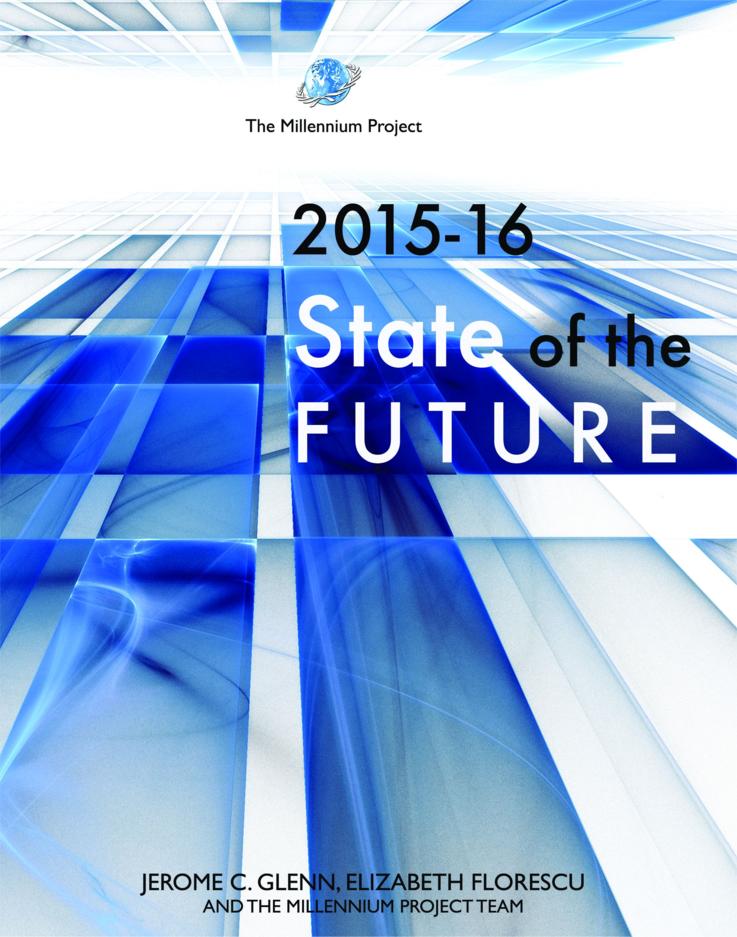 The 2015-16 State of the Future is a compelling overview of humanity’s present situation, challenges and opportunities, potentials for the future, and actions and policies that could improve humanity’s outlook — in clear, precise, and readable text with unparalleled breadth and depth.
This is the 18th and best edition of the State of the Future produced by The Millennium Project with its 56 Nodes around the world and two regional networks (Europe and Latin America).
It clearly documents humanity’s present situation; its challenges and opportunities; potentials for the future; and actions and policies that could improve humanity’s outlook with unparalleled breadth and depth.
“It is time for intolerance of irrelevant speeches and non-actions by leaders. The stakes are too high to tolerate business as usual,” declares Jerome Glenn, lead author of the report and CEO of The Millennium Project — referring to issues like future impacts of artificial intelligence, synthetic biology, organized crime, asymmetric warfare, and how to produce enough food, water, and energy for another 2.3 billion people in just 35 years.
289 pages; 53 Figures, and 11 tables. Price: electronic (pdf) $29.95; paperback: $39.95 US dollars + shipping
— Publisher
Friday, September 25, 2015

Thursday, September 24, 2015
Maps
18 Maps That Will Change How You See The World
Including some disturbing news for America.
posted on Sept. 8, 2015, at 1:21 p.m.

Franklin D. Roosevelt
5 FDR Quotes On Poverty That Still Totally Hold Up
It’s really quite surprising that Franklin D. Roosevelt was only considered important enough for the tiniest of American currency, because he was one hell of a President. Not only did he battle polio — POLIO — he also was a crusader for what he called “the forgotten man,” i.e. the poor.
Like waaaaaay before it was cool.
And get this — he didn’t even grow up poor! He just knew that poor people needed care and then talked about it and tried to help them.
As the Presidential race heats up (bye, Scott Walker! See you in Hell!) and New York City and other locations around the country fight for a higher minimum wage (with which even the current President is on board), it’s important to remember that:
a.) the idea of raising up the poor is neither new nor radical, and
b.) there’s a lot of really respected leadership that spoke on it decades ago.
********************
We cannot be content, no matter how high that general standard of living may be, if some fraction of our people — whether it be one-third or one-fifth or one-tenth — is ill-fed, ill-clothed, ill-housed, and insecure. [Source]
True individual freedom cannot exist without economic security and independence. People who are hungry and out of a job are the stuff of which dictatorships are made. [Source]
Subscribe to:
Posts (Atom)