Translate AMICOR contents if you like

Saturday, October 25, 2008

Wealth gap creating a social time bomb

Wealth gap creating a social time bomb

• Race behind division in US cities, says UN report 
• Beijing is most egalitarian place in the world

  • The Guardian
  • Thursday October 23 2008
    Growing inequality in US cities could lead to widespread social unrest and increased mortality, says a new United Nations report on the urban environment.

In a survey of 120 major cities, New York was found to be the ninth most unequal in the world and Atlanta, New Orleans, Washington, and Miami had similar inequality levels to those of Nairobi, Kenya Abidjan and Ivory Coast. Many were above an internationally recognised acceptable "alert" line used to warn governments.

"High levels of inequality can lead to negative social, economic and political consequences that have a destabilising effect on societies," said the report. "[They] create social and political fractures that can develop into social unrest and insecurity."

According to the annual State of the World's cities report from UN-Habitat, race is one of the most important factors determining levels of inequality in the US and Canada.
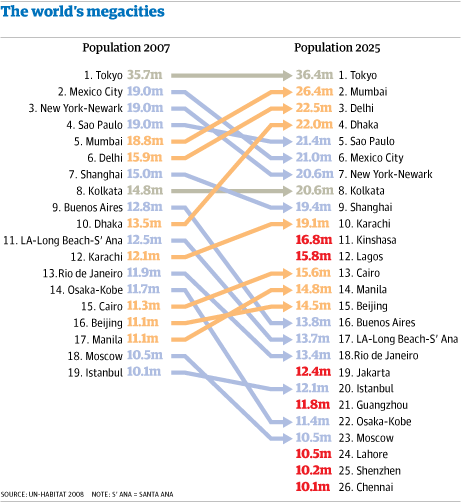
megacities

Growing inequality in U.S. cities could lead to widespread social unrest and increased mortality.


From: San Francisco Sentinel.com

Growing inequality in U.S. cities could lead to widespread social unrest and increased mortality, says a new United Nations report on the urban environment.

In a survey of 120 major cities New York was found to be the ninth most unequal in the world and Atlanta, Georgia, New Orleans, Louisiana, Washington, D.C., and Miami, Florida, had similar inequality levels to those of Nairobi, Kenya and Abidjan, Ivory Coast. Many were above an internationally recognized acceptable “alert” line used to warn governments.

“High levels of inequality can lead to negative social, economic and political consequences that have a destabilizing effect on societies,” said the report. “[They] create social and political fractures that can develop into social unrest and insecurity.”/.../

A Study of Risk Factors for First Myocardial Infarction in 52 Countries and Over 27,000 Subjects (INTERHEART)


Title: Dietary Patterns and the Risk of Acute Myocardial Infarction in 52 Countries: Results of the INTERHEART Study
Topic: General Cardiology
Date Posted: 10/20/2008
Author(s): Iqbal R, Anand S, Ounpuu S, et al., on behalf of the INTERHEART Study Investigators.
Citation: Circulation 2008;Oct 20:[Epub ahead of print].
Clinical Trial: No
Study Question: Diet is a major modifiable risk factor for cardiovascular disease, but it varies markedly in different regions of the world. Is the association between dietary patterns and acute myocardial infarction (AMI) comparable globally?
Methods:  INTERHEART is a standardized case-control study involving participants from 52 countries designed to identify risk markers for AMI. The present analysis included 5,761 cases with AMI and 10,646 control subjects. Three major dietary patterns were identified using factor analysis: Oriental (high intake of tofu and soy and other sauces), Western (high in fried foods, salty snacks, eggs, and meat), and prudent (high in fruit and vegetables)./.../

Friday, October 24, 2008

Post–Cardiac Arrest Syndrome

Post–Cardiac Arrest Syndrome
Epidemiology, Pathophysiology, Treatment, and Prognostication
A Consensus Statement From the International Liaison Committee on Resuscitation (American Heart Association, Australian and New Zealand Council on Resuscitation, European Resuscitation Council, Heart and Stroke Foundation of Canada, InterAmerican Hear Foundation, Resuscitation Council of Asia, and the Resuscitation Council of Southern Africa); the American Heart Association Emergency Cardiovascular Care Committee; the Council on Cardiovascular Surgery and Anesthesia; the Council on Cardiopulmonary, Perioperative, and Critical Care; the Council on Clinical Cardiology; and the Stroke Council Endorsed by the American College of Emergency Physicians, Society for Academic Emergency Medicine, Society of Critical Care Medicine, and Neurocritical Care Society Robert W. Neumar, MD, PhD, Co-Chair; Jerry P. Nolan, FRCA, FCEM, Co-Chair; Christophe Adrie, MD, PhD; Mayuki Aibiki, MD, PhD; Robert A. Berg, MD, FAHA; Bernd W. Böttiger, MD, DEAA; Clifton Callaway, MD, PhD; Robert S.B. Clark, MD;
Romergryko G. Geocadin, MD; Edward C. Jauch, MD, MS; Karl B. Kern, MD; Ivan Laurent, MD; W.T. Longstreth, Jr, MD, MPH; Raina M. Merchant, MD; Peter Morley, MBBS, FRACP, FANZCA, FJFICM; Laurie J. Morrison, MD, MSc; Vinay Nadkarni, MD, FAHA; Mary Ann Peberdy, MD, FAHA; Emanuel P. Rivers, MD, MPH; Antonio Rodriguez-Nunez, MD, PhD; Frank W. Sellke, MD; Christian Spaulding, MD; Kjetil Sunde, MD, PhD; Terry Vanden Hoek, MD

UN established in 1945

United Nations

According to its Charter, the UN aims:

to save succeeding generations from the scourge of war,…to reaffirm faith in fundamental human rights,…to establish conditions under which justice and respect for the obligations arising from treaties and other sources ofinternational law can be maintained, and to promote social progress and better standards of life in larger freedom.

In addition to maintaining peace and security, other important objectives include developing friendly relations among countries based on respect for the principles of equal rights and self-determination of peoples; achieving worldwide cooperation to solve international economic, social, cultural, and humanitarian problems; respecting and promoting human rights; and serving as a centre where countries can coordinate their actions and activities toward these various ends./...

Thursday, October 23, 2008

Smoking Cessation Drug Linked to 1,001 New Serious Adverse Events


Smoking Cessation Drug Linked to 1,001 New Serious Adverse Events

By Peggy Peck, Executive Editor, MedPage Today
Published: October 22, 2008

ALEXANDRIA, Va., Oct. 22 -- The smoking-cessation drug varenicline (Chantix) has been associated with 1,001 serious adverse events -- including 50 deaths -- during the first quarter of 2008, a drug-safety watchdog group said today.

The Institute for Safe Medication Practices said that total put varenicline at the top of its list of drugs associated with serious injuries during the quarter. Heparin was second. The institute's drug-safety watchers include Curt D. Furberg, M.D., Ph.D., of Wake Forest.

Wednesday, October 22, 2008

NEJM image challenge

Não são imagens específicas de cardiologia, mas vale a pena ampliar nosso conhecimento para melhor atender nossos pacientes.

Is prophylaxis for endocarditis essential, or just a habit that's hard to break?

Is prophylaxis for endocarditis essential, or just a habit that's hard to break?
OCTOBER 17, 2008 Lisa Nainggolan

Oxford, UK - The issue of when, or even if, antibiotics should be given for the prevention of infective endocarditis (IE) has been the subject of much debate recently, with three clear schools of thought emerging. These have resulted in varying guidance from different organizations and countries, leading to much confusion.

For more than 50 years, in most Western countries, the administration of antibiotics as prophylaxis to those individuals at high risk of developing endocarditis has been routine before dental and other invasive surgical procedures. But at the beginning of this decade, scientists started to see a shift in the clinical and microbiologic profile of the disease, which led some to question whether the traditional practice of prophylaxis for all patients at risk should continue. Beginning a few years ago, certain organizations started to alter their recommendations, leading to the current situation./.../

Tuesday, October 21, 2008

The Relationship between Proteinuria and Coronary Risk:

A Systematic Review and Meta-Analysis

Vlado Perkovic1,2*, Christine Verdon2, Toshiharu Ninomiya1, Federica Barzi1,2, Alan Cass1,2, Anushka Patel1,2, Meg Jardine1, Martin Gallagher1,2, Fiona Turnbull1,2, John Chalmers1,2, Jonathan Craig2, Rachel Huxley1,2

1 The George Institute for International Health, Sydney, New South Wales, Australia, 2 University of Sydney, Sydney, New South Wales, Australia

Background

Markers of kidney dysfunction such as proteinuria or albuminuria have been reported to be associated with coronary heart disease, but the consistency and strength of any such relationship has not been clearly defined. This lack of clarity has led to great uncertainty as to how proteinuria should be treated in the assessment and management of cardiovascular risk. We therefore undertook a systematic review of published cohort studies aiming to provide a reliable estimate of the strength of association between proteinuria and coronary heart disease.

Monday, October 20, 2008

HUMAN OPPORTUNITY INDEX

From: Ruggiero, Mrs. Ana Lucia (WDC)

“….Between one fourth and one half of income inequality observed among Latin America and the Caribbean adults is due to personal circumstances endured during childhood that fell outside of their control or responsibility, such as race, gender, birthplace, parent’s educational level and their father’s occupation. These circumstances reveal the level of inequality of opportunity in the region

The new Human Opportunity Index, developed by a Group of economists from the World Bank, Argentina and Brazil, shows how personal circumstances play in gaining or preventing access to those services needed for a productive life, such as running water, sanitation, electricity or basic education among children in the region. This opens up a whole new field of study dedicated to designing public policy focused on equity


“……The inequality debate is a loud and acrimonious one. It has polarized Latin America’s politics and blurred its development vision. It has called into question the very role of the state: should it try to redistribute wealth or protect property rights? Encourage social equality or enforce private contracts? And yet, for all its ideological and emotional intensity, this has been the wrong debate. Much more important than inequality of outcomes among adults is inequality of opportunity among children.

The debate should not be about equality (equal rewards for all) but about equity (equal chances for all), because the idea of giving people equal opportunity early in life, whatever their socioeconomic background, is embraced across the political spectrum—as a matter of fairness for the left and as a matter of personal effort for the right….”

Medicaid Spending Expected to Outpace Economic Growth
http://www.medpagetoday.com/PublicHealthPolicy/Medicaid/11372

By Charles Bankhead, Staff Writer, MedPage Today
Published: October 17, 2008
Reviewed by 
Robert Jasmer, MD; Associate Clinical Professor of Medicine, University of California, San Francisco

Michael O. Leavitt, Secretary of Health and Human Services
WASHINGTON, Oct. 17 -- Medicaid spending will outpace national economic growth by more than 60% over the next 10 years, according to the first fiscal report from the federal-state program since it began 42 years ago.

Total Medicaid expenditures will reach $674 billion annually by 2017, representing an annual growth rate of 7.9%, Michael O. Leavitt, the secretary of HHS, said at the annual meeting of the National Association of State Budget Officers here.

In contrast, the U.S. economy is projected to have an annual growth rate of 4.8% over the same time period. Total healthcare costs are expected to increase by 6.7% per year./.../

Sunday, October 19, 2008

Os Custos da Doença Cardiovascular no Brasil: um Breve Comentário Econômico


Artigo / Article 
 Os Custos da Doença Cardiovascular no Brasil: um Breve Comentário Econômico
:. Giácomo Balbinotto Neto e Everton Nunes da Silva
Editorial na última edição dos Arquivos Brasileiros de Cardiologia, a respeito de nosso artigo que foi publicado na edição anterior.
Azambuja MIR, Foppa M, Maranhão MC, Achutti AC. Impacto econômico dos casos de doença cardiovascular grave no Brasil: uma estimativa baseada em dados secundários. Arq Bras Cardiol. 2008; 91 (3): 163-71.

Caros leitores, acreditamos que o primeiro passo para entendermos um problema é sabermos a sua dimensão e custos. Assim, o objetivo deste editorial é mostrar a importância e as limitações dos estudos econômicos de custo da doença (CdD), em especial as doenças cardiovasculares severas e as recentes contribuições que podem emergir da avaliação econômica em saúde.Segundo dados da Pesquisa Nacional por Amostra de Domicílios - PNAD 2003, a proporção de brasileiros que declarou ter doença do coração foi de 3,61%, totalizando cerca de sete milhões de indivíduos. A prevalência de doença do coração não é homogênea ao longo da distribuição etária da população, como é de se esperar. Por exemplo, na faixa etária entre zero e 34 anos, a prevalência é de 0,87%, enquanto que para a população acima de 64 anos é de 19,20%. As mulheres representam aproximadamente 60% de todos os casos declarados de doença do coração (ver Tabela 1)./.../
 

Terrorismo

ZERO HORA: 19 de outubro de 2008 | N° 15763

ARTIGOS

Terrorismo, por Aloyzio Achutti *

Nova estratégia de mercado? Pelo visto, o terrorismo é muito eficiente e, parece estar substituindo a propaganda ingênua, através da qual apenas se alardeavam os aspectos positivos do produto, ou de idéias à venda.

É possível que estejamos apreciando uma peculiaridade da natureza humana ou de nossa cultura catastrófica. O fato é que prestamos muito mais atenção ao desastre e nos emocionamos muito mais com o crime do que com a paz e com a virtude, e há sempre alguém ganhando com esta estratégia.

A violência e a corrupção dão mais Ibope. A suspeita da existência de armas de destruição em massa, e de potenciais novos atentados, mobilizaram todo o mundo, passaram a justificar desrespeito a direitos humanos, invasões, guerras, e enormes desvios de recursos públicos para sustentar ações que não teriam o mesmo respaldo político se dirigidas para causas altruísticas. Certamente há quem esteja lucrando com tudo isso, e até há quem acredite no desencadeamento perverso e intencional do desastre, para depois ganhar com a reconstrução.

Agora é a vez do terrorismo financeiro que justifica intervenções antes jamais pensadas, usando o caos para o assalto a reservas, em benefício de uns poucos.

Na linguagem médica falamos muito mais em doenças e morte do que em saúde e vida. A prevenção de doenças antecede com mais sucesso a promoção da saúde. O próprio discurso preventivista está cheio de alarmes e restrições cuja generalização pode ser altamente contestável. O medo da morte e do sofrimento tem levado mais gente aos consultórios para checar sua saúde, tomar remédios e mudar hábitos de vida, do que em busca da saúde e da felicidade. A indústria sabe disso e tira partido.

A dificuldade em delimitar fronteiras entre saúde, risco e doença, torna mais difícil estabelecer um saudável equilíbrio, facilitando a tentação de errar por excesso, antecipando o sofrimento e exagerando o temor infundado, seguimos a tendência de uma sociedade que já se acostumou com o clima de terror.

É bem possível que devêssemos investir mais em nossos currículos com o reconhecimento das variações da normalidade, da biodiversidade, das diferenças naturais étnicas, de gênero, e das etapas do desenvolvimento humano. A tradição de começar o estudo da anatomia pelo cadáver, e de concentrar o treinamento na beira do leito, confinado atrás dos muros dos hospitais, favorece a visão de que quase todo o mundo tem alguma espécie de doença, ou alto risco de adoecer, e necessita tomar algum tipo de remédio.

O terrorismo como forma de agressão gratuita ou como estratégia de mercado, não passa de mais um sintoma de doença social. Embora mergulhados nesta sociedade, seria altamente desejável que ao tentar protegê-la, nos médicos pudéssemos permanecer isentos e equilibrados, e minimizar mais este sofrimento.

* MÉDICO

Saturday, October 18, 2008

International Coalition Against Prohibition

We are regional, national, and international organisations, now bound in solidarity against the damaging prohibitions which in most cases serve to enrich special interests through scientific fraud and political manipulation, where adults are treated as children and freedom of choice is brushed aside.

Following the planning conference in Holland of May 2008 that produced the Aldebaran Treaty, we now have the vehicle with which to cooperate, nation with nation, group with group, and people to people, united and yet different, against a philosophy that sees the state as the dispenser of rights and social discrimination and the citizen as merely an obedient production unit.

Such a conception of state and citizens diminishes us all, and TICAP will fight for a free and just society where individually established quality of life -  not collectively established quantity of life -  is the paramount value of that society.  Where the individual -  not the bureaucrat -  establishes the rules of personal behaviour and where the parent -  not the state or the school - has the power to teach our children the ideals and values that will shape their dreams and futures./.../

Friday, October 17, 2008

Metabolic Syndrome

This collection of Nature Publishing Group articles highlights the various medical conditions that make up what is commonly referred to as Metabolic Syndrome.

Metabolic syndrome affects nearly 50 million Americans — almost one in four American adults. Approximately seven percent of adults in their 20s and about 40 percent of adults over 40 meet the criteria for the syndrome. Metabolic syndrome is a cluster of conditions that occur together and increase the risk for heart disease, stroke and diabetes. Having just one of these conditions — increased blood pressure, elevated insulin levels, excess body fat around the waist or abnormal cholesterol levels — contributes to the risk of serious disease and in combination, the risk is even greater.

There is no accepted or official definition of metabolic syndrome. Whether these risk factors actually can be referred to as a syndrome or not, they represent a growing medical condition involving multiple medical specialties.

This free collection provides valuable insight into this emerging medical and public health epidemic.

Tuesday, October 14, 2008

World Health Report 2008

(From: Ana Lucia Ruggiero - PAHO)

Available online as PDF [148p.] at: http://www.who.int/whr/2008/whr08_en.pdf


14 October 2008 -- There are striking inequities within and between countries in health outcomes, in access to care, and in what people have to pay for care, says the World Health Report 2008 launched today.


To steer health systems towards better performance and greater equity, the report calls for a revival of the primary health care approach launched 30 years ago.


“….The report critically assesses the way that health care is organized, financed, and delivered in rich and poor countries around the world and documents a number of failures and shortcomings that have left the health status of different populations, both within and between countries, dangerously out of balance….”


:: Primary health in action: examples from countries 

PRESS RELEASE

World Health Report calls for return to primary health care approach 

English [pdf 42kb] 
French [pdf 55kb] 
Russian [pdf 203kb] 
Spanish [pdf 48kb]


SUMMARY OF THE REPORT

Primary Health Care - Now More Than Ever 

Arabic [pdf 63kb] 
Chinese [pdf 103kb] 
English [pdf 37kb] 
French [pdf 65kb] 
Russian [pdf 106kb] 
Spanish [pdf 17kb]

REPORT BY CHAPTERS

-          Contents [pdf 129kb] 
Introduction and overview 
Chapter 1: The challenges of a changing world 
Chapter 2: Advancing and sustaining universal coverage 
Chapter 3: Primary care: putting people first 
Chapter 4: Public policies for the public’s health 
Chapter 5: Leadership and effective government 
Chapter 6: The way forward 
Index [pdf 124kb]


Da Radiologia à Cardiologia


Trajetória de Realizações de um AMICOR: Dr. Luis Maria Yordi, no Jornal da SBHCI (Ano IX - No.3 - Jul-Set. 2008, pag. 28 e 29)

Interventional Cardiologists Celebrate 20th Anniversary of TCT

WASHINGTON, Oct. 13 -- Interventional cardiologists celebrated the opening today of the 20th annual meeting of the world's largest scientific assembly devoted to catheter-based therapies -- TCT 2008, a gathering of 10,000 attendees.

The sessions mark the coming of age of the field, according to participants in this exclusive MedPage Todayroundtable.

The leitmotif of TCT 2008 (Transcatheter Cardivascular Therapeutics) is an affirmation of the pivotal role of percutaneous interventions, said Roxana Mehran, M.D., an associate professor of medicine at Columbia University Medical Center and director of clinical research at the data coordinating and analysis center at the Cardiovascular Research Foundation in New York, and Ajay J. Kirtane, M.D., S.M., an assistant clinical professor at Columbia University and director of clinical biometrics at the CRF data coordinating and analysis center.

For the last few years, the TCT meeting has featured studies that defended the safety of drug-eluting stents in response to reports that the use of the stents increased the risk of in-stent thrombosis, but Dr. Mehran said that as more data have accumulated the weight of the evidence favors the safety of drug-eluting stents. Dr. Kirtane agreed, noting that the interventional cardiology world has moved beyond the controversy as the field has matured.

The discussion was moderated by Peggy Peck, executive editor of MedPage Today.

Wednesday, October 08, 2008

Health is Global

There are ten principles that underpin Health is Global

They are that we will:


1.       set out to do no harm and, as far as feasible, evaluate the impact of our domestic and foreign policies on global health to ensure that our intention is fulfilled;

2.       base our global health policies and practice on sound evidence, especially public health evidence, and work with others to develop evidence where it does not exist;

3.       use health as an agent for good in foreign policy, recognising that improving the health of the world’s population can make a strong contribution towards promoting a low-carbon, high-growth global economy;

4.       promote outcomes on global health that support the achievement of the MDGs and the MDG Call for Action;

5.       promote health equity within and between countries through our foreign and domestic policies;

6.       ensure that the effects of foreign and domestic policies on global health are much more explicit and that we are transparent about where the objectives of different policies may conflict;

7.       work for strong and effective leadership on global health through strengthened and reformed international institutions;

8.       learn from other countries’ policies and experience in order to improve the health and well-being of the UK population and the way we deliver healthcare;

9.       protect the health of the UK proactively, by tackling health challenges that begin outside our borders; and

10.   work in partnership with other governments, multilateral agencies, civil society and business in pursuit of our objectives

Tuesday, October 07, 2008

Why Current Publication Practices May Distort Science

Neal S. Young*, John P. A. Ioannidis, Omar Al-Ubaydli
This essay makes the underlying assumption that scientific information is an economic commodity, and that scientific journals are a medium for its dissemination and exchange. While this exchange system differs from a conventional market in many senses, including the nature of payments, it shares the goal of transferring the commodity (knowledge) from its producers (scientists) to its consumers (other scientists, administrators, physicians, patients, and funding agencies). The function of this system has major consequences. Idealists may be offended that research be compared to widgets, but realists will acknowledge that journals generate revenue; publications are critical in drug development and marketing and to attract venture capital; and publishing defines successful scientific careers. Economic modelling of science may yield important insights /.../