This Blog AMICOR is a communication instrument of a group of friends primarily interested in health promotion, with a focus on cardiovascular diseases prevention. To contact send a message to achutti@gmail.com http://achutti.blogspot.com
Translate AMICOR contents if you like
Sunday, May 22, 2011
DCNT-BR Consenso e Declaração de Porto Alegre
No dia 20 maio 2011, conforme programado realizou-se no Hospital Moinhos de Vento, como primeiro evento no Simpósio Internacional sobre Tratamento do Câncer de Mama, liderado pela Dra. MAIRA CALEFFI, um encontro para discutir a Declaração de Porto Alegrem 2011, sobre controle das Doenças Crônicas Não Transmissíveis no Brasil.
http://www.tvi.com.br/player-programa?idprograma=38&idvideo=718 endereço para acompanhada toda a gravação das apresentações e discussões.
Na parte 1 a apresentação inicial e depoimentos do Secretário da Saúde de Porto Alegre, dos representantes do Hospital, da Associação Médica do RS e na parte 2 da Sociedade Brasileira de Cardiologia, seguidos dos depoimentos de representantes dos serviços de Cardiologia, Penumonologia, Oncologia e Endocrinologia do Hospital.
Na parte 3 teleconferência direta com Nova York com representante da NCD Aliance, apresentando detalhes sobre a mobilização global visando a Conferência de Alto Nivel da ONU em Setembro próximo.
Na parte 4 uma apresentação minha sobre um panorama nacional e revisão da Declaração de Porto Alegre. Na parte 5 a discussão final.
Dentro de uma semana teremos a versão final do documento para circular entre os presentes e outros interessados, além de sua publicação neste Blog AMICOR.
Aceita a versão final será encaminhada para nosso Ministério da Saúde e de Relações Exsteriores e divulgada amplamente.
Saturday, May 21, 2011
Your gut microbes are what you eat
Diet strongly influences intestinal bacteria populations
Web edition : Thursday, May 19th, 2011
On the Serengeti plain, gut bacteria reveal who’s been eating grass and who’s been sampling the gazelle.
What a mammal eats seems to determine the microbial species that live in its intestines and what jobs those microbes take on, an international team of researchers reports May 20 in Science. The nutrients inside meat and veggies predictably influence the different communities of friendly bacteria that inhabit both vegetarian and meat-eating species, the group says.
“This kind of work is foundational,” says Martin Blaser, a microbiologist at New York University who was not involved in this study. “It helps to define the macro rules that govern these things.”/.../
What a mammal eats seems to determine the microbial species that live in its intestines and what jobs those microbes take on, an international team of researchers reports May 20 in Science. The nutrients inside meat and veggies predictably influence the different communities of friendly bacteria that inhabit both vegetarian and meat-eating species, the group says.
“This kind of work is foundational,” says Martin Blaser, a microbiologist at New York University who was not involved in this study. “It helps to define the macro rules that govern these things.”/.../
Update from the World Health Assembly, Geneva
Hello everyone,
It has been an exciting few days here in Geneva. Modi and I have been representing you and the Young Professional Chronic Disease Network, attending key events, armed with fliers and some key messages from young people and young professionals.
Some highlights are as follows:
1. There is a real buzz here about the role for young people in building an NCD social movement. At a meeting held by the NCD Alliance and Lancet last night, Sir George Alleyne (a long standing NCD advocate) emphasized that young people are critical, they should be a key part of the movement, and and in direct reference to the NCD Action Network and YPCDN - that they are mobilizing from across the globe. A senior executive from the Pan American Health Organization spoke with us at length about the role of young people in the coming months. Some advice from him was i) make sure that each NCD Action Network member asks their head of state to attend the UN Summit in New York this September, and ii) to tell their head of state that if they do not attend, young people will not vote for them! Some advice we intend to follow.
2. We have had discussions with several other young persons and young professionals organizations to build an alliance and to promote a unified position statement in the build up to the UN Summit. Further updates to follow. This may substantially grow our advocacy efforts as a few of these organizations have literally millions of members.
3. Finally, many people we have spoken to have mentioned the NCD Action Network and the huge potential that we have to make a difference in the coming months.
We look forward to updating you again tomorrow.
~ Phillip
It has been an exciting few days here in Geneva. Modi and I have been representing you and the Young Professional Chronic Disease Network, attending key events, armed with fliers and some key messages from young people and young professionals.
Some highlights are as follows:
1. There is a real buzz here about the role for young people in building an NCD social movement. At a meeting held by the NCD Alliance and Lancet last night, Sir George Alleyne (a long standing NCD advocate) emphasized that young people are critical, they should be a key part of the movement, and and in direct reference to the NCD Action Network and YPCDN - that they are mobilizing from across the globe. A senior executive from the Pan American Health Organization spoke with us at length about the role of young people in the coming months. Some advice from him was i) make sure that each NCD Action Network member asks their head of state to attend the UN Summit in New York this September, and ii) to tell their head of state that if they do not attend, young people will not vote for them! Some advice we intend to follow.
2. We have had discussions with several other young persons and young professionals organizations to build an alliance and to promote a unified position statement in the build up to the UN Summit. Further updates to follow. This may substantially grow our advocacy efforts as a few of these organizations have literally millions of members.
3. Finally, many people we have spoken to have mentioned the NCD Action Network and the huge potential that we have to make a difference in the coming months.
We look forward to updating you again tomorrow.
~ Phillip
Lifestyle Factors at Root of Non-Communicable Disease Crisis
Lisa Schlein | Geneva May 19, 2011

Photo: Reuters
WHO Director-General Margaret Chan makes a point during her address to the 64th World Health Assembly at the United Nations European headquarters in Geneva, May 16, 2011
Related Articles
The World Health Organization says lifestyle factors are at the root of the non-communicable disease crisis, which is responsible for millions of premature deaths every year. WHO is calling for global action to combat this epidemic.
Friday, May 20, 2011
Placebos in Clinical Practice: Comparing Attitudes, Beliefs, and Patterns of Use Between Academic Psychiatrists and Nonpsychiatrists
Amir Raz; Natasha Campbell; Daniella Guindi; Christina Holcroft; Catherine Déry; Olivia Cukier.
Controversial and ethically tenuous, the use of placebos is central to medicine but even more pivotal to psychosocial therapies. Scholars, researchers, and practitioners largely disagree about the conceptualization of placebos. While different professionals often confound the meanings of placebo effects with placebo responses, physicians continue to prescribe placebos as part of clinical practice. Our study aims to review attitudes and beliefs concerning placebos outside of clinical research. Herein we compare patterns of placebo use reported by academic psychiatrists with those reported by physicians from different specialties across Canadian medical schools. Using a web-based tool, we circulated an online survey to all 17 Canadian medical schools, with a special emphasis on psychiatry departments therein and in university-affiliated teaching hospitals./.../
Digging into our consciousness
USC's Dr. Antonio Damasio's latest work, 'Self Comes to Mind,' explores how consciousness evolved and how it contributes to our culture.
Dr. Antonio Damasio, a neuroscientist and director of the Brain and Creativity Institute at USC, is best known for his pioneering work on how the brain generates emotion and how emotion, in turn, helps people make decisions. His books "Descartes' Error" and "Looking for Spinoza" were international bestsellers. His latest work, "Self Comes to Mind," extends his theories and adds new facts to the ever-vexing question of consciousness — what it is, why it evolved and how it contributes to human culture.Damasio discussed these ideas with The Times.What is consciousness?It's this ability that we have to look out on the world and grasp it. It is a way evolution found to increase our effectiveness in dealing with life and its struggles.
Dr. Antonio Damasio, a neuroscientist and director of the Brain and Creativity Institute at USC, is best known for his pioneering work on how the brain generates emotion and how emotion, in turn, helps people make decisions. His books "Descartes' Error" and "Looking for Spinoza" were international bestsellers. His latest work, "Self Comes to Mind," extends his theories and adds new facts to the ever-vexing question of consciousness — what it is, why it evolved and how it contributes to human culture.
Damasio discussed these ideas with The Times.
What is consciousness?
It's this ability that we have to look out on the world and grasp it. It is a way evolution found to increase our effectiveness in dealing with life and its struggles.
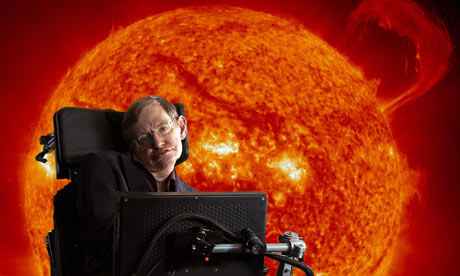
Stephen Hawking: 'There is no heaven; it's a fairy story'
In an exclusive interview with the Guardian, the cosmologist shares his thoughts on death, M-theory, human purpose and our chance existence
- Ian Sample, science correspondent
- guardian.co.uk,
- Article history

Stephen Hawking dismisses belief in God in an exclusive interview with the Guardian. Photograph: Solar & Heliospheric Observatory/Discovery Channel
A belief that heaven or an afterlife awaits us is a "fairy story" for people afraid of death, Stephen Hawking has said.
In a dismissal that underlines his firm rejection of religious comforts, Britain's most eminent scientist said there was nothing beyond the moment when the brain flickers for the final time./.../
The cost of bin Laden: $3 trillion over 15 years
Falta acrescentar nesta conta as perdas nos países atacados e no resto do mundo...
May 17, 2011
Source: The Atlantic — May 7, 2011
By conservative estimates, bin Laden cost the United States at least $3 trillion over the past 15 years, counting the disruptions he wrought on the domestic economy, the wars and heightened security triggered by the terrorist attacks he engineered, and the direct efforts to hunt him down.
Certainly, in the course of the fight against bin Laden, the United States escaped another truly catastrophic attack on our soil. Al-Qaida, though not destroyed, has been badly hobbled. But that willingness may have given bin Laden exactly what he wanted: bleeding America to the point of bankruptcy.
All of that has not given us, at least not yet, anything close to the social or economic advancements produced by America’s costliest past enemies.
Perhaps the biggest economic gain from our bin Laden spending, if there is one, is the accelerated development of unmanned aircraft. That’s our $3 trillion windfall, so far: Predator drones.
Topics: Social/Ethical/Legal | Survival/Defense
‘That gut feeling’: how stomach bacteria impact brain chemistry and behavior
From Kurzweil
May 18, 2011 by Editor
Experiments with mice have determined that behavior and brain chemistry varies depending on the type of bacteria in the gut, report Stephen Collins at McMaster University and Premysl Bercik at the Farncombe Family Digestive Health Research Institute.
Working with healthy adult mice, the researchers showed that disrupting the normal bacterial content of the gut with antibiotics produced changes in behavior; the mice became either anxious or less cautious. This change was accompanied by an increase in brain-derived neurotrophic factor (BDNF), which has been linked to depression and anxiety.
When oral antibiotics were discontinued, bacteria in the gut returned to normal, “accompanied by restoration of normal behavior and brain chemistry,” Collins said.
CDC to America: How to Prepare for a Zombie Apocalypse
By Meredith Melnick Thursday, May 19, 2011 |

COURTESY OF CDC
"There are all kinds of emergencies out there that we can prepare for. Take a zombie apocalypse for example. That's right, I said z-o-m-b-i-e a-p-o-c-a-l-y-p-s-e," wrote Dr. Ali S. Khan, a specialist in infectious disease, in the latest update on the Centers for Disease Control and Prevention's Public Health Matters blog.
The first step in preparing for a zombie attack — or for that matter a hurricane or pandemic — is to put together an emergency kit. "This includes things like water, food and other supplies to get you through the first couple of days before you can locate a zombie-free refugee camp," Khan wrote.
Thursday, May 19, 2011
Moacyr Scliar
The Lancet, Volume 377, Issue 9779, Page 1742, 21 May 2011
doi:10.1016/S0140-6736(11)60722-8
Cite or Link Using DOI
Moacyr Scliar
Original Text
Barbara Fraser Public health expert and award-winning writer. Born on March 23, 1937, in Porto Alegre, Brazil, he died from complications of a stroke on Feb 27, 2011, in Porto Alegre, aged 73 years.
Moacyr Scliar's death marked the loss not only of a Brazilian public health leader, but also of a prolific, prize-winning literary figure. Many obituaries referred to him as a novelist, making no mention of his medical work, but colleagues said his two passions were inseparable. “Literature and medicine were intertwined in his life and helped him achieve success in both fields. What made him so human was knowing how to listen, so he could then tell the story”, said cardiologist Aloyzio Achutti, who worked in the state health secretariat in Rio Grande do Sul in the 1970s, when Scliar was director of the public health department.
Scliar's dual vocation began when he was a medical student at the Federal University of Rio Grande do Sul. His first book, Stories of a Doctor in Training, was published in 1962, the year he graduated. He later said that early book was premature, and considered Carnival of the Animals, published in 1968, his first real literary work. In the years that followed, Scliar combined literary creation with a career in public health in Porto Alegre, first in the municipal health department, then in the state secretariat where he headed the health education team, was medical assistance coordinator, and became director of the public health department. “Scliar had a special skill in transforming technical and policy information into precise messages that everyone could understand”, said Jorge Ossanai, who worked with the team in its early years, before becoming head of the Inter-American Development Bank's health sector in Washington, DC. “His literary works reflect constant concern with social and economic problems and inequalities”, Ossanai said. “Literature allowed him to point out and criticise those inequalities, and his public health work gave him the opportunity to try to correct social differences and injustices.”
At a time when most developing countries were focusing on combating infectious diseases, Scliar and his colleagues began addressing problems that also afflicted developed countries. Part of Scliar's legacy was “getting chronic diseases onto the public health agenda”, Achutti said. Although some members of his team took jobs abroad or at the national Health Ministry, Scliar stayed in Porto Alegre, working in public health and teaching, except for graduate study in community medicine in Israel in 1970 and a stint as a visiting professor in the USA at Brown University in 1993. “Perhaps because his books became so widely known, he was content to stay close to home”, Achutti said. Although Ossanai left Brazil, his friendship with Scliar endured. “Throughout his professional life, Scliar remained the same simple, sincere person, and an affectionate, unconditional friend”, Ossanai said.
Writing fables that explored themes that went unmentioned during Brazil's military dictatorship, Scliar drew on Latin American literature's magical realism and the story-telling tradition of his own Jewish heritage. That heritage also surfaced in some of his non-fiction. His dissertation for his PhD in public health, obtained in 2002 from the National School of Public Health, was entitled, “From the Bible to Psychoanalysis: Health, Pain and Medicine in Jewish Culture.” Although best known for dozens of short stories and novels, including Max and the Cats and The Centaur in the Garden, Scliar published non-fiction books on medical topics, including the work of Brazilian tropical disease research pioneers Oswaldo Cruz and Carlos Chagas.
Scliar wrote regularly for the Brazilian publication Zero Hora. His first column, about a car accident in which he was seriously injured, offered the perspective of both doctor and patient, combining an eye for medical detail with sensitivity to feeling and language. Comments left on the Zero Hora website after Scliar's death paid tribute to those abilities, with young authors expressing gratitude for his encouragement. Achutti said he also benefited from Scliar's literary advice. “He told me something that has helped me throughout my life, and not only in writing for newspapers: try to express your idea in a short text, never more than a page, both to hold the reader's attention and because newspaper space has a cost.” Scliar, who was admitted to the Brazilian Academy of Letters in 2003, is survived by his wife of 50 years, Judith, and their son, Roberto.
Labels:
chronic diseases,
culture,
medicine,
public health
Wednesday, May 18, 2011
The $640 Billion Question — Why Does Cost-Effective Care Diffuse So Slowly?
NEJM | May 18, 2011
Victor R. Fuchs, Ph.D., and Arnold Milstein, M.D., M.P.H.

Health Care Expenditures and Life Expectancy in the United States and Ten Other Developed Countries, 2005.
To avoid financial crises in federal and state governments and turmoil for health care stakeholders, U.S. health care must become more cost-effective.1 The United States spends much more per capita on health care than do other developed countries, with broad outcomes no better than those of its peers (see graph). There are, however, individual U.S. physicians and health care organizations that deliver high-quality care at a cost roughly 20% lower than the average.2 If the rest of the U.S. health care industry followed their example, health care spending would drop from 17% of the gross domestic product to 13%. Though that would still be well above the spending level in other high-income countries, $640 billion would become available for addressing other important public- and private-sector needs. Why don’t cost-effective models diffuse rapidly in health care, as they do in other industries? The answers to this $640 billion question lie in the perceptions and behaviors of the major participants in health care./.../
Tuesday, May 17, 2011
AMICOR 14 ANOS
Caríssimos AMICOR,
Hoje completamos 14 anos de estimulante convivio no espaço cibernético.
Foram 2500 mensagens de alerta enviadas e, desde agosto de 2004 cerca de 2800 referências selecionadas e enviadas.
Tenho alguns planos de modernizar nosso contato, mas ainda em elaboração. De qualquer forma estamos interessados em receber sugestões, críticas e colaborações.
Agradeço mais uma vez pela companhia e apoio recebidos.
Um abraço
AA
Dear AMICOR,
Today we are completing 14 years of stimulating friendship in the cyberspace.
There were 2,500 alert messages, and since 2004 August around 2,800 sellected references,
We have some plans to modernize our contact and interested in suggestions, and collaboration.
Thanks once more for your partnership and support.
A hug to all of you
AA
Hoje completamos 14 anos de estimulante convivio no espaço cibernético.
Foram 2500 mensagens de alerta enviadas e, desde agosto de 2004 cerca de 2800 referências selecionadas e enviadas.
Tenho alguns planos de modernizar nosso contato, mas ainda em elaboração. De qualquer forma estamos interessados em receber sugestões, críticas e colaborações.
Agradeço mais uma vez pela companhia e apoio recebidos.
Um abraço
AA
Dear AMICOR,
Today we are completing 14 years of stimulating friendship in the cyberspace.
There were 2,500 alert messages, and since 2004 August around 2,800 sellected references,
We have some plans to modernize our contact and interested in suggestions, and collaboration.
Thanks once more for your partnership and support.
A hug to all of you
AA
Declaração de Porto Alegre, DCNT, 2011.
Caros AMICOR, vai hoje uma nova versão do esboço da Declaração de Porto Alegre que está esperando sugestões e críticas pela internet e para uma discussão final no dia 20, próxima sexta feira, a partir das 18 horas no anfiteatro do Hospital Moinhos de Vento
(esboço para ser discutido e receber as modificações necessárias)
Com vistas na Reunião de Alto Nível das Nações Unidas (ONU)* de setembro deste ano em Nova York, destinada a discutir a inclusão do controle de Doenças Crônicas Não Transmissíveis (DCNT)* nas Metas do Milênio da ONU*, o Hospital Moinhos de Vento (HMV)* e Federeção Brasileira de Instituições em Apoio à Saúde da Mama (FEMAMA)* e a Associação Médica do Rio Grande do Sul (AMRIGS)* atendendo à mobilização que se faz em todo o mundo, promoveu, em 20 de maio, um encontro de representantes de entidades interessadas e de governo, profissionais da saúde e membros da comunidade em geral, para discutir temas críticos sobre o controle de DCTN e tornar pública uma declaração através de um documento de consenso.
A Reunião da ONU deve ser encarada como uma oportunidade única para abordar com nova perspectiva uma questão de direito, não somente de saúde, mas também de desenvolvimento, contando com apoio de um grande número de grupos interessados ao redor do mundo. Serve como um passo adiante na conscientização do problema, na identificação de melhores soluções, e na implementação de políticas e de ações correspondentes. Esta é uma resposta local visando reconhecimento de determinantes de saúde ou de seu prejuízo, como prioridades locais, estaduais, nacionais e globais.
O caminho, o desenvolvimento histórico da medicina e da epidemiologia, e seus sucessos em busca da prevenção de doenças, pode ser de utilidade neste momento em que se vislumbra a possibilidade de um passo a mais no controle de doenças até há bem pouco somente contempladas como objeto de tratamento individual em sua fase avançada. De indivíduos portadores de doenças isoladas, passou-se a considerar seus fatores de risco separadamente; depois os fatores de risco agregados, e mais adiante conjuntos de doenças e seus fatores comuns ao se constatar que estavam todos de alguma forma interligados, e sócio-ecologicamente determinados, passando-se a considerar como um grupo o das Doenças Crônicas Não Transmissíveis. Simultaneamente se evoluiu da prevenção secundária, para a primária, primordial e promoção da saúde. Da mesma forma a medicina passou a valorizar a perspectiva populacional e a necessidade de atuação trans-setorial para conseguir um controle efetivo dos problemas desde sua origem, e não somente suas consequências. Aprendeu-se que não basta tratar um órgão doente, nem somente um indivíduo. A família é importante, suas relações, seu ambiente de trabalho, a cidade onde se vive, e o mundo todo, na perspectiva da saúde global.
A mobilização atual pode ter um subproduto valioso e que não pode ser utópico, no controle de problemas que somente serão resolvidos se houver ação participativa de todos os profissionais envolvidos, das instituições muitas ainda hoje agindo isoladamente, de políticos, empresários e de todos os cidadãos em busca de uma sociedade mais justa e com melhor qualidade de vida.
A Organização Mundial da Saúde (OMS)* e a Organização Pan-Americana da Saúde (OPS)* vêm insistentemente chamando atenção para o problema das DCNT que corresponde à soma das Doenças do Aparelho Circulatório, Câncer, Diabete, Doenças Respiratórias Crônicas e algumas outras doenças, entre as quais Doenças Mentais. A proporção destas doenças para todas as mortes em 2004 ficou estimada em 65,5% para homens e em 76,3% para mulheres; enquanto para o mundo todo, os mesmos parâmetros, ficam respectivamente em 57,9% e 61,4%.
No cenário nacional mais detalhes podem ser apreciados em estudo feito por pesquisadores nossos e publicados na Revista The Lancet* deste mês.
As causas, os fatores de risco e as barreiras sociais precisam ser superados. Já foi demonstrado que somente para o grupo das Doenças Cardiovasculares em Porto Alegre* há um gradiente de 3, até quase 4 vezes, na mortalidade precoce, quando se comparam bairros de nossa cidade, desigualdade esta que se expressa também da mesma forma na expectativa de vida da população.
Foi em nosso Estado que se iniciaram programas de Saúde Pública voltados para este grupo de problemas bem no início da década de 70, e em 1997 também ficou clara esta preocupação durante o Seminário de Epidemiologia e Prevenção de Doenças Cardiovasculares, do qual saiu a Declaração de Gramado*, mas até agora os objetivos almejados não foram atingidos em plenitude.
Assim como existem comitês para lidar com problemas mais difíceis como Controle da Infecção Hospitalar, com este encontro e discussão inicial de um consenso, espera-se que cada instituição ou grupo organizado da sociedade mantenha em sua agenda o tema das Doenças Crônicas Não Transmissíveis e seus Fatores de Risco, para que se possa progredir no seu controle, definindo pesquisas, prioridades, políticas, articulações, parcerias (locais, nacionais, regionais e globais).
Desde logo endossamos os importantes tópicos e recomendações levantados ao redor do mundo. Declaração de Buenos Aires* elaborada pela Coalizão Latino-Americana Saudável (CLAS)* e aqueles mais recentes, constantes da Reunião de Ministros de Saúde de todo o mundo realizada em Moscou*, e do discurso de nosso Ministro na Assembléia Mundial da Saúde.
Em outubro do corrente ano nosso Ministério da Saúde (MS)*, OPS e OMS realizarão no Rio de Janeiro uma outra Reunião Internacional sobre Determinantes Sociais de Saúde/Doença* dando continuidade ao esforço no controle das causas dos problemas que se encontram fora do alcance imediato do setor saúde. As desigualdades nos indicadores de saúde, e dentre eles, aqueles relativos às DCNT pelo peso que têm, devem refletir o desenvolvimento humano das populações e o desempenho político dos governos.
RECOMENDAÇÕES:
Documentos recentes, cuja bibliografia segue abaixo, são unânimes em chamar atenção para algumas recomendações que endossamos e reforçamos:
1. Valorização das DCNT como causa de mortalidade precoce, com responsabilidade na progressão do custo assistencial e na obstaculização do desenvolvimento humano, com carga maior quanto menos desenvolvida a população;
2. Necessidade urgente de priorizar este grupo de doenças, com suporte epidemológico, para poder abordá-las com políticas e ações de promoção da saúde, prevenção, vigilância e controle em todos os setores e em todos os níveis de governo;
3. Valorização dos determinantes psico-sócio-econômicos na origem e na manutenção das DCNT e seus fatores de risco;
4. Abordagem com integração inter-setorial e participação da sociedade civil;
5. Promoção de ampla informação e discussão para o público em geral e para a academia e instituições responsáveis pela formação profissional;
6. Aspectos específicos a serem considerados prioritariamente: controle do tabagismo, segurança alimentar (obesidade e poluição), controle do abuso de álcool, promoção da atividade física;
7. Garantia de serviços de saúde acessíveis e eficientes, inclusive para emergências e urgências conseqüentes a doenças crônicas;
8. Neutralização de forças contrárias: interessadas em hábitos de vida não saudáveis, despreocupadas com a poluição ambiental, ou que possam desvirtuar esforços voltados para as mudanças necessárias;
9. Promoção de valores voltados para o desenvolvimento de um novo paradigma favorável ao desenvolvimento sustentado, equalitário e compatível com saúde física e mental.
.......................................................................
* REFERÊNCIAS ACESSÍVEIS PELA INTERNET:
· Premature Mortality due to Cardiovascular Disease and Social Inequalities in Porto Alegre: From Evidence to Action. ABC. Sérgio Luiz Bassanesi, Maria Inês Azambuja, Aloyzio Achutti http://www.arquivosonline.com.br/english/2008/9006/PDF/i9006004.pdf
· Moscow Declaration: http://www.who.int/nmh/events/moscow_ncds_2011/conference_documents/moscow_declaration_en.pdf
· Chronic non-communicable diseases in Brazil: burden and current challenges.The Lancet. Maria Inês Schmidt, Bruce Bartholow Duncan, Gulnar Azevedo e Silva, Ana Maria Menezes, Carlos Augusto Monteiro, Sandhi Maria Barreto, Dora Chor, Paulo Rossi Menezes. http://www.thelancet.com/journals/lancet/article/PIIS0140-6736(11)60135-9/fulltext
· Priority actions for NCD crisis. The Lancet. http://www.thelancet.com/journals/lancet/article/PIIS0140-6736(11)60393-0/fulltext?_eventId=login
-IMAMA
-Hospital Moinhos de Vento
-Associação Médica do Rio Grande do Sul
-FUNCOR-SBC
-Academia Sul-Rio-Grandense de Medicina
-
-
-
- 269 membros que aderiram à Causa do Comitê de DCNT- Brasil, através do Facebook.
Subscribe to:
Posts (Atom)