Translate AMICOR contents if you like

Saturday, July 17, 2010

Hospital São Francisco: 80 anos

Ontem, dia 16 de julho, Dr. Fernando Lucchese (AMICOR), diretor do Hospital São Francisco e de seu Serviço de Cardiologia, promoveu um jantar comemorativo dos 80 anos da instituição e homenageou vários presentes com um Troféu São Francisco.
No muito agradável encontro, estive com Dra. Valderês, ao lado de Dra. Amanda (AMICOR) e Dr. Eduardo Souza que também foi agraciado.
Falando em histórias e memórias, Lucchese sugeriu que promovessemos no AMICOR contribuições nesta linha. Desde já estão todos convidados e eu pretendo iniciar já na próxima semana.


CORAÇÕES


Dentro da programação do Simpósio Internacional de Atualização e Controvérsias em Cardiologia, o Hospital São Francisco, da Santa Casa de Porto Alegre, homenageia 20 personalidades da cardiologia brasileira e mundial. A cerimônia será realizada hoje em jantar no Plaza. Entre os contemplados com o Troféu São Francisco, estão os médicos Adib Jatene, Enio Buffolo, Aloizio Achutti, Ivo Nesralla, Domingo Braile, Leopoldo Piegas, Luis Carlos Bento de Souza e Protásio Lemos da Luz. A coordenação do Simpósio é dos cardiologistas Fernando Lucchese, Gilberto Nunes e Paulo Leães, com apoio dos médicos Enio Buffolo, Noedir Stolf e Protásio Lemos da Luz na organização nacional do evento.

Reunião com a ABES

Maria Inês Reinert Azambuja dá notícia da Reunião-almoço promovido pela ABES


Ontem participamos, o Dr. Achutti, o Bassanesi e eu, da reunião-almoço da Associação Brasileira de Engenharia Sanitária. Acho que foi um momento muito importante de intercâmbio. Este grupo é muito interessante, e é hoje possivelmente um dos grandes parceiros para uma necessária retomada de uma perspectiva de saúde pública focada em determinantes do adoecimento, e não na prevenção secundária via assistencial. Temos que aprofundar esta parceria. Estavam lá, além dos nossos anfitriões da ABES, os colegas da vigilância em saúde da SES (Francisco Paz, Alethea Fagundes, Marilina Bercini, Airton Fishman) e do município (LIsiane (no momento trabalhando com HIV) e colega da área da Dengue). Estava o Campani, também. Conhecemos, do DMAE, a  Maria de Lourdes Wolf , que é editora da revista Quadrimestral de Saneamento Ambiental, que já tem 15 anos, e tem uma edição de notícias e um encarte técnico - formato bem interessante... Estava também o vereador Beto Moesh e muitos outras pessoas que espero, com o tempo, conhecer melhor e saber os nomes... Creio que poderíamos avaliar se não seria o caso de nos associarmos 'a ABES.

Thursday, July 15, 2010

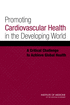
Promoting Cardiovascular Health in the Developing World: A Critical Challenge to Achieve Global Health

Promoting Cardiovascular Health in the Developing World:

A Critical Challenge to Achieve Global Health

Book Cover
Status: Available Now
Size: 484 pages, 6 x 9
Publication Year:2010

PrintList PriceYour Price 
Order online and save 10%
PAPERBACK
ISBN-10: 0-309-14774-3
ISBN-13: 978-0-309-14774-3
$93.00$83.70Add to Cart
PDF Your Price 
PDF Download [5.3 MB] FreeDownload
PDF Chapters FreeSelect
Authors:
Valentin Fuster and Bridget B. Kelly, Editors; Committee on Preventing the Global Epidemic of Cardiovascular Disease: Meeting the Challenges in Developing Countries; Institute of Medicine
Authoring Organizations
Description:
Cardiovascular disease (CVD), once thought to be confined primarily to industrialized nations, has emerged as a major health threat in developing countries. Cardiovascular disease now accounts for nearly 30 percent of deaths in low and middle income countries each year, ...
Read More


Se eu não fosse imperador...

15 de julho de 2010 | N° 16397

ARTIGOS

Se eu não fosse imperador..., por Aloyzio Achutti*


“Se não fosse imperador do Brasil, quisera ser mestre-escola. Não conheço missão maior e mais nobre que a de dirigir as inteligências jovens e preparar os homens do futuro.” (Pedro II)

É pena que ele tivesse sido imperador, quem sabe não nos faltariam hoje professores, e nós, homens do futuro (dele), estaríamos mais bem preparados...

De qualquer forma, não temos mais imperadores. Eles foram parar nas escolas de samba e no futebol. Entretanto, a julgar pela política nacional, expressa no salário dos professores, nas escolas e seus equipamentos, nossos dirigentes de hoje – parafraseando – provavelmente diriam: “Se eu não fosse presidente da República, quisera ser jogador de futebol”.

Muitos jogadores ganham salários astronômicos, fora de parâmetros do mercado de trabalho, desproporcionado com seu preparo profissional, impossível de encontrar termo de comparação com o salário de professores e de profissionais da saúde. É a maior evidência de que nós, homens do futuro do imperador, não fomos preparados para formar uma cultura adequada, pois enquanto freneticamente aplaudimos uns, não valorizamos e agredimos outros.

É compreensível que o povo necessite de circo assim como necessita de pão. Jogos, como alternativas para extravasar a violência reprimida, também são necessários, e não podem ser menosprezados. Entretanto, seria bom que tivéssemos também alternativas participativas, nas quais o esporte fosse compartilhado, e não ficássemos sentados como espectadores aplaudindo ou vaiando, nem alienados desviando nossa atenção de assuntos muito mais importantes.

Sabe-se também que há muito interesse secundário em jogo, da indústria, do comércio e da política populista, mas não podemos ficar insensíveis para a deformação provocada na lapidação de ídolos populares, expondo-os a condições de vida e de permissividades para as quais eles absolutamente não foram preparados.

Dá também para entender que grande parte da população, e até de políticos que ascendem ao poder, assim como ascendem jogadores famosos, não tenha condições de valorizar a educação, o ensino e a saúde, porque não teve aquela orientação e o preparo de que falava nosso imperador.

Vale a pena examinar (embora não tenhamos uma supervisão de projetos como tem a Fifa), nas plataformas políticas – entre as quais teremos que escolher –, quais as metas educacionais a estarem prontas até a Copa de 2014.

Assim como saúde, educação é um investimento a ser feito em longo prazo e continuamente. O imperador tinha razão: não há missão mais nobre que a de dirigir inteligências jovens.
*MÉDICO

Wednesday, July 14, 2010

Dreaming of a fairer world

Published 8 July 2010, doi:10.1136/bmj.c3658
Cite this as: BMJ 2010;341:c3658

Editor's Choice

Dreaming of a fairer world

Fiona Godlee, editor, BMJ
I wrote about the paper by David Stuckler and colleagues when it went online two weeks ago (BMJ 2010;340:c3311, doi:10.1136/bmj.c3311). Now it’s in print, and it couldn’t be more relevant to the debate in the UK and elsewhere about how much to cut from social welfare budgets and what the cuts will do to health. Much damage, is the answer from these authors. They conclude that spending on social welfare may be more important for health than spending on health care. Over the past 30 years when social spending in Europe was high mortality fell, but when it was low, mortality rose substantially.
They quote Michael Marmot: "Austerity need not lead to retrenchment in the welfare state. Indeed the opposite may be necessary." The opposite—by which I assume he means investment in welfare—seems unlikely in the UK at the moment, but other governments may be in a position to show greater wisdom for the long term.
Michael Marmot gets his own slot in this week’s journal, in an edited version of the speech he gave last week at his inauguration as president of the BMA. You can read the full speech on bmj.com (BMJ 2010;341:c3617, doi:10.1136/bmj.c3617). Highlighting the 44 year difference in life expectancy between women in Zimbabwe and Japan, he puts before us again the uncomfortable fact that this is not due to biology but to social injustice. Rather than focusing solely on known causes of health inequality such as smoking and obesity, we must also deal with "the causes of the causes," by which he means our unfair economic and social arrangements. Paraphrasing former WHO director general Halfden Mahler, Marmot says, "If we really want to fight the alligators of health inequalities, we have to drain the swamp."
Is there a role for doctors here? Marmot says there is, but I wonder how easy it is for each of us to see where and how to make our contribution. Within the UK, GPs are being asked by the National Audit Office to target the neediest groups with health inequalities initiatives—prescribing for high blood pressure and cholesterol, and smoking cessation services (doi:10.1136/bmj.c3558). Meanwhile at a meeting in London last week, delegates discussed how to get the millennium development goals (MDGs) back on track, particularly the goals to reduce child mortality by two thirds and maternal mortality by three quarters by 2015 (doi:10.1136/bmj.c3521). They heard the depressing news that little has changed since these goals were set 10 years ago. Worldwide 29 000 children under five die each day, mostly from preventable diseases, and only one in four women in sub-Saharan Africa has access to contraception. But they also heard that there are three "straightforward actions" that are cost effective and could make a big difference: promoting free access to health care for the poor, strengthening the healthcare workforce in developing countries, and involving affected communities in decision making.
Tackling local and global health inequalities is perhaps the great challenge of our generation. Marmot invites us to dream of a fairer world but also calls on us to take the necessary practical steps to achieve it.
Cite this as: BMJ 2010;341:c3658

Social determinants of diabetes and challenges of prevention

The Lancet, Volume 375, Issue 9733, Pages 2204 - 2205, 26 June 2010

doi:10.1016/S0140-6736(10)60840-9
Social determinants of diabetes and challenges of prevention
Type 2 diabetes, which accounts for roughly 90% of all cases of diabetes, is still widely perceived as a disease of affluence that is strongly associated with obesity and physical inactivity.1 This perception is mirrored in policy for international development, with the UN's Millennium Development Goals (MDGs) making no mention of diabetes or related chronic diseases. Notably, diabetes was one of a small number of priority public-health conditions that were assessed in a recent publication developed to inform the work of the WHO Commission on Social Determinants of Health. The chapter about diabetes illustrates why this disorder and related chronic diseases are key targets for reduction of health inequity worldwide, and specifically in countries with low and middle incomes.2/.../

A New Look at Global Poverty

http://www.ophi.org.uk/research/multidimensional-poverty/

Alanna Shaikh - July 13, 2010 - 1:28 pm
The Oxford Poverty and Human Development Institute has released a new measure of global poverty. It’s called the multidimensional poverty index. The new metric seeks to measure household level deprivations such as education, health, and assets and services.
The index is the product of a long series of consultations among economic experts. It aims to look deeper than just income levels, and serve as a “high resolution lens which reveals a vivid spectrum of challenges facing the poorest households.”
To quote the OPHD website:
It’s an impressive effort. Clearly poverty is about more than income. And the first conclusion of the new poverty index is fascinating - eight Indian states contain more poor people than the 26 poorest African countries combined. That certainly shakes up my view of global poverty.

Tobacco, Alcohol and Big Food: the Sickly Trifecta?

Tobacco, Alcohol and Big Food: the Sickly Trifecta?

What do the tobacco and alcohol industries have in common, apart from both contributing to a huge slab of the burden of disease?
They have used similar tactics to defend their markets and to fight off public health measures, according to a new analysis from researchers at Curtin University in Perth.
The paper, Selling addictions: Similarities in approaches between Big Tobacco and Big Booze, is published in the Australasian Medical Journal and based upon a search of tobacco industry documents published online as part of the Master Settlement Agreement in the US.
The study identified 29 documents relevant to alcohol. The authors conclude: “The documents show that alcohol and tobacco companies have worked closely together, have shared information, share similar concerns and have used similar arguments to defend their products and prevent or delay restrictions being placed on their products.
“It is clear from the documents identified that both industries use similar strategies to market their products through product placement, target marketing to youth and specific ethnic groups. They develop and provide potentially counter-productive public education campaigns so as to appear socially responsible and in an effort to deflect tighter controls on products. The alcohol and tobacco industries have demonstrated through the documents that they are opposed to regulations which threaten their sales and have used similar methods of lobbying and use of front groups to delay progress./.../

Monday, July 12, 2010

Cardiopulmonary Exercise Testing in Adults

(Circulation. 2010;122:191-225.)
© 2010 American Heart Association, Inc. 


AHA Scientific Statement


Clinician’s Guide to Cardiopulmonary Exercise Testing in Adults

A Scientific Statement From the American Heart Association

Gary J. Balady, MD, FAHA, ChairRoss Arena, PhD, FAHAKathy Sietsema, MDJonathan Myers, PhD, FAHA;Lola Coke, RN, PhDGerald F. Fletcher, MD, FAHADaniel Forman, MDBarry Franklin, PhD, FAHA;Marco Guazzi, MD, PhDMartha Gulati, MDSteven J. Keteyian, PhDCarl J. Lavie, MDRichard Macko, MD;Donna Mancini, MDRichard V. Milani, MD, FAHA, on behalf of the American Heart Association Exercise, Cardiac Rehabilitation, and Prevention Committee of the Council on Clinical Cardiology; Council on Epidemiology and Prevention;Council on Peripheral Vascular DiseaseInterdisciplinary Council on Quality of Care and Outcomes Research
Key Words: AHA Scientific Statements • diagnosis • exercise • heart failure • prognosis • exercise test • blood gas analysis

*   Introduction

Exercise testing remains a remarkably durable and versatile tool that provides valuable diagnostic and prognostic informationregarding patients with cardiovascular and pulmonary disease. Exercise testing has been available for more than a half centuryand, like many other cardiovascular procedures, has evolved in its technology and scope. When combined with exercise testing,adjunctive imaging modalities offer greater diagnostic accuracy, additional information regarding cardiac structure and function,and additional prognostic information. Similarly, the addition of ventilatory gas exchange measurements during exercise testingprovides a wide array of unique and clinically useful incremental information that heretofore has been poorly understood and underutilized by the practicing clinician. The reasons for this are many and include the requirement for additional equipment (cardiopulmonary exercise testing [CPX] systems), personnel who are proficient in the administration and interpretation of these tests, limited or absence of training of cardiovascular specialists and limited training by pulmonary specialists in this technique, and the lack of understanding of the value of CPX by practicing clinicians./.../

Why the Poor Get Fat: Weight Gain and Economic Insecurity


Why the Poor Get Fat: Weight Gain and Economic Insecurity

Trenton G. SmithWashington State University
Christiana StoddardMontana State University
Michael G. BarnesHartford Life

Abstract

Something about being poor makes people fat. Though there are many possible explanations for the income-body weight gradient, we investigate a promising but little-studied hypothesis: that changes in body weight can—at least in part—be explained as an optimal response to economic insecurity. We use data on working-age men from the 1979 National Longitudinal Survey of Youth (NLSY79) to identify the effects of various measures of economic insecurity on weight gain. We find in particular that over the 12-year period between 1988 and 2000, the average man gained about 21 pounds. A one percentage point (0.01) increase in the probability of becoming unemployed causes weight gain over this period to increase by about 0.6 pounds, and each realized 50% drop in annual income results in an increase of about 5 pounds. The mechanism also appears to work in reverse, with health insurance and intrafamily transfers protecting against weight gain.

Recommended Citation

Trenton G. Smith, Christiana Stoddard, and Michael G. Barnes (2009) "Why the Poor Get Fat: Weight Gain and Economic Insecurity," Forum for Health Economics & Policy: Vol. 12: Iss. 2 (Obesity), Article 5.
http://www.bepress.com/fhep/12/2/5

The Case for Universal Cholesterol Screening in Kids Read more: http://www.time.com/time/health/article/0,8599,2003096,00.html?xid=newsletter-daily#ixzz0tTIz7Duw

By ALICE PARK Monday, Jul. 12, 2010
A cholesterol home test
Steve Horrell / SPL / Getty Images
A new study finds that current guidelines for cholesterol screening in children may miss nearly 10% of those who have high levels of LDL, or bad cholesterol.
The question of how soon children should be screened for high cholesterol is becoming increasingly important in the U.S., with the rate of child obesity topping 20%. Along with obesity, high levels of blood fats can lead to heart disease and other health problems including diabetes./.../


Read more: http://www.time.com/time/health/article/0,8599,2003096,00.html?xid=newsletter-daily#ixzz0tTIWezda

Friday, July 09, 2010

Saúde: meio interno e meio ambiente. Desigualdades no desenvolvimento urbano.

http://www.abes-rs.org.br/

Why Breakups Hurt

The Cruelest Study: Why Breakups Hurt

Stephen de las Heras / Getty Images

  • Say you're a college student who was recently dumped by the person you thought was the One. You're moping around campus in your I've-given-up sweatpants and eating crappy comfort food when you come across a flyer seeking people who are still pining for their exes. You think, at last, someone to talk to!
Well, not exactly. When about 15 sad sacks responded to the flyers, which had been distributed around the State University of New York at Stony Brook and Rutgers University, they discovered they were actually being invited to take part in a psychological study: researchers wanted to gauge the kind of pain felt by people on the business end of a breakup./.../

Read more: http://www.time.com/time/health/article/0,8599,2002688,00.html?xid=newsletter-daily#ixzz0tBvJEwmy

Thursday, July 08, 2010

Oficina ACT de Custos do Tabagismo no Brasil

Oficina ACT de Custos do Tabagismo no Brasil

by ACTbr
14 photos
Oficina para discussão de metodologias de mensuração dos custos do tabagismo no Brasil
Location: Rio de Janeiro
Created July 2

Wednesday, July 07, 2010

Don't Forget Tobacco


Published at www.nejm.org July 7, 2010 (10.1056/NEJMp1003883)

Don't Forget Tobacco
Steven A. Schroeder, M.D., and Kenneth E. Warner, Ph.D.
Figure 1

Smoking Prevalence among U.S. Adults, 1955–2008.
Data are from the Centers for Disease Control and Prevention.


At a time when all eyes are focused on health care reform, escalating medical costs, and childhood obesity, cigarette smoking remains by far the most common cause of preventable death and disability in the United States. Because important strides have been made in tobacco control, in terms of both interventions (tax hikes and laws creating smoke-free workplaces) and outcomes (smoking prevalence that has more than halved since the early 1960s [see graph]), it is tempting to believe that the battle is largelywon and that we should move on to other pressing public health issues. But the prevalence of smoking in the United States hoversat 20%, more than 8 million people are sick or disabled as a result of tobacco use, and smoking kills 450,000 Americans annually. If no additional progress is made in reducing smoking-initiation rates and increasing cessation rates, the prevalence of smoking in the United States will decline only to 16.7% by 2020 and will stabilize at 13.5% shortly after midcentury,1 and millionsof people will die prematurely. We need to understand the epidemiology of smoking, look at the current state of tobacco control, and determine what more can be done; then we need to do it./.../

“Fumar é feio: como a indústria do tabaco engana as mulheres”

É necessário impor restrições aos esforços da indústria do tabaco em fazer com que as mulheres fumem

Numa cerimônia especial denominada “Fumar é feio: como a indústria do tabaco engana as mulheres”, a Dra. Roses insistiu na adoção das medidas que constam na Convenção-Quadro da OMS para o Controle do Tabaco e indicou que oito países da Região das Américas estão livres de fumaça de tabaco: Canadá, Colômbia, Guatemala, Panamá, Paraguai, Peru, Trinidad e Tobago e Uruguai.


Foto: Nancy G. Brinker, fundadora da Fundação Susan G. Komen para a Cura e Dra. Mirta Roses, Diretora da OPAS
Leia mais...
 

Tuesday, July 06, 2010

all-sky image

Planck all-sky image depicts galactic mist over the cosmic background

05 Jul 2010
An all-sky image from Planck's recently completed first survey highlights the two major emission sources in the microwave sky: the cosmic background and the Milky Way. The relic radiation coming from the very early Universe is, to a large extent, masked by intervening astronomical sources, in particular by our own Galaxy's diffuse emission. Thanks to Planck's nine frequency channels, and to sophisticated image analysis techniques, it is possible to separate these two contributions into distinct scientific products that are of immense value for cosmologists and astrophysicists, alike.
This multi-colour all-sky image of the microwave sky has been synthesized using data spanning the full frequency range of Planck, which covers the electromagnetic spectrum from 30 to 857 GHz. The sequence of images shows the all-sky map with, superimposed, the locations of previous Planck image releases, a selection of extragalactic sources, and a map of molecular clouds. Individual images and detailed captions can be accessed by following the image links on the right-hand menu. Credit: ESA, HFI and LFI consortia./.../

Monday, July 05, 2010

Galaxies on a String

See Explanation.  Clicking on the picture will download
 the highest resolution version available.


Helping us to set our actual dimension...
Galaxies on a String Image Credit & CopyrightAdam BlockMt. Lemmon SkyCenterU. Arizona
Explanation: Galaxies NGC 5216 (top) and NGC 5218 really do look like they are connected by a string. Of course, that string is a cosmic trail of gas, dust, and stars about 22,000 light-years long. Also known as Keenan's system (for its discoverer) and Arp 104, the interacting galaxy pair is some 17 million light-years away in the constellation Ursa Major. The debris trail that joins them, along with NGC 5218's comma-shaped extension and the distorted arms of NGC 5216, are a consequence of mutual gravitational tides. The tides disrupt the galaxies as they repeatedly swing close to one another. Drawn out over billions of years, the encounters will likely result in their merger into a single galaxy of stars. Such spectacular galactic mergers are now understood to be a normal part of the evolution of galaxies, including our own Milky Way.

Saturday, July 03, 2010

Sons sem fronteiras

Nosso Genro Músico Sérgio Olivé


Duo erudito formado por Marjana Rutkowski e Sergio Olivé lança CD no StudioClio

Piano e violoncelo formam uma combinação normalmente associada a recitais eruditos. Mas tal rótulo não cabe no concerto que Sergio Olivé e Marjana Rutkowski apresentam esta noite no StudioClio para lançar o CD de estreia do duo, Y También nos Iremos Riendo en el Camino, às 20h30min.

Trata-se de um encontro musical fadado a romper fronteiras. Reunidos há um ano, o pianista argentino – radicado em Porto Alegre desde 1988 – e a violoncelista gaúcha – que morou nos Estados Unidos por duas décadas – trouxeram um pouco de cada uma dessas culturas para seu disco. O repertório deles percorre a canção brasileira (Viola Enluarada, Caicó), o tango (Libertango), o folclore argentino (La Añera) e a tradição irlandesa (Danny Boy, Fhir A’ Bhàta). Há também as composições do próprio Olivé (Renacer de las Cenizas, La Construcción del Mundo en el Café), influenciadas por praticamente todos os elementos citados acima./.../