Health News Article | Reuters.com
WHO sees 'global epidemic' of chronic disease
Tue Oct 4, 2005 8:10 PM ET
By Stephanie Nebehay
GENEVA (Reuters) - Developing countries can tackle a "global epidemic" of chronic disease by adopting cheap measures that have helped cut heart disease deaths in some rich nations by up to 70 percent, the World Health Organization (WHO) said.
In a report published on Wednesday, the WHO said nearly half of all deaths from heart disease, cancer, respiratory infections, strokes and diabetes -- to which about 35 million people will succumb this year -- were preventable.
The report, "Preventing Chronic Diseases -- a Vital Investment", said developing countries, where most such deaths occur, must copy Western nations by discouraging tobacco use and curbing salt, sugar and saturated fats in food.
"Today we have a major epidemic and we know that if nothing is done, it will evolve rapidly and even more dramatically," Catherine Le Gales-Camus, WHO assistant director-general of non-communicable disease, told a news briefing.
The WHO, a United Nations agency, said its goal was to prevent the deaths of 36 million people by 2015, by reducing death rates from chronic disease by 2 percent each year.
"It is achievable. We want to stop people dying at an early age, prematurely and painfully, from a preventable condition," said Robert Beaglehole, WHO's director of chronic diseases and health promotion.
Eighty percent of all heart disease, stroke and type 2 diabetes cases, and over 40 percent of cancer cases, could be prevented, the report said.
Chronic disease also has a huge economic impact. The WHO estimates that such illnesses will cost China $558 billion over the next decade, the Russian Federation $303 billion and India $237 billion.
Low and middle income countries, where the epidemic is worst, need to look to the example of industrialized nations. Some 80 percent of deaths from chronic diseases occur in developing countries, and half are women.
"There is a very pervasive misunderstanding that chronic diseases affect only wealthy men in wealthy countries," Beaglehole said.
Alerting the public to the dangers of high cholesterol levels or blood pressure have paid off in Western countries, the report said. Heart disease death rates have fallen by up to 70 percent in the last three decades in Australia, Britain, Canada and the United States.
Poland lowered death rates among young adults by 10 percent per year in the 1990s at low cost, mainly by ensuring fruits and vegetables were available and by removing subsidies on butter which made it competitive with healthier vegetable oils, according to Beaglehole.
Over one billion people worldwide are overweight or obese -- putting them at risk of deadly heart disease --- and the figure could rise to 1.5 billion in a decade, the report warned.
About 22 million children under age five are overweight.
Child obesity was "a number one public health problem," and talks are scheduled next week with the food and beverage industry to discuss a "plan of action", Le Gales-Camus said.
"Reports of type 2 diabetes in children and adolescents -- previously unheard of -- have begun to mount worldwide," the WHO report said, referring to a form of the disease previously known as adult-onset diabetes.
Wang Longde, China's vice-minister of health, said in an introduction to the report: "We have an obesity epidemic, with more than 20 percent of our 7-17 year old children in urban centers tipping the scales as either overweight or obese".
Wednesday, October 05, 2005


Tuesday, October 04, 2005
WHO Department of Chronic Diseases and Health Promotion (CHP)
WHO | Department of Chronic Diseases and Health Promotion (CHP)
The rapid rise of chronic, noncommunicable diseases represents one of the major health challenges to global development. The principle chronic diseases are: stroke, cancer, diabetes and chronic respiratory diseases. Chronic diseases currently account for some 60% of global deaths and almost one third of the global burden of disease. The Department of Chronic Diseases and Health Promotion (CHP) leads the global efforts to prevent and control chronic diseases and promote health./.../
The rapid rise of chronic, noncommunicable diseases represents one of the major health challenges to global development. The principle chronic diseases are: stroke, cancer, diabetes and chronic respiratory diseases. Chronic diseases currently account for some 60% of global deaths and almost one third of the global burden of disease. The Department of Chronic Diseases and Health Promotion (CHP) leads the global efforts to prevent and control chronic diseases and promote health./.../
Increased GGT Linked to Cardiovascular Mortality
Increased GGT Linked to Cardiovascular Mortality: "NEW YORK (Reuters Health) Sept 30 - An elevated level of gamma-glutamyltransferase (GGT) is an independent risk factor for death from cardiovascular disease, according to a report in the October 4th issue of Circulation: Journal of the American Heart Association.
'People with high GGT had more than a 1.5-fold risk of dying from cardiovascular diseases in comparison to people with normal low levels of GGT,' senior author Dr. Hanno Ulmer, from Innsbruck Medical University in Austria, said in a statement. 'For people under 60 years of age, this risk is even higher, amounting to more than twofold.'
Recent reports have linked GGT levels with cardiovascular disease (CVD), but most studies have had inadequate sample sizes to investigate any association with CVD mortality.
The new findings are based on a study of 163,944 Austrian adults who had GGT levels measured and were followed for up to 17 years.
In both men and women, a high GGT level was independently associated with CVD mortality and a clear dose-response relationship was observed.
In men, a high GGT was linked to death from chronic coronary heart disease, heart failure, and ischemic or hemorrhagic stroke. By contrast, the association with fatal acute MI did not reach statistical significance.
In women, a high GGT was significantly associated with death from all cardiovascular diseases, except for hemorrhagic and ischemic strokes.
In a related editorial, Dr. Michele Emdin, from the National Research Council in Pisa, Italy, and colleagues comment that 'elevation in serum GGT activity predicts outcomes in unselected populations and in patients with ascertained ischemic heart disease, independently of myocardial damage, thus adding to prognostic information provided by traditional risk factors.'
Circulation 2005."
'People with high GGT had more than a 1.5-fold risk of dying from cardiovascular diseases in comparison to people with normal low levels of GGT,' senior author Dr. Hanno Ulmer, from Innsbruck Medical University in Austria, said in a statement. 'For people under 60 years of age, this risk is even higher, amounting to more than twofold.'
Recent reports have linked GGT levels with cardiovascular disease (CVD), but most studies have had inadequate sample sizes to investigate any association with CVD mortality.
The new findings are based on a study of 163,944 Austrian adults who had GGT levels measured and were followed for up to 17 years.
In both men and women, a high GGT level was independently associated with CVD mortality and a clear dose-response relationship was observed.
In men, a high GGT was linked to death from chronic coronary heart disease, heart failure, and ischemic or hemorrhagic stroke. By contrast, the association with fatal acute MI did not reach statistical significance.
In women, a high GGT was significantly associated with death from all cardiovascular diseases, except for hemorrhagic and ischemic strokes.
In a related editorial, Dr. Michele Emdin, from the National Research Council in Pisa, Italy, and colleagues comment that 'elevation in serum GGT activity predicts outcomes in unselected populations and in patients with ascertained ischemic heart disease, independently of myocardial damage, thus adding to prognostic information provided by traditional risk factors.'
Circulation 2005."
Prêmio Zerbini de Cardiologia 2005
Ref: Novas formas de inscrição de trabalhos para o Prêmio Zerbini de Cardiologia – Edição 2005.
Prezado pesquisador,
Informamos a V. Sa. que as inscrições de trabalhos concorrentes ao “Prêmio Zerbini de Cardiologia – Edição 2005”, poderão ser efetuadas das seguintes formas:
1- Através do website da Fundação Zerbini. (www.zerbini.org.br)
2- Mediante o envio do trabalho para seguinte endereço eletrônico: zerbini2005@zerbini.org.br
3- Mediante o envio do trabalho em CD-Rom/ Disquete via correio para o seguinte endereço: Fundação Zerbini - Av. Brigadeiro Faria Lima – n. 1884 – 2. andarBairro: Jd. Paulistano / São Paulo – SPCEP 01451-000
Assim sendo, consideramos que estas novas oportunidades de envio de trabalhos irão facilitar a inscrição de trabalhos por parte de V. Sa.
Ressaltamos que a data limite para as inscrições é o dia 28 de outubro.
Estamos desde o momento à sua disposição para eventuais dúvidas e informações adicionais.
Agradecemos antecipadamente,
Kleber Di Pardi (55) (11) 3038 5301 kleber@zerbini.org.br
Ricardo Duailibi(55) (11) 3038 5367duailibi@zerbini.org.br
Prezado pesquisador,
Informamos a V. Sa. que as inscrições de trabalhos concorrentes ao “Prêmio Zerbini de Cardiologia – Edição 2005”, poderão ser efetuadas das seguintes formas:
1- Através do website da Fundação Zerbini. (www.zerbini.org.br)
2- Mediante o envio do trabalho para seguinte endereço eletrônico: zerbini2005@zerbini.org.br
3- Mediante o envio do trabalho em CD-Rom/ Disquete via correio para o seguinte endereço: Fundação Zerbini - Av. Brigadeiro Faria Lima – n. 1884 – 2. andarBairro: Jd. Paulistano / São Paulo – SPCEP 01451-000
Assim sendo, consideramos que estas novas oportunidades de envio de trabalhos irão facilitar a inscrição de trabalhos por parte de V. Sa.
Ressaltamos que a data limite para as inscrições é o dia 28 de outubro.
Estamos desde o momento à sua disposição para eventuais dúvidas e informações adicionais.
Agradecemos antecipadamente,
Kleber Di Pardi (55) (11) 3038 5301 kleber@zerbini.org.br
Ricardo Duailibi(55) (11) 3038 5367duailibi@zerbini.org.br
Sunday, October 02, 2005
Acidente Vascular Cerebral
-----Mensagem original-----De: Isaac Roitman [mailto:iroitman@imagelink.com.br] Enviada em: domingo, 2 de outubro de 2005 17:54Para: Aloyzio AchuttiAssunto: Fw: Derrame - Importante - repassando
----- Original Message -----
From: Henrique Galinkin
To: Undisclosed-Recipient:;
Sent: Friday, September 30, 2005 6:37 PM
Subject: Fw: Derrame - Importante - repassando
Subject: Derrame - Importante
Um cardiologista afirma: "Se cada um que receber este e-mail mandá-lo para mais dez pessoas, você pode apostar que, no mínimo, uma vida será salva".
Sintomas de um derrame:
Às vezes, os sintomas de um derrame são difíceis de identificar. Infelizmente, a falta de reconhecimento provoca um estrago. A vítima de um derrame pode sofrer danos cerebrais quando as pessoas em redor não reconhece os sintomas do derrame. Agora, os médicos contam que alguém que convive com a pessoa em questão pode reconhecer o derrame mediante três testes simples.
1. Pedindo à ela para rir
2. Pedindo à ela para levantar os dois braços;
3. Pedindo à ela para falar uma frase simples; se ela tem dificuldade com um destes testes, chame imediatamente o pronto socorro e conte sobre os sintomas a quem atender ao telefone.
Depois de fazer com que um grupo de voluntários não-médicos fosse capaz de identificar um problema facial, um problema nos braços ou dificuldade em falar, cientistas querem que estes os três testes sejam conhecidos pelo maior número possível de pessoas. Eles apresentaram suas conclusões na American Stroke Association na reunião anual em fevereiro de 2004.O uso comum destes testes pode dar oportunidade de uma diagnose imediata e um tratamento de derrame, e prevenir um prejuízo do cérebro.Por favor, partilhe este artigo com quantos amigos for possível......................
----- Original Message -----
From: Henrique Galinkin
To: Undisclosed-Recipient:;
Sent: Friday, September 30, 2005 6:37 PM
Subject: Fw: Derrame - Importante - repassando
Subject: Derrame - Importante
Um cardiologista afirma: "Se cada um que receber este e-mail mandá-lo para mais dez pessoas, você pode apostar que, no mínimo, uma vida será salva".
Sintomas de um derrame:
Às vezes, os sintomas de um derrame são difíceis de identificar. Infelizmente, a falta de reconhecimento provoca um estrago. A vítima de um derrame pode sofrer danos cerebrais quando as pessoas em redor não reconhece os sintomas do derrame. Agora, os médicos contam que alguém que convive com a pessoa em questão pode reconhecer o derrame mediante três testes simples.
1. Pedindo à ela para rir
2. Pedindo à ela para levantar os dois braços;
3. Pedindo à ela para falar uma frase simples; se ela tem dificuldade com um destes testes, chame imediatamente o pronto socorro e conte sobre os sintomas a quem atender ao telefone.
Depois de fazer com que um grupo de voluntários não-médicos fosse capaz de identificar um problema facial, um problema nos braços ou dificuldade em falar, cientistas querem que estes os três testes sejam conhecidos pelo maior número possível de pessoas. Eles apresentaram suas conclusões na American Stroke Association na reunião anual em fevereiro de 2004.O uso comum destes testes pode dar oportunidade de uma diagnose imediata e um tratamento de derrame, e prevenir um prejuízo do cérebro.Por favor, partilhe este artigo com quantos amigos for possível......................
Friday, September 30, 2005
How Do I Start My Exercise Program/ Prescribing Fitness in Your Office Practice
Cardiosource: "Abstract
The Third Report of the National Cholesterol Education Program (NCEP) Expert Panel on Detection, Evaluation, and Treatment of High Blood Cholesterol in Adults (Adult Treatment Panel or ATP III) estimates that the direct medical costs to diagnose and manage cardiovascular disease (CVD) exceeds $100 billion each year in the United States; indirect costs, such as reduced productivity, accounts for a similar amount./.../
The most cost-effective methods to prevent coronary heart disease, according to ATP III, remain lifestyle modifications such as changes in diet, weight control, smoking avoidance/cessation, and exercise (Slide 1) (Click here for ATP III www.nhlbi.nih.gov). Moreover, new data suggest that one of the most effective prescriptions a clinician can write is an exercise prescription. "
The Third Report of the National Cholesterol Education Program (NCEP) Expert Panel on Detection, Evaluation, and Treatment of High Blood Cholesterol in Adults (Adult Treatment Panel or ATP III) estimates that the direct medical costs to diagnose and manage cardiovascular disease (CVD) exceeds $100 billion each year in the United States; indirect costs, such as reduced productivity, accounts for a similar amount./.../
The most cost-effective methods to prevent coronary heart disease, according to ATP III, remain lifestyle modifications such as changes in diet, weight control, smoking avoidance/cessation, and exercise (Slide 1) (Click here for ATP III www.nhlbi.nih.gov). Moreover, new data suggest that one of the most effective prescriptions a clinician can write is an exercise prescription. "
Therapeutic angiogenesis
E-Journal - Volume 4 - vol4n3:
"Prof. S. Nikol
Munich, Germany
Member of the Nucleus of the ESC Working Group on Interventional Cardiology
Recommended by Marcelo Gustavo Colominas [mgcolominas@hotmail.com]
Therapeutic angiogenesis : Definition
Therapeutic angiogenesis describes an emerging field of cardiovascular medicine whereby new blood vessels are induced to grow to supply oxygen and nutrients to cardiac muscle tha has mostly been rendered ischaemic as a result of progressive atherosclerosis.
Myocardial ischemia is one of the most promising targets of gene therapy, particularly, in the case of refractory angina.
As life expectancy is increasing, patients with angina pectoris refractory to conventional antianginal therapeutics are a challenging problem. Therapeutic angiogenesis may be one way to approach this problem. "/.../
"Prof. S. Nikol
Munich, Germany
Member of the Nucleus of the ESC Working Group on Interventional Cardiology
Recommended by Marcelo Gustavo Colominas [mgcolominas@hotmail.com]
Therapeutic angiogenesis : Definition
Therapeutic angiogenesis describes an emerging field of cardiovascular medicine whereby new blood vessels are induced to grow to supply oxygen and nutrients to cardiac muscle tha has mostly been rendered ischaemic as a result of progressive atherosclerosis.
Myocardial ischemia is one of the most promising targets of gene therapy, particularly, in the case of refractory angina.
As life expectancy is increasing, patients with angina pectoris refractory to conventional antianginal therapeutics are a challenging problem. Therapeutic angiogenesis may be one way to approach this problem. "/.../
Wednesday, September 28, 2005
Hygiene Hypothesis May Explain Rise in Coronary Heart Disease
Hygiene Hypothesis May Explain Rise in Coronary Heart Disease: "Hygiene Hypothesis May Explain Rise in Coronary Heart Disease
By Matias A. Loewy
BUENOS AIRES (Reuters Health) Sept 23 - Early childhood viral infections might reduce the risk of later ischemic heart disease by as much as 90%, researchers from Sweden and Finland reported here on Wednesday at the IV World Congress of Pediatric Cardiology and Cardiac Surgery.
According to the investigators, 'improved hygiene in early childhood might partially explain the greatest epidemic of the 20th century, coronary heart disease'.
It is the first time that the so-called 'hygiene hypothesis', which postulates that reduced microbial exposure because of improved sanitation and cleaner lifestyles has facilitated the rise in asthma, allergic disease and multiple sclerosis in the Western world, is linked to the development of heart disease.
Researchers led by Dr. Erkki Pesonen, from the University Hospital in Lund, Sweden, compared 350 patients with unstable angina pectoris or myocardial infarction with paired controls without coronary disease. They all answered a questionnaire about their childhood experience of contagious diseases, specifically whether they had ever had varicella, scarlet fever, measles, German measles, mononucleosis or parotitis.
Childhood contagious diseases were more frequent in the controls, researchers noted. Furthermore, they found a consistent linear trend between the number of childhood infections and the reduction in coronary risk. For instance, two viral infections reduced the coronary risk by 40%, four infections was associated with a 60% decreased risk, and six infections with a 90% reduction in risk.
Dr. Horacio Faella, a pediatric cardiologist at the Garrahan Hospital, Buenos Aires, and member of the Organizing Committee of the meeting, considered the finding to be interesting but preliminary. 'We need to do more studies about the influence of the immune system on the cardiovascular system', he said.
"
By Matias A. Loewy
BUENOS AIRES (Reuters Health) Sept 23 - Early childhood viral infections might reduce the risk of later ischemic heart disease by as much as 90%, researchers from Sweden and Finland reported here on Wednesday at the IV World Congress of Pediatric Cardiology and Cardiac Surgery.
According to the investigators, 'improved hygiene in early childhood might partially explain the greatest epidemic of the 20th century, coronary heart disease'.
It is the first time that the so-called 'hygiene hypothesis', which postulates that reduced microbial exposure because of improved sanitation and cleaner lifestyles has facilitated the rise in asthma, allergic disease and multiple sclerosis in the Western world, is linked to the development of heart disease.
Researchers led by Dr. Erkki Pesonen, from the University Hospital in Lund, Sweden, compared 350 patients with unstable angina pectoris or myocardial infarction with paired controls without coronary disease. They all answered a questionnaire about their childhood experience of contagious diseases, specifically whether they had ever had varicella, scarlet fever, measles, German measles, mononucleosis or parotitis.
Childhood contagious diseases were more frequent in the controls, researchers noted. Furthermore, they found a consistent linear trend between the number of childhood infections and the reduction in coronary risk. For instance, two viral infections reduced the coronary risk by 40%, four infections was associated with a 60% decreased risk, and six infections with a 90% reduction in risk.
Dr. Horacio Faella, a pediatric cardiologist at the Garrahan Hospital, Buenos Aires, and member of the Organizing Committee of the meeting, considered the finding to be interesting but preliminary. 'We need to do more studies about the influence of the immune system on the cardiovascular system', he said.
"
Monday, September 26, 2005
Dietary Recommendations for Children and Adolescents: A Guide for Practitioners:
Dietary Recommendations for Children and Adolescents: A Guide for Practitioners: Consensus Statement From the American Heart Association: Endorsed by the American Academy of Pediatrics -- Gidding et al. 112 (13): 2061 -- Circulation:
"Since the American Heart Association last presented nutrition guidelines for children, significant changes have occurred in the prevalence of cardiovascular risk factors and nutrition behaviors in children. Overweight has increased, whereas saturated fat and cholesterol intake have decreased, at least as percentage of total caloric intake. Better understanding of children’s cardiovascular risk status and current diet is available from national survey data. New research on the efficacy of diet intervention in children has been published. Also, increasing attention has been paid to the importance of nutrition early in life, including the fetal milieu. This scientific statement summarizes current available information on cardiovascular nutrition in children and makes recommendations for both primordial and primary prevention of cardiovascular disease beginning at a young age."/.../
"Since the American Heart Association last presented nutrition guidelines for children, significant changes have occurred in the prevalence of cardiovascular risk factors and nutrition behaviors in children. Overweight has increased, whereas saturated fat and cholesterol intake have decreased, at least as percentage of total caloric intake. Better understanding of children’s cardiovascular risk status and current diet is available from national survey data. New research on the efficacy of diet intervention in children has been published. Also, increasing attention has been paid to the importance of nutrition early in life, including the fetal milieu. This scientific statement summarizes current available information on cardiovascular nutrition in children and makes recommendations for both primordial and primary prevention of cardiovascular disease beginning at a young age."/.../
Colchicine in Addition to Conventional Therapy for Acute Pericarditis: Results of the COlchicine for acute PEricarditis (COPE) Trial -- Imazio et al.
Colchicine in Addition to Conventional Therapy for Acute Pericarditis: Results of the COlchicine for acute PEricarditis (COPE) Trial -- Imazio et al. 112 (13): 2012 -- Circulation
Conclusions— Colchicine plus conventional therapy led to a clinically important and statistically significant benefit over conventional treatment, decreasing the recurrence rate in patients with a first episode of acute pericarditis. Corticosteroid therapy given in the index attack can favor the occurrence of recurrences.
Conclusions— Colchicine plus conventional therapy led to a clinically important and statistically significant benefit over conventional treatment, decreasing the recurrence rate in patients with a first episode of acute pericarditis. Corticosteroid therapy given in the index attack can favor the occurrence of recurrences.
Saturday, September 24, 2005
Dia Mundial do Coração: 25 de Setembro 2005. Caminhada do Centro de Qualidade de Vida
Comemorando o Dia Mundial do Coração, unindo-se ao que acontece ao redor de todo o mundo neste dia 25 de setembro, o Centro de Qualidade de Vida do Hospital Moinhos de Vento convida a todos, profissionais da saúde e população em geral, para uma caminhada que deverá sair do Shopping Center Iguatemy, até o Parcão.
O lema deste ano é “Healthy weight, healthy shape” ou Peso Saudável, mantenha-se em Forma
O endereço internacional na INTERNET é: http://www.worldheartday.org
Em Porto Alegre, o credenicamento será às 09:00 em frente ao Iguatemi e saída às 09:30.
Em caso de chuva será cancelada a atividade. A distância é de carca de 3 Km, seremos recepcionados pela equipe do Parcão com relaxamento e alongamento na chegada além de dicas de nutrição. A indumentária recomendada é tênis e uma roupa confortável, tipo abrigo/ bermuda, roupa de ginástica, etc... aqui será dado camisetas no cadastro com a arte do convite: os dois saltando e formando um coração.
No Boulevard – PARCÃO , recepcionaremos o público que chegar da caminhada.
Lá teremos:
- Medição dos números da Saúde com os profissionais do ESBE (peso, altura, circunferência abdominal, medição de pressão)
- quiosque da Sanofi com distribuição de folders
- mesa de apoio para o hospital divulgar material educativo.
- distribuição de água
- Profissionais para alongamentos
- Apoio do pessoal do Núcleo da Mama de Porto Alegre
http://www.hmv.org.br/
centro.qualidade.vida@hmv.org.br
O lema deste ano é “Healthy weight, healthy shape” ou Peso Saudável, mantenha-se em Forma
O endereço internacional na INTERNET é: http://www.worldheartday.org
Em Porto Alegre, o credenicamento será às 09:00 em frente ao Iguatemi e saída às 09:30.
Em caso de chuva será cancelada a atividade. A distância é de carca de 3 Km, seremos recepcionados pela equipe do Parcão com relaxamento e alongamento na chegada além de dicas de nutrição. A indumentária recomendada é tênis e uma roupa confortável, tipo abrigo/ bermuda, roupa de ginástica, etc... aqui será dado camisetas no cadastro com a arte do convite: os dois saltando e formando um coração.
No Boulevard – PARCÃO , recepcionaremos o público que chegar da caminhada.
Lá teremos:
- Medição dos números da Saúde com os profissionais do ESBE (peso, altura, circunferência abdominal, medição de pressão)
- quiosque da Sanofi com distribuição de folders
- mesa de apoio para o hospital divulgar material educativo.
- distribuição de água
- Profissionais para alongamentos
- Apoio do pessoal do Núcleo da Mama de Porto Alegre
http://www.hmv.org.br/
centro.qualidade.vida@hmv.org.br
The metabolic syndrome—a new worldwide definition
www.thelancet.com Vol 366 September 24, 2005
(Full text available on request)
The metabolic syndrome (visceral obesity, dyslipidaemia, hyperglycaemia, and hypertension), has become one of the major public-health challenges worldwide.1 There has been growing interest in this constellation of closely
related cardiovascular risk factors. Although the association of several of these risk factors has been known for more than 80 years,2 the clustering received scant attention until 1988 when Reaven described syndrome X:
insulin resistance, hyperglycaemia, hypertension, low HDL-cholesterol, and raised VLDL-triglycerides. Surprisingly, he omitted obesity, now seen by many as an essential component, especially visceral obesity. Various names were subsequently proposed, the most popular being metabolic syndrome.
The cause of the syndrome remains obscure. Reaven proposed that insulin resistance played a causative role, but this remains uncertain. Lemieux et al suggested visceral obesity and the hypertriglyceridaemic waist phenotype as a central component,4 but this too has been contested. Several different factors are probably involved, many related to changes in lifestyle.
The ultimate importance of metabolic syndrome is that it helps identify individuals at high risk of both type 2 diabetes and cardiovascular disease (CVD). Several expert groups have therefore attempted to produce diagnostic criteria. The first attempt was by a WHO diabetes group in 1999, which proposed a definition that could be modified as more information became available.5 The criteria had insulin resistance or its surrogates, impaired glucose tolerance or diabetes, as essential components, together with at least two of: raised blood pressure, hypertriglyceridaemia and/or low HDL-cholesterol, obesity (as measured by waist/hip ratio or body-mass index), and microalbuminuria. The European Group for the Study of Insulin Resistance6 then produced a modification of the WHO criteria excluding people with diabetes and requiring hyperinsulinaemia to be present. Waist circumference was the measure of obesity, with different cutoffs for the other variables./.../
(Full text available on request)
The metabolic syndrome (visceral obesity, dyslipidaemia, hyperglycaemia, and hypertension), has become one of the major public-health challenges worldwide.1 There has been growing interest in this constellation of closely
related cardiovascular risk factors. Although the association of several of these risk factors has been known for more than 80 years,2 the clustering received scant attention until 1988 when Reaven described syndrome X:
insulin resistance, hyperglycaemia, hypertension, low HDL-cholesterol, and raised VLDL-triglycerides. Surprisingly, he omitted obesity, now seen by many as an essential component, especially visceral obesity. Various names were subsequently proposed, the most popular being metabolic syndrome.
The cause of the syndrome remains obscure. Reaven proposed that insulin resistance played a causative role, but this remains uncertain. Lemieux et al suggested visceral obesity and the hypertriglyceridaemic waist phenotype as a central component,4 but this too has been contested. Several different factors are probably involved, many related to changes in lifestyle.
The ultimate importance of metabolic syndrome is that it helps identify individuals at high risk of both type 2 diabetes and cardiovascular disease (CVD). Several expert groups have therefore attempted to produce diagnostic criteria. The first attempt was by a WHO diabetes group in 1999, which proposed a definition that could be modified as more information became available.5 The criteria had insulin resistance or its surrogates, impaired glucose tolerance or diabetes, as essential components, together with at least two of: raised blood pressure, hypertriglyceridaemia and/or low HDL-cholesterol, obesity (as measured by waist/hip ratio or body-mass index), and microalbuminuria. The European Group for the Study of Insulin Resistance6 then produced a modification of the WHO criteria excluding people with diabetes and requiring hyperinsulinaemia to be present. Waist circumference was the measure of obesity, with different cutoffs for the other variables./.../
Monday, September 19, 2005
Aplicación del pensamiento complejo e introducción de la Epistemología Crítica en las Insuficiencias Cardíacas
criticamedicina.blogia.com
Artigos discutindo aspectos filosóficos da Medicina e Saúde são frequentemente postados no endereço Crítica Medicina constante na lista de referências colocados na coluna ao lado. Recomendamos aos interessados que visitem periodicamente o endereço. Na medida do possível chamaremos atenção para novas publicações.
Aplicación del pensamiento complejo en las insuficiencias cardíacas Dr. Alejandro Wajner
Aplicación del pensamiento complejo e introducción de la Epistemología Crítica en las Insuficiencias Cardíacas (ICCs)
" Atreverse sigue siendo la mejor manera de lograr algo en la vida"
tomado prestado del Consultorio pedagógico de Emilia Digistani.
1):
¿ Cómo pasar del Corazón como máquina biológica a un “Ser con el Corazón en queja” ?
Una Respuesta:
“ perseguir una pregunta difícil de contestar”( Nicolás Casullo: Revista Confines, N° 16, 2005)
Tal vez atravesar los cuerpos y conocimientos con relaciones y Otros saberes, para abrirlos a la complejidad./.../
Artigos discutindo aspectos filosóficos da Medicina e Saúde são frequentemente postados no endereço Crítica Medicina constante na lista de referências colocados na coluna ao lado. Recomendamos aos interessados que visitem periodicamente o endereço. Na medida do possível chamaremos atenção para novas publicações.
Aplicación del pensamiento complejo en las insuficiencias cardíacas Dr. Alejandro Wajner
Aplicación del pensamiento complejo e introducción de la Epistemología Crítica en las Insuficiencias Cardíacas (ICCs)
" Atreverse sigue siendo la mejor manera de lograr algo en la vida"
tomado prestado del Consultorio pedagógico de Emilia Digistani.
1):
¿ Cómo pasar del Corazón como máquina biológica a un “Ser con el Corazón en queja” ?
Una Respuesta:
“ perseguir una pregunta difícil de contestar”( Nicolás Casullo: Revista Confines, N° 16, 2005)
Tal vez atravesar los cuerpos y conocimientos con relaciones y Otros saberes, para abrirlos a la complejidad./.../
Risk Factor Modification of Coronary Artery Disease, Vol. 5, No. 1, SEMJ
Risk Factor Modification of Coronary Artery Disease, Vol. 5, No. 1, SEMJ:
"Risk Factor Modification of Coronary Artery Disease
A. R. Moarreaf , M.D."
Cerebrovascular accident (CVA) is the third most common cause of death and has two main types: Ischemic (subdivided to thrombotic and embolic) and hemorrhagic (including intracranial hemorrhage and subarachnoid hemorrhage). Administration of thrombolytic, anticoagulant and antiplatelet agents are the main treatments of ischemic stroke; while surgical procedures, brain structure decompression, and closure of aneurysm are essential in the management of hemorrhagic ones./.../
"Risk Factor Modification of Coronary Artery Disease
A. R. Moarreaf , M.D."
Cerebrovascular accident (CVA) is the third most common cause of death and has two main types: Ischemic (subdivided to thrombotic and embolic) and hemorrhagic (including intracranial hemorrhage and subarachnoid hemorrhage). Administration of thrombolytic, anticoagulant and antiplatelet agents are the main treatments of ischemic stroke; while surgical procedures, brain structure decompression, and closure of aneurysm are essential in the management of hemorrhagic ones./.../
Sunday, September 18, 2005
60o. Congreso da SBC em Porto Alegre. Começa hoje.
COMEÇA EM PORTO ALEGRE O MAIOR EVENTO DE CARDIOLOGIA DO BRASILComeça nesse domingo, dia 18, no Centro de Eventos FIERGS, em Porto Alegre, o 60º Congresso da Sociedade Brasileira de Cardiologia, o maior evento do setor, que traz ao Rio Grande do Sul mais de 4.000 especialistas do Brasil e de outros países, com destaque para 31 conferencistas dos Estados Unidos, Itália, França, Canadá, Venezuela, Portugal e Argentina, todos eles mundialmente famosos por suas pesquisas e conhecimento sobre as moléstias que afetam o coração. O presidente do Congresso, Iran Castro, explica que o coração mata a cada ano 300 mil brasileiros e que a maior parte dessas mortes é evitável, à luz dos modernos avanços da Cardiologia e da prevenção dos fatores de risco. Por isso mesmo o Congresso deste ano não é um evento fechado e exclusivo para médicos, mas inclui um importante fórum de Nutrição em Cardiologia, outro de Fisioterapia em Cardiologia, pois ao contrário do que ocorria há alguns anos, o exercício físico, supervisionado, é essencial até para o infartado. Haverá também um fórum de Psicologia em cardiologia e outro de Enfermagem. O médico destaca ainda duas características especiais deste Congresso: os "highlights", sessões especiais onde será resumido o "estado da arte" de cada setor da Cardiologia, isto é, onde o médico poderá receber numa única sessão todos os dados sobre pesquisas e evoluções recentes de temas como Cirurgia Cardíaca, Hipertensão ou Cardiologia Pediátrica, setor muito desenvolvido nos últimos anos especialmente no Rio Grande do Sul, onde cirurgias cardíacas tem sido realizadas em fetos que ainda não nasceram, durante a gestação. A segunda característica do Congresso é a valorização da Cardiologia brasileira pois, "apesar da presença de muitos especialistas internacionais, que valorizam o evento, uma grande parte da evolução recente da Cardiologia se deve a pesquisas brasileiras, que tornam a especialidade uma das mais evoluídas em nosso País", garante Iran Castro. Para ele, o Brasil nada fica a dever no setor no que respeita à capacitação de seus profissionais. "O que falta ainda, é garantir o acesso de maior parcela da população aos benefícios da Cardiologia". É justamente por isso que a SBC insiste tanto na divulgação dos fatores de risco para o coração, colesterol elevado, sedentarismo, fumo, estresse, hipertensão, etc. O médico alerta que justamente por causa disso a entidade maior da Cardiologia acaba de preparar o "Atlas Corações do Brasil", que será distribuído à mídia durante o Congresso e que, com base numa pesquisa de dois anos, realizada em 72 cidades brasileiras, mostra em detalhes os fatores de risco mais presentes, em cada região.
Thursday, September 15, 2005
"Happy Hour" dia 17 setembro (sábado) 19 horas

Professor Jorge Pinto Ribeiro (Diretor) e demais membros do Centro de Cardiologia do Hospital Moinhos de Vento, convidam, e terão um grande prazer em receber, os colegas que vêm para o 60o.Congresso da SBC, numa "Happy Hour" a partir das 19 horas no próximo sábado dia 17, dia de atividades pré-congresso.
O endereço é na Rua Tiradentes 333, 3o andar, no próprio Centro de Cardiologia, situado no Bairro Moinhos de Vento, entrada preferencial pelo prédio novo do Hospital, em rua transversal à Ramiro Barcellos, onde se situa o antigo acesso.
Para qualquer dificuldade ou informação adicional podem ser usados os telefones 3314-3434 ou 3233-3579.
Esperamos todos lá para confraternizar e conhecer o serviço.
Sunday, September 11, 2005
World Heart Day: healthy weight, healthy shape

World Heart Day: "
The World Heart Day motto 'A Heart for Life'. Healthy Weight, Healthy Shape is the theme of WHD 2005.
Go through a plenty of material on prevention and celebrate de World Heart Day 2005, next September 25.
Governments ignore the world’s leading cause of death
press.releases.esc.4sept.pdf (application/pdf Object)
4th September 2005, Stockholm, Sweden - Cardiovascular disease is the world’s leading cause of death and a major cost burden for healthcare administrators. 17 million people die from cardiovascular disease (CVD) each year, with 80 per cent of all deaths occurring in low and middle income countries. While simple and costeffective preventative measures can reduce CVD death and disability by 50 per cent, CVD is being excluded from the global health agenda. At the European Society of Cardiology (ESC) Congress 2005, the World Heart Federation, an NGO dedicated to the global prevention of heart disease and stroke, will call for an expansion of the global health agenda, particularly the Millennium Development Goals, a week before the 2005 World Summit where Heads of State and Government will meet at the United Nations, in New York, for the first comprehensive review of the goals set in 2000.
“Many developing countries are now affected by a double burden of disease; the combination of infectious diseases, with a rapidly growing new epidemic of chronic, noncommunicable diseases, such as heart disease, stroke, diabetes, chronic lung disease and some cancers. While it is important to remain focused on HIV/AIDS, Malaria and TB, it is imperative to begin to reduce the burden of cardiovascular disease, the leading chronic disease,” said Dr Valentin Fuster, President, World Heart Federation.
“Governments simply cannot afford to wait any longer. The lack of global recognition will limit investment into research, programmes and policies to help prevent cardiovascular disease from overwhelming already overstretched health budgets, negatively impacting developing economies and resulting in millions of unnecessary premature deaths. Governments need to acknowledge the global threat of cardiovascular disease, to extend the health objectives of the Millennium Development Goals by including chronic disease such as cardiovascular disease and to take action now./.../
4th September 2005, Stockholm, Sweden - Cardiovascular disease is the world’s leading cause of death and a major cost burden for healthcare administrators. 17 million people die from cardiovascular disease (CVD) each year, with 80 per cent of all deaths occurring in low and middle income countries. While simple and costeffective preventative measures can reduce CVD death and disability by 50 per cent, CVD is being excluded from the global health agenda. At the European Society of Cardiology (ESC) Congress 2005, the World Heart Federation, an NGO dedicated to the global prevention of heart disease and stroke, will call for an expansion of the global health agenda, particularly the Millennium Development Goals, a week before the 2005 World Summit where Heads of State and Government will meet at the United Nations, in New York, for the first comprehensive review of the goals set in 2000.
“Many developing countries are now affected by a double burden of disease; the combination of infectious diseases, with a rapidly growing new epidemic of chronic, noncommunicable diseases, such as heart disease, stroke, diabetes, chronic lung disease and some cancers. While it is important to remain focused on HIV/AIDS, Malaria and TB, it is imperative to begin to reduce the burden of cardiovascular disease, the leading chronic disease,” said Dr Valentin Fuster, President, World Heart Federation.
“Governments simply cannot afford to wait any longer. The lack of global recognition will limit investment into research, programmes and policies to help prevent cardiovascular disease from overwhelming already overstretched health budgets, negatively impacting developing economies and resulting in millions of unnecessary premature deaths. Governments need to acknowledge the global threat of cardiovascular disease, to extend the health objectives of the Millennium Development Goals by including chronic disease such as cardiovascular disease and to take action now./.../
Thursday, September 08, 2005
ACC/AHA Key Data Elements and Definitions for Measuring the Clinical Management of Chronic Heart Failure
1124918429571HFDataStndsFinal.pdf (application/pdf Object)
PREAMBLE
The American College of Cardiology (ACC) and the American Heart Association (AHA) recognize the importance of refining the lexicon used to describe the process and outcomes of clinical care, whether in randomized trials, observational studies, registries, or quality improvement initiatives. Broad professional agreement on a common vocabulary with common definitions will facilitate cross-study comparisons or, when advantageous, combining of data across studies and improving the assessment of any project’s generalizability to clinical practice. To further efforts aimed at standardizing such a
lexicon, the ACC and AHA have undertaken to develop and publish clinical data standards—sets of standardized data elements and corresponding definitions that can be used in a variety of data collection efforts for a range of cardiovascular conditions.
It is hoped that these clinical data standards will:
1. Improve cross-comparison of results and clinical outcomes between different trials and registries.
2. Facilitate the development and conduct of future registries, at both hospital and national levels, by providing a list of major variables, outcomes, and definitions.
3. Facilitate measurement for quality improvement programs.
4. Become the basis for a standardized medical documentation process with the anticipation that the medical record will progress to an electronic format.
PREAMBLE
The American College of Cardiology (ACC) and the American Heart Association (AHA) recognize the importance of refining the lexicon used to describe the process and outcomes of clinical care, whether in randomized trials, observational studies, registries, or quality improvement initiatives. Broad professional agreement on a common vocabulary with common definitions will facilitate cross-study comparisons or, when advantageous, combining of data across studies and improving the assessment of any project’s generalizability to clinical practice. To further efforts aimed at standardizing such a
lexicon, the ACC and AHA have undertaken to develop and publish clinical data standards—sets of standardized data elements and corresponding definitions that can be used in a variety of data collection efforts for a range of cardiovascular conditions.
It is hoped that these clinical data standards will:
1. Improve cross-comparison of results and clinical outcomes between different trials and registries.
2. Facilitate the development and conduct of future registries, at both hospital and national levels, by providing a list of major variables, outcomes, and definitions.
3. Facilitate measurement for quality improvement programs.
4. Become the basis for a standardized medical documentation process with the anticipation that the medical record will progress to an electronic format.
Wednesday, September 07, 2005
How New Heart-Scanning Technology Could Save Your Life -- Sep. 05, 2005 -- Page 1
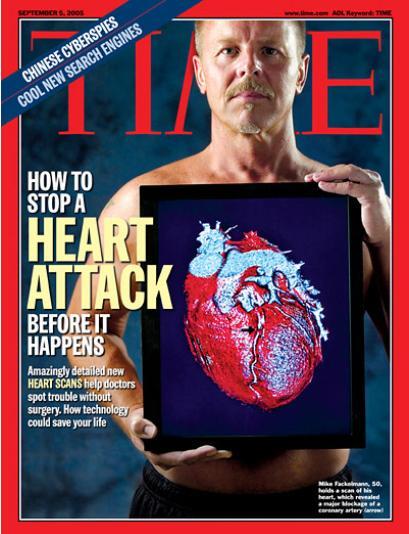
TIME.com: How New Heart-Scanning Technology Could Save Your Life -- Sep. 05, 2005 -- Page 1
(Recommended by Paulo Schvartzman [paulos@terra.com.br])
More and more, doctors are diagnosing coronary disease without any invasive tests whatever
By CHRISTINE GORMAN, ALICE PARKimprovements in CT (for computed tomography) scanning, which uses highly specialized X-ray machines to take multiple, finely layered pictures of the heart and surrounding blood vessels. Sophisticated computer programs sort the data to generate amazingly detailed, three-dimensional images like the ones that alerted Fackelmann's doctors to his hidden heart problem. Advances in other techniques like MRI (magnetic resonance imaging) have astonished physicians with the clarity of details now available to them on the inner workings of the heart.
Tuesday, September 06, 2005
IV Congreso Virtual de Cardiologia.
Estimado Dr. Achutti, el 1º de setiembre se inicio con todo exito el Cuarto Congreso Virtual de Cardiologia.
Hasta la fecha contamos con 17.364 inscriptos de 126 paises del mundo.
Durante los proximos tres meses, trataremos de ofrecer a nuestros lectores, un variado y ambicioso programa cientifico, dentro del cual se destaca la realizaciòn del LinuxMed 1er Congreso Mundial Virtual sobre Software Libre en el Area Salud y
ISHNE Atrial Fibrillation World-Wide Internet Symposium
ISHNE Atrial Fibrillation World-Wide Internet Symposium
Tambien se realizara un curso basico de Bioestadisticas para medicos.
La incripcion al Congreso es libre y gratuita y puede realizarse en:
Seria un honor para nosotros contar en nuestra audiencia con Usted y los prestigiosos miembros de AmiCor.
Afectuosamente
Dra. Silvia Nanfara
Co-Presidente Cuarto Congreso Virtual de Cardiologia
Federacion Argentina de Cardiologia
comparing contributions from primary prevention and secondary prevention
Modelling the decline in coronary heart disease deaths in England and Wales, 1981-2000: comparing contributions from primary prevention and secondary prevention
(Recommended by Mario de Camargo Maranhão[mariomaranhao@uol.com.br])
* Correspondence to: belgin.unal@deu.edu.tr
Objective To investigate whether population based primary prevention (risk factor reduction in apparently healthy people) might be more powerful than current government initiatives favouring risk factor reduction in patients with coronary heart disease (CHD) (secondary prevention).
Design, setting, and participants The IMPACT model was used to synthesise data for England and Wales describing CHD patient numbers, uptake of specific treatments, trends in major cardiovascular risk factors, and the mortality benefits of these specific risk factor changes in healthy people and in CHD patients.
Results Between 1981 and 2000, CHD mortality rates fell by 54%, resulting in 68 230 fewer deaths in 2000. Overall smoking prevalence declined by 35% between 1981 and 2000, resulting in approximately 29 715 (minimum estimate 20 035, maximum estimate 44 675) fewer deaths attributable to smoking cessation: approximately 5035 in known CHD patients and approximately 24 680 in healthy people. Population total cholesterol concentrations fell by 4.2%, resulting in approximately 5770 fewer deaths attributable to dietary changes (1205 in CHD patients and 4565 in healthy people) plus 2135 fewer deaths attributable to statin treatment (1990 in CHD patients, 145 in people without CHD). Mean population blood pressure fell by 7.7%, resulting in approximately 5870 fewer deaths attributable to secular falls in blood pressure (520 in CHD patients and 5345 in healthy people) plus approximately 1890 fewer deaths attributable to antihypertensive treatments in people without CHD. Approximately 45 370 fewer deaths were thus attributable to reductions in the three major risk factors in the population: some 36 625 (81%) in people without recognised CHD and 8745 (19%) in CHD patients.
Conclusions Compared with secondary prevention, primary prevention achieved a fourfold larger reduction in deaths. Future CHD policies should prioritise population-wide tobacco control and healthier diets.
(Accepted 26 July 2005)
Monday, September 05, 2005
IEA World Congress of Epidemiology 2008: Porto Alegre

De: Bruce B. Duncan [mailto:bbduncan@orion.ufrgs.br]
Enviada em: segunda-feira, 5 de setembro de 2005
Para: Aloyzio Achutti
Cc: Maria Ines Azambuja
Assunto: IAE World Congress of Epidemiologia 2008 Porto Alegre
Prezado Achutti,
É com imensa alegria que informamos que Porto Alegre foi a cidade vencedora para receber o XVIII Congresso Mundial de Epidemiologia para o ano de 2008.
Com esforços conjuntos da ABRASCO (Associação Brasileira de Saúde Coletiva), EMBRATUR e o Porto Alegre Convention & Visitors Bureau, a defesa da candidatura aconteceu nesta quarta-feira, dia 24 de agosto, em Bangkok, Tailândia.
Porto Alegre recebeu 75 votos, contra os 11 votos recebidos por Agra (Índia) e os 36 votos recebidos por Edinburgh (Escócia).
Dra. Maria Inês Schmidt (PPG-Epidemiologia, UFRGS) fez a apresentação vencedora. Participaram também, no esforço, Maurício Barreto, Glória Teixeira, César Víctora e Bruce Duncan. O congresso será feito em paralelo com o Epi-Tche, o VII Congresso Brasileira de Epidemiologia.
Um abraço,
Bruce
P.S. Foto da equipe atachado.
Parabens aos promotores e para todos nós!.
Como no ano anterior ao Congresso Mundial (2007) estaremos completando 10 anos do Seminário Nacional de Epidemiologia e Prevenção Cardiovascular de Gramado, sugiro que se organize um segundo comemorativo, de atualização da Declaração de Gramado e de Preparação de última hora para o Mundial.
Wednesday, August 31, 2005
Racial Trends in the Use of Major Procedures among the Elderly
Ashish K. Jha, M.D., M.P.H., Elliott S. Fisher, M.D., M.P.H., Zhonghe Li, M.A., E. John Orav, Ph.D., and Arnold M. Epstein, M.D., M.A.
Recommended by Marcelo Gustavo Colominas mgcolominas@gigared.com
ABSTRACT
Background Differences in the use of major procedures according to patients' race are well known. Whether national and local initiatives to reduce these differences have been successful is unknown.
Methods We examined data for men and women enrolled in Medicare from 1992 through 2001 on annual age-standardized rates of receipt of nine surgical procedures previously shown to have disparities in the rates at which they were performed in black patients and in white patients. We also examined data according to hospital-referral region for three of the nine procedures: coronary-artery bypass grafting (CABG), carotid endarterectomy, and total hip replacement.
Results Nationally, in 1992, the rates of receipt for all the procedures examined were higher among white patients than among black patients. The difference between the rates among whites and blacks increased significantly between 1992 and 2001 for five of the nine procedures, remained unchanged for three procedures, and narrowed significantly for one procedure. We examined rates of CABG, carotid endarterectomy, and total hip replacement in 158 hospital-referral regions (79 hospital-referral regions for black men and white men and 79 for black women and white women) with an adequate number of persons for each procedure. We found that in the early 1990s, whites had higher rates for these procedures than blacks in every hospital-referral region. By 2001, the difference between whites and blacks (both men and women) in the rates of these procedures narrowed significantly in 22 hospital-referral regions, widened significantly in 42, and were not significantly changed in the remaining hospital-referral regions. At the end of the study period, we found no hospital-referral region in which the difference in rates between whites and blacks was eliminated for men or women with regard to any of these three procedures.
Conclusions For the decade of the 1990s, we found no evidence, either nationally or locally, that efforts to eliminate racial disparities in the use of high-cost surgical procedures were successful.
Source Information
From the Department of Health Policy and Management, Harvard School of Public Health (A.K.J., Z.L., A.M.E.); the Division of General Medicine, Brigham and Women's Hospital (A.K.J., E.J.O., A.M.E.); and the Boston Veterans Affairs (VA) Health System (A.K.J.) — all in Boston; and the Outcomes Group, White River Junction VA Medical Center, White River Junction, Vt., and Dartmouth Medical School, Hanover, N.H. (E.S.F.).
Recommended by Marcelo Gustavo Colominas mgcolominas@gigared.com
ABSTRACT
Background Differences in the use of major procedures according to patients' race are well known. Whether national and local initiatives to reduce these differences have been successful is unknown.
Methods We examined data for men and women enrolled in Medicare from 1992 through 2001 on annual age-standardized rates of receipt of nine surgical procedures previously shown to have disparities in the rates at which they were performed in black patients and in white patients. We also examined data according to hospital-referral region for three of the nine procedures: coronary-artery bypass grafting (CABG), carotid endarterectomy, and total hip replacement.
Results Nationally, in 1992, the rates of receipt for all the procedures examined were higher among white patients than among black patients. The difference between the rates among whites and blacks increased significantly between 1992 and 2001 for five of the nine procedures, remained unchanged for three procedures, and narrowed significantly for one procedure. We examined rates of CABG, carotid endarterectomy, and total hip replacement in 158 hospital-referral regions (79 hospital-referral regions for black men and white men and 79 for black women and white women) with an adequate number of persons for each procedure. We found that in the early 1990s, whites had higher rates for these procedures than blacks in every hospital-referral region. By 2001, the difference between whites and blacks (both men and women) in the rates of these procedures narrowed significantly in 22 hospital-referral regions, widened significantly in 42, and were not significantly changed in the remaining hospital-referral regions. At the end of the study period, we found no hospital-referral region in which the difference in rates between whites and blacks was eliminated for men or women with regard to any of these three procedures.
Conclusions For the decade of the 1990s, we found no evidence, either nationally or locally, that efforts to eliminate racial disparities in the use of high-cost surgical procedures were successful.
Source Information
From the Department of Health Policy and Management, Harvard School of Public Health (A.K.J., Z.L., A.M.E.); the Division of General Medicine, Brigham and Women's Hospital (A.K.J., E.J.O., A.M.E.); and the Boston Veterans Affairs (VA) Health System (A.K.J.) — all in Boston; and the Outcomes Group, White River Junction VA Medical Center, White River Junction, Vt., and Dartmouth Medical School, Hanover, N.H. (E.S.F.).
Saturday, August 27, 2005
Adventitial dysfunction: an evolutionary model for understanding atherosclerosis.
Med Hypotheses. 2005;65(5):962-5.
(Recommended by Marcelo Colominas. Full article available on request)
Adventitial dysfunction: an evolutionary model for understanding atherosclerosis.Yun AJ, Doux JD, Bazar KA, Lee PY.
Department of Radiology, Stanford University, 470 University Avenue, Palo Alto, CA 94301, USA.
Endothelial and smooth muscle dysfunctions are widely implicated in the pathogenesis of atherosclerosis. Modern mechanical and pharmacologic treatments aim to remodel abnormalities of the vessel intima and media. We hypothesize that adventitial dysfunction comprises the dominant source of atherosclerosis by originating many endothelial and smooth muscle abnormalities. The autonomic nervous system innervates the adventitia, and autonomic dysfunction induces many end-organ dysfunctions including inflammation and thrombosis. The link between diabetes and atherosclerosis may operate through adventitial autonomic neuropathy. Smoking may promote atherosclerosis by inducing adventitial autonomic dysfunction related to nicotine-mediated compensatory upregulation of sympathetic bias independent of endothelial injury induced by purported tobacco toxins. While hypertension is thought to cause atherosclerosis, the two conditions may instead represent independent consequences of autonomic dysfunction. The link between aging and atherosclerosis may operate through adventitial dysfunction induced by autonomic dysregulations. Exercise may ameliorate atherosclerosis by restoring adventitial autonomic function, thereby normalizing adventitial regulation of medial and intimal biology. Feed-forward adventitial vascular baroreceptor and chemoreceptor dysregulation may further exacerbate atherosclerosis as intimal plaque interferes with these sensors. Since penetrating external physical injury likely represented a dominant selective force during evolution, the adventitia may be preferentially equipped with sensors and response systems for vessel trauma. The convergent response of adrenergia, inflammation, and coagulation, which is adaptive for physical trauma, may be maladaptive today when different stressors trigger the cascade. Endoluminal therapies including atherectomy, angioplasty, and stent deployment involve balloon expansion that traumatizes all layers of the vessel wall. These interventions may paradoxically reinitiate the cascade of atherogenesis that begins with adventitial dysfunction and leads to restenosis. Methods to reduce adventitial trauma, a maladaptive trigger of adventitial dysfunction, may reduce the risk of restenosis. We envision novel mechanical and biopharmaceutical solutions that target the adventitia to prevent or treat atherosclerosis including novel drug delivery strategies, exo-stents that wrap vessels, and neuromodulation of vessels.
The role of stem cells in atherosclerosis
The role of stem cells in atherosclerosis
Full article available under request
Sent by Marcelo Colominas
q.xu@sghms.ac.uk
Summary
Accumulating evidence indicates the involvement of stem cells and/or progenitors in the development of arteriosclerosis, including transplant arteriosclerosis, angioplasty-induced restenosis, vein graft atherosclerosis and spontaneous atherosclerosis.
Recently, it was demonstrated that stem/progenitor cells existing in the circulation and adventitia contribute to endothelial repair and smooth muscle cell (SMC) accumulation. Atherosclerosis can be initiated by endothelial death in specific areas, e.g. bifurcation regions, and subsequent replacement by stem/progenitor cells.
Meanwhile, progenitor cells from blood and the adventitia migrate into the intima where they proliferate and differentiate into neo-SMC.
Stem/progenitor cells are responsible for the formation of atherosclerotic lesions, which appear as an inflammatory disease. Thus, these cells may be a source of endothelial cells and SMC, and might have implications for cellular, genetic, and tissue engineering approaches to vascular disease. Arch Mal Coeur 2005 ; 98 : 672-6.
Full article available under request
Sent by Marcelo Colominas
q.xu@sghms.ac.uk
Summary
Accumulating evidence indicates the involvement of stem cells and/or progenitors in the development of arteriosclerosis, including transplant arteriosclerosis, angioplasty-induced restenosis, vein graft atherosclerosis and spontaneous atherosclerosis.
Recently, it was demonstrated that stem/progenitor cells existing in the circulation and adventitia contribute to endothelial repair and smooth muscle cell (SMC) accumulation. Atherosclerosis can be initiated by endothelial death in specific areas, e.g. bifurcation regions, and subsequent replacement by stem/progenitor cells.
Meanwhile, progenitor cells from blood and the adventitia migrate into the intima where they proliferate and differentiate into neo-SMC.
Stem/progenitor cells are responsible for the formation of atherosclerotic lesions, which appear as an inflammatory disease. Thus, these cells may be a source of endothelial cells and SMC, and might have implications for cellular, genetic, and tissue engineering approaches to vascular disease. Arch Mal Coeur 2005 ; 98 : 672-6.
Friday, August 26, 2005
Heart bypass surgery increases risk of Alzheimer's disease - New research suggests
Heart bypass surgery increases risk of Alzheimer's disease - New research suggests
Heart bypass surgery increases risk of Alzheimer's disease - New research suggests
26 Aug 2005
Researchers say stress and trauma of surgery may be to blame Boston University School of Medicine (BUSM) researchers have discovered that patients who have either coronary artery bypass graft surgery or coronary angioplasty are at an increased risk of developing Alzheimer's disease.
The research, which appears in the current issue of the Journal of Alzheimer's Disease (http://www.j-alz.com), pinpoints stress and trauma of the surgery as the major cause for the increased risk.
Led by Benjamin Wolozin, MD, PhD, professor of pharmacology at BUSM, researchers compared 5,216 people who underwent coronary artery bypass graft surgery (CABG) and 3,954 people who had a percutaneous transluminal coronary angioplasty (PTCA) in 1996 and 1997. Over the course of five years, 78 of the patients who had bypass surgery and 41 of those who had angioplasty developed Alzheimer's disease.
Heart bypass surgery increases risk of Alzheimer's disease - New research suggests
26 Aug 2005
Researchers say stress and trauma of surgery may be to blame Boston University School of Medicine (BUSM) researchers have discovered that patients who have either coronary artery bypass graft surgery or coronary angioplasty are at an increased risk of developing Alzheimer's disease.
The research, which appears in the current issue of the Journal of Alzheimer's Disease (http://www.j-alz.com), pinpoints stress and trauma of the surgery as the major cause for the increased risk.
Led by Benjamin Wolozin, MD, PhD, professor of pharmacology at BUSM, researchers compared 5,216 people who underwent coronary artery bypass graft surgery (CABG) and 3,954 people who had a percutaneous transluminal coronary angioplasty (PTCA) in 1996 and 1997. Over the course of five years, 78 of the patients who had bypass surgery and 41 of those who had angioplasty developed Alzheimer's disease.
Tuesday, August 23, 2005
Esclarescimentos sobre a Sexta Conferencia Internacional de Cardiologia Preventiva.
A pedido do Presidente Mario de Camargo Maranhão - mariomaranhao@uol.com.br
Caros amigos e colegas : Gostaria de expor aos colegas brasileiros alguns detalhes que talvez não sejam suficientemente conhecidos por todos com relação à Sexta Conferencia Internacional de Cardiologia Preventiva, realizada em Foz de Iguassú em maio deste ano..
O programa científico foi de total responsabilidade do Council of Epidemiology and Prevention da WHF, e minha atuação foi de Chairman e organizador local, ao lado de Aloyzio Achutti que foi Co-Chairman,
mas sem maior participação nas decisões tomadas pelo Chairman do Conselho, dr. Srinath Reddy.
Me concentrei na divulgação ( que foi intensa) e captação de recursos,os quais foram insuficientes para que pudessemos ter uma representação brasileira e sul-americana mais adequada, diante da falta de patrocinios da indústria farmaceutica ou de alimentos .
Na realidade contamos apenas com o apoio da Becel Flora(Unilever), Sanofi-Aventis (tabagismo e obesidade) e Bayer Health Care(aspirina) , patrocínios conquistados em nivel internacional com o apoio da WHF, sendo que as participações de palestrantes foram de total resposabilidade de suas respectivas áreas internacionais.
Consegui encaixar poucos colegas brasileiros e sulamericanos no programa como Co-Presidentes, justamente aqueles que já estariam participando do evento ou - que poderiam estar viajando com patrocinio próprio, a fim de não gerar despesas, como o caso do dr. Mario Garcia Palmieri.Por absoluta falta de recursos tive até que cancelar a participação de amigos pessoais como os doutores Antionio Bayés de Luna e David Kelly.
A falta de maior participação da SBC se deveu à propria decisão desta entidade, convidada que foi em tempo hábil - bem como seu Presidente, o qual foi convidado à participar da cerimonia Inaugural e dos simpósios conjuntos com a SAC, FAC e WHF .
De qualquer maneira, a SBC credenciou o evento para a revalidação do titulo de especialista e permitiu sua divulgação em seu site , no Jornal da SBC e em vários eventos,inclusive com "stand"em Congressos da SBC.
Sendo assim, espero ter contribuido para a melhor compreensão dos fatos, os quais estiveram acima de minhas possibilidades em contorna-las, dada a intransigencia do Conselho e das limitações impostas pelo rigido orçamento aprovado pela WHF. Felizmente, o evento foi auto-suficiente, face o apoio de outras entidades como por exemplo o NIH, CDC, WHO,International Heart Health, IAHF, além de outras entidades que se fizeram representar e contribuiram financeiramente ou com seus convidados.Se não houve lucro, não houve prejuízos! As entidades argentinas se encarregaram das despesas de seus representantes e a World Heart federation custeou as despesas dos membros de suas diversas comissões e principalmente nos membros de seu Board.
Atenciosamente,
Mario Maranhão
Em tempo: Pela quarta vez consecutiva, a rede Globo vai transmitir um "clip"alusivo ao Dia Mundial do Coração, durante sua programaçãio normal. A exemplo d anos anteriores, a Central Globo de Comunicações, por mim acionada, se encarregou da criação,produção e divulgação do "clip"sem onus para a WHF e a SBC, cujos logos serão estampados.
Saturday, August 20, 2005
Night heart attack care 'worse'
Night heart attack care 'worse'
Patients who have a heart attack during the night or at weekends have to wait longer for treatment and are more likely to die, a US study suggests.
The report in the Journal of the American Medical Association found these patients waited longer for clot-busting drugs and surgery.
The study of 102,000 patients concluded the risk of dying increased by 7% when patients were treated out of hours.
UK experts said NHS out-of-hours care was also likely to be slower.
Lead researcher David Magid said the delays were putting lives at risk.
Patients who have a heart attack during the night or at weekends have to wait longer for treatment and are more likely to die, a US study suggests.
The report in the Journal of the American Medical Association found these patients waited longer for clot-busting drugs and surgery.
The study of 102,000 patients concluded the risk of dying increased by 7% when patients were treated out of hours.
UK experts said NHS out-of-hours care was also likely to be slower.
Lead researcher David Magid said the delays were putting lives at risk.
Friday, August 19, 2005
Five-Year Outcomes After Coronary Stenting Versus Bypass Surgery for the Treatment of Multivessel Disease: The Final Analysis of the Arterial Revascul
Five-Year Outcomes After Coronary Stenting Versus Bypass Surgery for the Treatment of Multivessel Disease: The Final Analysis of the Arterial Revascularization Therapies Study (ARTS) Randomized Trial -- Serruys et al. 46 (4): 575 -- Journal of the American College of Cardiology: "CONCLUSIONS: At five years there was no difference in mortality between stenting and surgery for multivessel disease. Furthermore, the incidence of stroke or myocardial infarction was not significantly different between the two groups. However, overall MACCE was higher in the stent group, driven by the increased need for repeat revascularization."
Friday, August 12, 2005
A framework for measuring health inequity --
A framework for measuring health inequity -- Asada 59 (8): 700 -- Journal of Epidemiology and Community Health
Yukiko Asada
yukiko.asada@dal.ca
Background: Health inequality has long attracted keen attention in the research and policy arena. While there may be various motivations to study health inequality, what distinguishes it as a topic is moral concern. Despite the importance of this moral interest, a theoretical and analytical framework for measuring health inequality acknowledging moral concerns remains to be established.
Study objective: To propose a framework for measuring the moral or ethical dimension of health inequality—that is, health inequity.
Design: Conceptual discussion.
Conclusions: Measuring health inequity entails three steps: (1) defining when a health distribution becomes inequitable, (2) deciding on measurement strategies to operationalise a chosen concept of equity, and (3) quantifying health inequity information. For step (1) a variety of perspectives on health equity exist under two categories, health equity as equality in health, and health inequality as an indicator of general injustice in society. In step (2), when we are interested in health inequity, the choice of the measurement of health, the unit of time, and the unit of analysis in health inequity analysis should reflect moral considerations. In step (3) we must follow principles rather than convenience and consider six questions that arise when quantifying health inequity information. This proposed framework suggests various ways to conceptualise the moral dimension of health inequality and emphasises the logical consistency from conception to measurement.
Yukiko Asada
yukiko.asada@dal.ca
Background: Health inequality has long attracted keen attention in the research and policy arena. While there may be various motivations to study health inequality, what distinguishes it as a topic is moral concern. Despite the importance of this moral interest, a theoretical and analytical framework for measuring health inequality acknowledging moral concerns remains to be established.
Study objective: To propose a framework for measuring the moral or ethical dimension of health inequality—that is, health inequity.
Design: Conceptual discussion.
Conclusions: Measuring health inequity entails three steps: (1) defining when a health distribution becomes inequitable, (2) deciding on measurement strategies to operationalise a chosen concept of equity, and (3) quantifying health inequity information. For step (1) a variety of perspectives on health equity exist under two categories, health equity as equality in health, and health inequality as an indicator of general injustice in society. In step (2), when we are interested in health inequity, the choice of the measurement of health, the unit of time, and the unit of analysis in health inequity analysis should reflect moral considerations. In step (3) we must follow principles rather than convenience and consider six questions that arise when quantifying health inequity information. This proposed framework suggests various ways to conceptualise the moral dimension of health inequality and emphasises the logical consistency from conception to measurement.
Yale: Introduction to Cardiothoracic Imaging
Yale: Introduction to Cardiothoracic Imaging
(From Science Netwatch)
IMAGES: Portrait of the Heart
Can't remember the location of the tricuspid valve? Need to know what an aortic aneurysm looks like on an echocardiogram? Click over to Introduction to Cardiothoracic Imaging from Yale University School of Medicine. Although aimed at medical students, the beautifully illustrated tutorial is a good resource for researchers or anyone else who wants to pump up their knowledge of heart and lung anatomy. Other sections use x-rays, echocardiogram footage, and other media to show how the structures change as a result of diseases such as emphysema and mitral stenosis, a narrowing of the opening between the left atrium and ventricle that can allow blood backflow. You'll also find a rundown of various imaging techniques.
info.med.yale.edu/intmed/cardio/imaging
(From Science Netwatch)
IMAGES: Portrait of the Heart
Can't remember the location of the tricuspid valve? Need to know what an aortic aneurysm looks like on an echocardiogram? Click over to Introduction to Cardiothoracic Imaging from Yale University School of Medicine. Although aimed at medical students, the beautifully illustrated tutorial is a good resource for researchers or anyone else who wants to pump up their knowledge of heart and lung anatomy. Other sections use x-rays, echocardiogram footage, and other media to show how the structures change as a result of diseases such as emphysema and mitral stenosis, a narrowing of the opening between the left atrium and ventricle that can allow blood backflow. You'll also find a rundown of various imaging techniques.
info.med.yale.edu/intmed/cardio/imaging
Tuesday, August 09, 2005
INFOBASE: Country-level data and comparable estimates on Risk Factors
WHO | SuRF 2: "The SuRF Report 2: Surveillance of chronic disease Risk Factors:
Country-level data and comparable estimates
This report is the second in the Surveillance of Risk Factors Report Series. SuRF2 updates the Country Profiles provided by SuRF1 in 2003. SuRF2 also presents, for the first time, comparable country-level estimates for raised blood pressure, obesity, and overweight.
The focus of the Country Profiles is recent, nationally representative risk factor data. The risk factors included in this report are those that make the greatest contribution to mortality and morbidity from cardiovascular disease, can be changed through primary intervention, and are easily measured in populations. These risk factors are:
* tobacco and alcohol use
* patterns of physical inactivity
* low fruit/vegetable intake
* overweight/obesity
* blood pressure
* cholesterol
* diabetes
The text of SuRF2 (which includes everything but the Country Profiles) can be viewed in its entirety by clicking here, view complete SuRF2.
Otherwise individual sections of the report can be viewed by using the left hand navigation.
The global maps and data tables for the country-level comparable estimates are available in the Comparable estimates section."
Country-level data and comparable estimates
This report is the second in the Surveillance of Risk Factors Report Series. SuRF2 updates the Country Profiles provided by SuRF1 in 2003. SuRF2 also presents, for the first time, comparable country-level estimates for raised blood pressure, obesity, and overweight.
The focus of the Country Profiles is recent, nationally representative risk factor data. The risk factors included in this report are those that make the greatest contribution to mortality and morbidity from cardiovascular disease, can be changed through primary intervention, and are easily measured in populations. These risk factors are:
* tobacco and alcohol use
* patterns of physical inactivity
* low fruit/vegetable intake
* overweight/obesity
* blood pressure
* cholesterol
* diabetes
The text of SuRF2 (which includes everything but the Country Profiles) can be viewed in its entirety by clicking here, view complete SuRF2.
Otherwise individual sections of the report can be viewed by using the left hand navigation.
The global maps and data tables for the country-level comparable estimates are available in the Comparable estimates section."
Monday, August 08, 2005
Spectral Analysis Identifies Sites of High-Frequency Activity Maintaining Atrial Fibrillation in Humans -- Sanders et al. 112 (6): 789 -- Circulation
Spectral Analysis Identifies Sites of High-Frequency Activity Maintaining Atrial Fibrillation in Humans -- Sanders et al. 112 (6): 789 -- Circulation: "Methods and Results— Thirty-two patients undergoing AF ablation (19 paroxysmal, 13 permanent) during ongoing arrhythmia were studied. Electroanatomic mapping was performed, acquiring 126+/-13 points per patient throughout both atria and coronary sinus. At each point, 5-second electrograms were obtained to determine the highest-amplitude frequency on spectral analysis and to construct 3D dominant frequency (DF) maps. The temporal stability of the recording interval was confirmed in a subset. Ablation was performed with the operator blinded to the DF maps. The effect of ablation at sites with or without high-frequency DF sites (maximal frequencies surrounded by a decreasing frequency gradient ≥20%) was evaluated by determining the change in AF cycle length (AFCL) and the termination and inducibility of AF. The spatial distribution of the DF sites was different in patients with paroxysmal and permanent AF; paroxysmal AF patients were more likely to harbor the DF site within the pulmonary vein, whereas in permanent AF, atrial DF sites were more prevalent. Ablation at a DF site resulted in significant prolongation of the AFCL (180+/-30 to 198+/-40 ms; P<0.0001; {kappa}= 0.77), whereas in the absence of a DF site, there was no change in AFCL (169+/-22 to 170+/-22 ms; P=0.4). AF terminated during ablation in 17 of 19 patients with paroxysmal and 0 of 13 with permanent AF (P<0.0001). When 2 patients with nonsustained AF during mapping were excluded, 13 of 15 (87%) had AF termination at DF sites (54% at the initially ablated DF site): 11 pulmonary veins and 2 atrial. In addition, AF could no longer be induced in 69% with termination of AF at a DF site. There were no significant differences in the number or percentage of DF sites detected (5.4+/-1.6 versus 4.9+/-2.1; P=0.3) and ablated (1.9+/-1.0 versus 2.4+/-1.0; P=0.3) in those with and without AF termination. The duration of radiofrequency ablation to achieve termination was significantly shorter than that delivered in those with persisting AF (34.8+/-24.0 versus 73.5+/-22.9 minutes; P=0.0002). All patients with persisting AF had additional DF sites outside the ablated zones.
Conclusions— Spectral analysis and frequency mapping identify localized sites of high-frequency activity during AF in humans with different distributions in paroxysmal and permanent AF. Ablation at these sites results in prolongation of the AFCL and termination of paroxysmal AF, indicating their role in the maintenance of AF.
"
Conclusions— Spectral analysis and frequency mapping identify localized sites of high-frequency activity during AF in humans with different distributions in paroxysmal and permanent AF. Ablation at these sites results in prolongation of the AFCL and termination of paroxysmal AF, indicating their role in the maintenance of AF.
"
Exercise Testing in Asymptomatic Adults:
Exercise Testing in Asymptomatic Adults: A Statement for Professionals From the American Heart Association Council on Clinical Cardiology, Subcommittee on Exercise, Cardiac Rehabilitation, and Prevention -- Lauer et al. 112 (5): 771 -- Circulation:
"Along with coronary artery calcium scanning, ankle-brachial index measurement, and carotid artery ultrasound, exercise electrocardiography has been proposed as a screening tool for asymptomatic subjects thought to be at intermediate risk for developing clinical coronary disease. A wealth of data indicate that exercise testing can be used to assess and refine prognosis, particularly when emphasis is placed on nonelectrocardiographic measures such as exercise capacity, chronotropic response, heart rate recovery, and ventricular ectopy. Nevertheless, randomized trial data on the clinical value of screening exercise testing are absent; that is, it is not known whether a strategy of routine screening exercise testing in selected subjects reduces the risk for premature mortality or major cardiac morbidity. The writing group believes that a large-scale randomized trial of such a strategy should be performed."
"Along with coronary artery calcium scanning, ankle-brachial index measurement, and carotid artery ultrasound, exercise electrocardiography has been proposed as a screening tool for asymptomatic subjects thought to be at intermediate risk for developing clinical coronary disease. A wealth of data indicate that exercise testing can be used to assess and refine prognosis, particularly when emphasis is placed on nonelectrocardiographic measures such as exercise capacity, chronotropic response, heart rate recovery, and ventricular ectopy. Nevertheless, randomized trial data on the clinical value of screening exercise testing are absent; that is, it is not known whether a strategy of routine screening exercise testing in selected subjects reduces the risk for premature mortality or major cardiac morbidity. The writing group believes that a large-scale randomized trial of such a strategy should be performed."
Sunday, August 07, 2005
Adaptation to a High-Fat Diet Leads to Hyperphagia and Diminished Sensitivity to Cholecystokinin in Rats --
Adaptation to a High-Fat Diet Leads to Hyperphagia and Diminished Sensitivity to Cholecystokinin in Rats -- Savastano and Covasa 135 (8): 1953 -- Journal of Nutrition:
"Rats fed high-fat (HF) diets exhibit reduced sensitivity to some peptide satiety signals. We hypothesized that reduced sensitivity to satiety signals might contribute to overconsumption of a high-energy food after adaptation to HF diets. To test this, we measured daily, 3-h intake of a high-energy, high-fat (HHF, 22.3 kJ/g) test food in rats fed either low-fat (LF) or HF, isoenergetic (16.2 kJ/g) diets. During testing, half of each group received the HHF test food (LF/HHF; HF/HHF), whereas the other half received their respective maintenance diet (LF/LF; HF/HF). Rats fed a HF diet ate more of the HHF food during the 3-h testing period than LF-fed rats (HF/HHF = 7.7 +/- 0.3 g vs. LF/HHF = 5.5 +/- 0.2 g; P = 0.003). Rats tested on their own maintenance diets had similar intakes (HF/HF = 3.2 +/- 0.2 g vs. LF/LF = 3.7 +/- 0.3 g), which were lower (P ≤ 0.008) than intakes of rats tested on HHF. HHF-tested rats did not differ in body weight by the end of wk 2 of testing. In a subsequent short-term choice preference test, rats exhibited an equal relative preference for HHF irrespective of their maintenance diets (HF = 63.1%, LF = 68.1%, P = 0.29). Finally, we examined the effect of intraperitoneal NaCl or cholecystokinin (CCK)-8 (100 and 250 ng/kg) injection on 1-h food intake. Both doses of CCK significantly suppressed food intake in LF-fed rats but not HF-fed rats. These results demonstrate that chronic ingestion of a HF diet leads to short-term overconsumption of a high-energy, high-fat food compared with LF-fed cohorts, which is associated with a decreased sensitivity to CCK."
"Rats fed high-fat (HF) diets exhibit reduced sensitivity to some peptide satiety signals. We hypothesized that reduced sensitivity to satiety signals might contribute to overconsumption of a high-energy food after adaptation to HF diets. To test this, we measured daily, 3-h intake of a high-energy, high-fat (HHF, 22.3 kJ/g) test food in rats fed either low-fat (LF) or HF, isoenergetic (16.2 kJ/g) diets. During testing, half of each group received the HHF test food (LF/HHF; HF/HHF), whereas the other half received their respective maintenance diet (LF/LF; HF/HF). Rats fed a HF diet ate more of the HHF food during the 3-h testing period than LF-fed rats (HF/HHF = 7.7 +/- 0.3 g vs. LF/HHF = 5.5 +/- 0.2 g; P = 0.003). Rats tested on their own maintenance diets had similar intakes (HF/HF = 3.2 +/- 0.2 g vs. LF/LF = 3.7 +/- 0.3 g), which were lower (P ≤ 0.008) than intakes of rats tested on HHF. HHF-tested rats did not differ in body weight by the end of wk 2 of testing. In a subsequent short-term choice preference test, rats exhibited an equal relative preference for HHF irrespective of their maintenance diets (HF = 63.1%, LF = 68.1%, P = 0.29). Finally, we examined the effect of intraperitoneal NaCl or cholecystokinin (CCK)-8 (100 and 250 ng/kg) injection on 1-h food intake. Both doses of CCK significantly suppressed food intake in LF-fed rats but not HF-fed rats. These results demonstrate that chronic ingestion of a HF diet leads to short-term overconsumption of a high-energy, high-fat food compared with LF-fed cohorts, which is associated with a decreased sensitivity to CCK."
Atherogenic amino acid elevated in cerebrovascular disease
Atherogenic amino acid elevated in cerebrovascular disease:
"The amino acid asymmetric dimethylarginine (ADMA), which is implicated in the development of atherosclerosis, may serve as a risk marker for stroke and transient ischemic attack (TIA), study findings suggest. "
"The amino acid asymmetric dimethylarginine (ADMA), which is implicated in the development of atherosclerosis, may serve as a risk marker for stroke and transient ischemic attack (TIA), study findings suggest. "
Monday, August 01, 2005
Exercise Testing in Asymptomatic Adults: A Statement for Professionals From the American Heart Association Council on Clinical Cardiology, Subcommitte
Exercise Testing in Asymptomatic Adults: A Statement for Professionals From the American Heart Association Council on Clinical Cardiology, Subcommittee on Exercise, Cardiac Rehabilitation, and Prevention -- Lauer et al. 112 (5): 771 -- Circulation:
"AHA Scientific Statement
Exercise Testing in Asymptomatic Adults
A Statement for Professionals From the American Heart Association Council on Clinical Cardiology, Subcommittee on Exercise, Cardiac Rehabilitation, and Prevention
Michael Lauer, MD, Chair; Erika Sivarajan Froelicher, RN, PhD; Mark Williams, PhD; Paul Kligfield, MD"
Along with coronary artery calcium scanning, ankle-brachial index measurement, and carotid artery ultrasound, exercise electrocardiography has been proposed as a screening tool for asymptomatic subjects thought to be at intermediate risk for developing clinical coronary disease. A wealth of data indicate that exercise testing can be used to assess and refine prognosis, particularly when emphasis is placed on nonelectrocardiographic measures such as exercise capacity, chronotropic response, heart rate recovery, and ventricular ectopy. Nevertheless, randomized trial data on the clinical value of screening exercise testing are absent; that is, it is not known whether a strategy of routine screening exercise testing in selected subjects reduces the risk for premature mortality or major cardiac morbidity. The writing group believes that a large-scale randomized trial of such a strategy should be performed.
"AHA Scientific Statement
Exercise Testing in Asymptomatic Adults
A Statement for Professionals From the American Heart Association Council on Clinical Cardiology, Subcommittee on Exercise, Cardiac Rehabilitation, and Prevention
Michael Lauer, MD, Chair; Erika Sivarajan Froelicher, RN, PhD; Mark Williams, PhD; Paul Kligfield, MD"
Along with coronary artery calcium scanning, ankle-brachial index measurement, and carotid artery ultrasound, exercise electrocardiography has been proposed as a screening tool for asymptomatic subjects thought to be at intermediate risk for developing clinical coronary disease. A wealth of data indicate that exercise testing can be used to assess and refine prognosis, particularly when emphasis is placed on nonelectrocardiographic measures such as exercise capacity, chronotropic response, heart rate recovery, and ventricular ectopy. Nevertheless, randomized trial data on the clinical value of screening exercise testing are absent; that is, it is not known whether a strategy of routine screening exercise testing in selected subjects reduces the risk for premature mortality or major cardiac morbidity. The writing group believes that a large-scale randomized trial of such a strategy should be performed.
Epidemiology of Decompensated Heart Failure
8202003.pdf (application/pdf Object)
Leandro Reis Tavares, Heraldo Victer, José Maurício Linhares, Clovis Monteiro de Barros, Marcus Vinicius Oliveira, Luis Carlos Pacheco, Cenésio Henrique Viana, Sabrina Bernardez Pereira, Gisele Pinto da Silva, Evandro Tinoco Mesquita
Objective - To compare the epidemiological and socioeconomic profiles, clinical features, etiology, length of hospitalization, and mortality of patients with decompensated heart failure admitted to public and private hospitals in the city of Niterói.
Methods - We carried out a prospective, multicenter study (from July to September 2001) comprising all patients older than 18 years with the primary diagnosis of heart failure and admitted to hospitals in the city of Niterói, whose scores according to the Boston criteria were 8 or above. Proportions were compared using the chi-square and Fisher exact tests.
Results - The sample comprised 203 patients as follows: 1) 98 patients from public hospitals: 50% were men, their mean age was 61.1±11.3 years, 65% were black, 57% had an income of 1 minimum wage or less, 56% were illiterate, 66% had ischemic heart disease, their mean length of hospitalization was 12.6 days, and the mortality rate adjusted for age was 5.23; 2) 105 patients from private hospitals: 49% were men, their mean age was 72±12.7 years, 20% were black, 58% had an income greater than 6 minimum wages, 11% were illiterate, 62% had ischemic heart disease, their mean length of hospitalization was 8 days, and the mortality rate adjusted for age was 2.94. The distribution of comorbidities and risk factors was similar among the patients of the 2 hospital systems, except for the smoking habit, which was more frequent among patients from public hospitals.
Conclusion - In addition to the socioeconomic asymmetries, the hospitalization length and the mortality rate adjusted for age were greater in patients in the public health system.
Leandro Reis Tavares, Heraldo Victer, José Maurício Linhares, Clovis Monteiro de Barros, Marcus Vinicius Oliveira, Luis Carlos Pacheco, Cenésio Henrique Viana, Sabrina Bernardez Pereira, Gisele Pinto da Silva, Evandro Tinoco Mesquita
Objective - To compare the epidemiological and socioeconomic profiles, clinical features, etiology, length of hospitalization, and mortality of patients with decompensated heart failure admitted to public and private hospitals in the city of Niterói.
Methods - We carried out a prospective, multicenter study (from July to September 2001) comprising all patients older than 18 years with the primary diagnosis of heart failure and admitted to hospitals in the city of Niterói, whose scores according to the Boston criteria were 8 or above. Proportions were compared using the chi-square and Fisher exact tests.
Results - The sample comprised 203 patients as follows: 1) 98 patients from public hospitals: 50% were men, their mean age was 61.1±11.3 years, 65% were black, 57% had an income of 1 minimum wage or less, 56% were illiterate, 66% had ischemic heart disease, their mean length of hospitalization was 12.6 days, and the mortality rate adjusted for age was 5.23; 2) 105 patients from private hospitals: 49% were men, their mean age was 72±12.7 years, 20% were black, 58% had an income greater than 6 minimum wages, 11% were illiterate, 62% had ischemic heart disease, their mean length of hospitalization was 8 days, and the mortality rate adjusted for age was 2.94. The distribution of comorbidities and risk factors was similar among the patients of the 2 hospital systems, except for the smoking habit, which was more frequent among patients from public hospitals.
Conclusion - In addition to the socioeconomic asymmetries, the hospitalization length and the mortality rate adjusted for age were greater in patients in the public health system.
Sunday, July 31, 2005
Opapel dos PPARs nas Doenças Cardiovasculares
artigo04.pdf (application/pdf Object)
Nadine Clausell, Angela M. V. Tavares
(MEMBROS DA LISTA AMICOR)
O Receptor Ativado por Proliferadores de Peroxissoma (PPAR) é um fator de transcrição, pertencente à super família de receptores nucleares que se ligam a agonistas específicos, também conhecidos como ligantes ou ativadores de PPARs. Evidências crescentes têm demonstrado a importância dos PPARs no controle de diversos processos biológicos relacionados principalmente ao metabolismo lipídico e ao processo inflamatório, desempenhando
papeis-chave em várias doenças cardiovasculares. Neste sentido, um elo que tem sido explorado, envolvendo a ação dos PPARs nessas doenças, é o efeito anti-inflamatório exercido por alguns ativadores de PPARs, como as glitazonas e os fibratos em modelos experimentais de ateroscleroese e insuficiência cardíaca, com potenciais implicações no tratamento dessas doenças em seres humanos. Neste artigo, estaremos revisando, em maior profundidade, o papel dos PPARs, tanto na aterosclerose como na insuficiência cardíaca, enfatizando conceitos mecanísticos e suas potenciais aplicações clínicas.
Nadine Clausell, Angela M. V. Tavares
(MEMBROS DA LISTA AMICOR)
O Receptor Ativado por Proliferadores de Peroxissoma (PPAR) é um fator de transcrição, pertencente à super família de receptores nucleares que se ligam a agonistas específicos, também conhecidos como ligantes ou ativadores de PPARs. Evidências crescentes têm demonstrado a importância dos PPARs no controle de diversos processos biológicos relacionados principalmente ao metabolismo lipídico e ao processo inflamatório, desempenhando
papeis-chave em várias doenças cardiovasculares. Neste sentido, um elo que tem sido explorado, envolvendo a ação dos PPARs nessas doenças, é o efeito anti-inflamatório exercido por alguns ativadores de PPARs, como as glitazonas e os fibratos em modelos experimentais de ateroscleroese e insuficiência cardíaca, com potenciais implicações no tratamento dessas doenças em seres humanos. Neste artigo, estaremos revisando, em maior profundidade, o papel dos PPARs, tanto na aterosclerose como na insuficiência cardíaca, enfatizando conceitos mecanísticos e suas potenciais aplicações clínicas.
BNP: do Laboratório à Beira do Leito
artigo03.pdf (application/pdf Object)
Luís Beck da Silva Neto, Nadine Clausell
(MEMBROS DA LISTA AMICOR)
Até meados de 1950, acreditava-se que a diurese era controlada por dois mecanismos neuro-hormonais: o sistema vasopressina (ADH) e o sistema renina-angiotensina-aldosterona (SRAA). No entanto, ainda em relatos daquela década, acreditavase existir um “terceiro fator”, o qual era pouco elucidado. Com adescrição de aumento de diurese associado a episódios paroxísticos de taquicardia supraventricular, passou-se a suspeitar que o terceiro fator estivesse ligado ao coração. Seguiu-se a clássica descrição do reflexo de Henry & Gauer, em que a dilatação atrial era capaz de
aumentar a diurese.1,2 Posteriormente, com o advento da microscopia eletrônica, foi possível visualizar a presença de grânulos intracelulares
nos miócitos atriais, em grande semelhança aos encontrados nas células endócrinas. A noção de que o coração possuía funções endócrinas ganhava fundamentação.3 A confirmação definitiva da ligação endócrina entre o coração e os rins foi definitivamente confirmada pelo clássico experimento de Bold e colaboradores, publicado em 1981.4 Neste experimento, extrato de músculo atrial foi injetado em ratos e observou-se rápido e potente efeito diurético e vasodilatador. Estava descoberto o fator natriurético atrial (ANF), um peptídeo circulante com propriedades natriuréticas, diuréticas e
vasodilatadoras, posteriormente chamado peptídeo natriurético atrial (ANP). Desde então, um imenso número de investigações multidisciplinares foi conduzido para esclarecer o real papel deste peptídeo na patogênese das doenças cardiovasculares, na regulação da pressão arterial e na excreção de sal e água. Em 1988, um grupo de pesquisadores japoneses demonstrou a existência de um peptídeo natriurético tipo-ANF em cérebro de porcos e o nomeou brain natriuretic peptide (BNP).5 Inúmeros experimentos subseqüentes demonstraram que o BNP era, de fato, produzido em miócitos cardíacos e que compartilhava receptores periféricos com o ANP. Hoje, o BNP (renomeado peptídeo natriurético tipo-B) tem alcançado importante papel na prática clínica cardiológica e seu uso clínico é brevemente revisado neste trabalho. Essas investigações se tornaram um excelente exemplo de pesquisa que evoluiu da bancada do laboratório à beira do leito do paciente.
Luís Beck da Silva Neto, Nadine Clausell
(MEMBROS DA LISTA AMICOR)
Até meados de 1950, acreditava-se que a diurese era controlada por dois mecanismos neuro-hormonais: o sistema vasopressina (ADH) e o sistema renina-angiotensina-aldosterona (SRAA). No entanto, ainda em relatos daquela década, acreditavase existir um “terceiro fator”, o qual era pouco elucidado. Com adescrição de aumento de diurese associado a episódios paroxísticos de taquicardia supraventricular, passou-se a suspeitar que o terceiro fator estivesse ligado ao coração. Seguiu-se a clássica descrição do reflexo de Henry & Gauer, em que a dilatação atrial era capaz de
aumentar a diurese.1,2 Posteriormente, com o advento da microscopia eletrônica, foi possível visualizar a presença de grânulos intracelulares
nos miócitos atriais, em grande semelhança aos encontrados nas células endócrinas. A noção de que o coração possuía funções endócrinas ganhava fundamentação.3 A confirmação definitiva da ligação endócrina entre o coração e os rins foi definitivamente confirmada pelo clássico experimento de Bold e colaboradores, publicado em 1981.4 Neste experimento, extrato de músculo atrial foi injetado em ratos e observou-se rápido e potente efeito diurético e vasodilatador. Estava descoberto o fator natriurético atrial (ANF), um peptídeo circulante com propriedades natriuréticas, diuréticas e
vasodilatadoras, posteriormente chamado peptídeo natriurético atrial (ANP). Desde então, um imenso número de investigações multidisciplinares foi conduzido para esclarecer o real papel deste peptídeo na patogênese das doenças cardiovasculares, na regulação da pressão arterial e na excreção de sal e água. Em 1988, um grupo de pesquisadores japoneses demonstrou a existência de um peptídeo natriurético tipo-ANF em cérebro de porcos e o nomeou brain natriuretic peptide (BNP).5 Inúmeros experimentos subseqüentes demonstraram que o BNP era, de fato, produzido em miócitos cardíacos e que compartilhava receptores periféricos com o ANP. Hoje, o BNP (renomeado peptídeo natriurético tipo-B) tem alcançado importante papel na prática clínica cardiológica e seu uso clínico é brevemente revisado neste trabalho. Essas investigações se tornaram um excelente exemplo de pesquisa que evoluiu da bancada do laboratório à beira do leito do paciente.
Therapeutics in Clinical Cardiovascular Practice. Experiences and Evidence
8501015.pdf (application/pdf Object)
Flávio Danni Fuchs
(AUTORMEMBRO DA LISTA AMIVOR)
A qualidade da evidência em Cardiologia acentuou-se nos últimos anos. Excedendo a fundamentação farmacológica e biológica clássica, os métodos da medicina baseada em evidências, particularmente o ensaio clínico randomizado, aplicaram-se ao cenário clínico, permitindo discernir entre terapias eficazes, inertes e deletérias.
Estudos clássicos, como o que demonstrou a ineficácia de cirurgia de ligadura da artéria mamária no tratamento da angina de peito refratária, foram predominantemente realizados em afecções cardiovasculares. A apropriação da linguagem e métodos da medicina baseada em evidências por parte das corporações, com o correspondente investimento em pesquisas e promoção, expandiu em muito o armamentário terapêutico e diagnóstico. Vive-se, no
entanto, época de distorções no relacionamento entre as corporações, academia e profissionais, decorrente de forte viés corporativo, que influencia prioridades de pesquisa, divulgação e prescrição. Limitações de custeio público requerem que cardiologistas se habilitem fortemente no domínio dos paradigmas da medicina baseada em evidências, para explorar a precisão de terapêutica cardiovascular a um custo socialmente tolerável.
Flávio Danni Fuchs
(AUTORMEMBRO DA LISTA AMIVOR)
A qualidade da evidência em Cardiologia acentuou-se nos últimos anos. Excedendo a fundamentação farmacológica e biológica clássica, os métodos da medicina baseada em evidências, particularmente o ensaio clínico randomizado, aplicaram-se ao cenário clínico, permitindo discernir entre terapias eficazes, inertes e deletérias.
Estudos clássicos, como o que demonstrou a ineficácia de cirurgia de ligadura da artéria mamária no tratamento da angina de peito refratária, foram predominantemente realizados em afecções cardiovasculares. A apropriação da linguagem e métodos da medicina baseada em evidências por parte das corporações, com o correspondente investimento em pesquisas e promoção, expandiu em muito o armamentário terapêutico e diagnóstico. Vive-se, no
entanto, época de distorções no relacionamento entre as corporações, academia e profissionais, decorrente de forte viés corporativo, que influencia prioridades de pesquisa, divulgação e prescrição. Limitações de custeio público requerem que cardiologistas se habilitem fortemente no domínio dos paradigmas da medicina baseada em evidências, para explorar a precisão de terapêutica cardiovascular a um custo socialmente tolerável.
Lipid Profile and Risk Factors for Cardiovascular Diseases in Medicine Students
8501011.pdf (application/pdf Object)
Vanessa Gregorin Coelho, Loeni Fátima Caetano, Raphael Del Roio Liberatore Júnior, José Antônio Cordeiro, Dorotéia Rossi Silva Souza
Analisar o perfil lipídico e sua correlação com fatores de risco
para doenças cardiovasculares (DCV) em estudantes de medicina.
Métodos
Foram avaliados 153 estudantes, independente do sexo, com idade entre 18 e 31 anos, submetidos à análise do perfil lipídico, incluindo níveis séricos de colesterol total (CT), fração de colesterol das lipoproteínas de baixa (LDLc), alta (HDLc) e muito baixa densidade (VLDLc) e triglicérides (TG), além de hábitos de vida e dados antropométricos. Aplicou-se análise estatística, incluindo teste de Mann Whitney, qui-quadrado, correlação de Pearson e análise multivariada, admitindo-se nível de significância para valor p<0,05.
Resultados
Destacaram-se sedentarismo (43,1%) e antecedentes familiais para DCV, particularmente hipertensão arterial (74,5%). O perfil lipídico mostrou-se desejável, embora níveis alterados de CT, LDLc e TG foram detectados em 11,8%, 9,8% e 8,5% dos estudantes, respectivamente, e níveis reduzidos de HDLc em 12,4% deles.
As mulheres apresentaram valores significativamente reduzidos para LDLc e elevados para HDLc comparado aos homens (p=0,031 e p<0,0001, respectivamente). Houve associação significante entre perfil lipídico e, preferencialmente, índice de massa corpórea (IMC), sedentarismo, ingesta de álcool, uso de anticoncepcional, antecedentes familiais de acidente vascular cerebral e dislipidemia.
Conclusão
Antecedentes familiais para DCV, sedentarismo e uso de anticoncepcional entre os estudantes de medicina mostram-se freqüentes e associados ao perfil lipídico, assim como ingesta de álcool e IMC. Embora com perfil lipídico desejável, independente do sexo, níveis mais elevados de LDLc e reduzidos de HDLc no sexo masculino conferem aos homens desvantagem comparado às mulheres.
Vanessa Gregorin Coelho, Loeni Fátima Caetano, Raphael Del Roio Liberatore Júnior, José Antônio Cordeiro, Dorotéia Rossi Silva Souza
Analisar o perfil lipídico e sua correlação com fatores de risco
para doenças cardiovasculares (DCV) em estudantes de medicina.
Métodos
Foram avaliados 153 estudantes, independente do sexo, com idade entre 18 e 31 anos, submetidos à análise do perfil lipídico, incluindo níveis séricos de colesterol total (CT), fração de colesterol das lipoproteínas de baixa (LDLc), alta (HDLc) e muito baixa densidade (VLDLc) e triglicérides (TG), além de hábitos de vida e dados antropométricos. Aplicou-se análise estatística, incluindo teste de Mann Whitney, qui-quadrado, correlação de Pearson e análise multivariada, admitindo-se nível de significância para valor p<0,05.
Resultados
Destacaram-se sedentarismo (43,1%) e antecedentes familiais para DCV, particularmente hipertensão arterial (74,5%). O perfil lipídico mostrou-se desejável, embora níveis alterados de CT, LDLc e TG foram detectados em 11,8%, 9,8% e 8,5% dos estudantes, respectivamente, e níveis reduzidos de HDLc em 12,4% deles.
As mulheres apresentaram valores significativamente reduzidos para LDLc e elevados para HDLc comparado aos homens (p=0,031 e p<0,0001, respectivamente). Houve associação significante entre perfil lipídico e, preferencialmente, índice de massa corpórea (IMC), sedentarismo, ingesta de álcool, uso de anticoncepcional, antecedentes familiais de acidente vascular cerebral e dislipidemia.
Conclusão
Antecedentes familiais para DCV, sedentarismo e uso de anticoncepcional entre os estudantes de medicina mostram-se freqüentes e associados ao perfil lipídico, assim como ingesta de álcool e IMC. Embora com perfil lipídico desejável, independente do sexo, níveis mais elevados de LDLc e reduzidos de HDLc no sexo masculino conferem aos homens desvantagem comparado às mulheres.
Anthropometric Indexes of Obesity as an Instrument of Screening for High
8501006.pdf (application/pdf Object)
Francisco José Gondim Pitanga e Ines Lessa
(AUTOR MEMBRO DA LISTA AMICOR)
Comparar vários indicadores antropométricos de obesidade e identificar dentre eles qual melhor discrimina o risco coronariano elevado (RCE).
Métodos
Estudo de corte transversal, com amostra composta por 968 adultos de 30 a 74 anos de idade, sendo 391 (40,4%) do sexo masculino. Foram construídas diversas curvas Receiver Operating Characteristic (ROC) e comparadas às áreas sob as mesmas entre o índice de conicidade (índice C), índice de massa corporal (IMC), razão circunferência cintura-quadril (RCCQ), circunferência de cintura (CC) e RCE. Verificou-se também a sensibilidade e especificidade para identificar e comparar o melhor ponto de corte entre os diversos indicadores de obesidade para discriminar o RCE. Foi utilizado intervalo de confiança a 95%.
Resultados
A maior área sob a curva ROC foi encontrada entre o índice C e RCE, em indivíduos do sexo masculino, 0,80 (0,74-0,85), diferindo significativamente dos demais indicadores de obesidade. Em mulheres, a maior área sob a curva ROC encontrada foi de 0,76 (0,71-0,81), sendo iguais entre índice C, RCCQ e RCE.
Conclusão
Esses resultados demonstram que o índice C e RCCQ são os melhores indicadores de obesidade para discriminar RCE. A CC tem intermediário poder discriminatório e o IMC foi o indicador antropométrico de obesidade menos adequado para discriminar RCE. Estes dados sugerem que os indicadores de obesidade abdominal são melhores para discriminar RCE que os indicadores de obesidade generalizada.
Francisco José Gondim Pitanga e Ines Lessa
(AUTOR MEMBRO DA LISTA AMICOR)
Comparar vários indicadores antropométricos de obesidade e identificar dentre eles qual melhor discrimina o risco coronariano elevado (RCE).
Métodos
Estudo de corte transversal, com amostra composta por 968 adultos de 30 a 74 anos de idade, sendo 391 (40,4%) do sexo masculino. Foram construídas diversas curvas Receiver Operating Characteristic (ROC) e comparadas às áreas sob as mesmas entre o índice de conicidade (índice C), índice de massa corporal (IMC), razão circunferência cintura-quadril (RCCQ), circunferência de cintura (CC) e RCE. Verificou-se também a sensibilidade e especificidade para identificar e comparar o melhor ponto de corte entre os diversos indicadores de obesidade para discriminar o RCE. Foi utilizado intervalo de confiança a 95%.
Resultados
A maior área sob a curva ROC foi encontrada entre o índice C e RCE, em indivíduos do sexo masculino, 0,80 (0,74-0,85), diferindo significativamente dos demais indicadores de obesidade. Em mulheres, a maior área sob a curva ROC encontrada foi de 0,76 (0,71-0,81), sendo iguais entre índice C, RCCQ e RCE.
Conclusão
Esses resultados demonstram que o índice C e RCCQ são os melhores indicadores de obesidade para discriminar RCE. A CC tem intermediário poder discriminatório e o IMC foi o indicador antropométrico de obesidade menos adequado para discriminar RCE. Estes dados sugerem que os indicadores de obesidade abdominal são melhores para discriminar RCE que os indicadores de obesidade generalizada.
Thursday, July 28, 2005
Lipid-Q&A-CARDS.pdf (application/pdf Object)
Lipid-Q&A-CARDS.pdf (application/pdf Object)
Foro AmiCOR-FECC - ProCOR-FAC wrote:
Foro AmiCOR-FECC - ProCOR-FAC wrote:
Federación Argentina de Cardiología - ProCOR
Foro AmiCOR-FECC - www.fac.org.ar/amicor
______________________________________________
Hace no mucho tiempo, me fueron presentados, en apretada síntesis - como lo hace la “industria”- los resultados del CARDS (Collaborative AtoRvastatin Diabetes Study, Lancet 2004;364:685-96) sobre las bondades de ésta estatina en la prevención primaria de diabéticos normolipidémicos o fronterizos con 1 o más factores de riesgo agrregado/s. Y la sospecha me asaltó inmediatamente. Eran resultados que se me hacían difíciles de creer. No por la estatina en sí, la cuál me parece excelente herremienta terapéutica, sinó por lo llamativo de los RRR (35% para eventos coronarios agudos y 47% para stroke).
Mi curiosidad me llevó a buscar “algo más” en Google y la primera opción que encontré es la siguiente, que recomiendo:
http://www.rxfiles.ca/acrobat/Lipid-Q&A-CARDS.pdf
Algunas cosas interesantes y para tener en cuenta:
-Como es la regla el porcentaje de varones de varones (68%) es muy superior; y el 94% de raza blanca (RU e Irlanda). La edad promedio 62 años (rango 40-75), algo tarde para prevención primaria...
-El NNT (sigla e información que esconden casi sistemáticamente los Trials financiados por la industria) es de:
32 pacientes durante 4 años para evitar un primer evento de cualquier tipo.
53 pacientes para evitar un síndrome coronario agudo (p = 0.02)
77 pacientes para evitar un stroke (p = 0.02)
-Magnitud del beneficio: 1 paciente menos desarrollará un evento cualquiera (Muerte coronaria, IAM, hospitalización por AI, paro cardíaco resuscitado, revascularización coronaria, stroke) si tratamos 32 pacientes con 10 mg de atorvastatin durante 4 años. Para semejante punto final combinado, el beneficio me parece casi impresentable.
-El LDL inicial global fue de 3.00 mmol/L. Rama placebo = 3.11 mmol/L; rama atorvastatin = 2.11 mmol/L. Un poco distintos, no?
-La diferencia en el número de pacientes revascularizados no fue significativa: placebo = 2.4 %, atorvastatin = 1.7 % (p=NS)
¿Qué opinarán de éstos datos los cardiodiabetólogos y los fundamentalistas de la MBE?
¿Se ajusta éste costo-beneficio a nuestra Medicina?
____________________________
Marcelo G. Colominas
SCChaco
Foro AmiCOR-FECC - ProCOR-FAC wrote:
Foro AmiCOR-FECC - ProCOR-FAC wrote:
Federación Argentina de Cardiología - ProCOR
Foro AmiCOR-FECC - www.fac.org.ar/amicor
______________________________________________
Hace no mucho tiempo, me fueron presentados, en apretada síntesis - como lo hace la “industria”- los resultados del CARDS (Collaborative AtoRvastatin Diabetes Study, Lancet 2004;364:685-96) sobre las bondades de ésta estatina en la prevención primaria de diabéticos normolipidémicos o fronterizos con 1 o más factores de riesgo agrregado/s. Y la sospecha me asaltó inmediatamente. Eran resultados que se me hacían difíciles de creer. No por la estatina en sí, la cuál me parece excelente herremienta terapéutica, sinó por lo llamativo de los RRR (35% para eventos coronarios agudos y 47% para stroke).
Mi curiosidad me llevó a buscar “algo más” en Google y la primera opción que encontré es la siguiente, que recomiendo:
http://www.rxfiles.ca/acrobat/Lipid-Q&A-CARDS.pdf
Algunas cosas interesantes y para tener en cuenta:
-Como es la regla el porcentaje de varones de varones (68%) es muy superior; y el 94% de raza blanca (RU e Irlanda). La edad promedio 62 años (rango 40-75), algo tarde para prevención primaria...
-El NNT (sigla e información que esconden casi sistemáticamente los Trials financiados por la industria) es de:
32 pacientes durante 4 años para evitar un primer evento de cualquier tipo.
53 pacientes para evitar un síndrome coronario agudo (p = 0.02)
77 pacientes para evitar un stroke (p = 0.02)
-Magnitud del beneficio: 1 paciente menos desarrollará un evento cualquiera (Muerte coronaria, IAM, hospitalización por AI, paro cardíaco resuscitado, revascularización coronaria, stroke) si tratamos 32 pacientes con 10 mg de atorvastatin durante 4 años. Para semejante punto final combinado, el beneficio me parece casi impresentable.
-El LDL inicial global fue de 3.00 mmol/L. Rama placebo = 3.11 mmol/L; rama atorvastatin = 2.11 mmol/L. Un poco distintos, no?
-La diferencia en el número de pacientes revascularizados no fue significativa: placebo = 2.4 %, atorvastatin = 1.7 % (p=NS)
¿Qué opinarán de éstos datos los cardiodiabetólogos y los fundamentalistas de la MBE?
¿Se ajusta éste costo-beneficio a nuestra Medicina?
____________________________
Marcelo G. Colominas
SCChaco
Thursday, July 21, 2005
Simpler Cardiovascular Risk Prediction in Women Suggested -
Simpler Cardiovascular Risk Prediction in Women Suggested - CME Teaching Brief - MedPage Today
* Evaluate primary cardiovascular risk in middle-aged, healthy women by calculating non-HDL-C or by using a ratio of LDL-C to total cholesterol.
* Apolipoprotein and high-sensitivity CRP evaluation may be useful adjunctively to monitor patients on statin therapy.
Review
BOSTON, July 20-Predicting cardiovascular risk in women is best done using simple measures such as non-HDL-cholesterol or LDL-C to total cholesterol ratios, rather than complex apolipoprotein evaluations or high sensitivity C-reactive protein (CRP), say researchers here.
When evaluating healthy, middle-age women those simple tests are as good as more expensive assays for apolipoproteins B100 and A-1, and superior to use of total cholesterol or LDL-cholesterol alone, said Paul M. Ridker, M.D., of the Center for Cardiovascular Disease Management.
* Evaluate primary cardiovascular risk in middle-aged, healthy women by calculating non-HDL-C or by using a ratio of LDL-C to total cholesterol.
* Apolipoprotein and high-sensitivity CRP evaluation may be useful adjunctively to monitor patients on statin therapy.
Review
BOSTON, July 20-Predicting cardiovascular risk in women is best done using simple measures such as non-HDL-cholesterol or LDL-C to total cholesterol ratios, rather than complex apolipoprotein evaluations or high sensitivity C-reactive protein (CRP), say researchers here.
When evaluating healthy, middle-age women those simple tests are as good as more expensive assays for apolipoproteins B100 and A-1, and superior to use of total cholesterol or LDL-cholesterol alone, said Paul M. Ridker, M.D., of the Center for Cardiovascular Disease Management.
Monday, July 18, 2005
The Art of Scenario Thinking for Nonprofits
GBN: What If?
The Art of Scenario Thinking for Nonprofits
Diana Scearce, Katherine Fulton
July 2004
Scenario thinking is a tool for motivating people to challenge the status quo, or get better at doing so, by asking "What if?" Asking "What if?" in a disciplined way allows you to rehearse the possibilities of tomorrow, and then to take action today empowered by those provocations and insights. What if we are about to experience a revolutionary change that will bring new challenges for nonprofits? Or enter a risk-averse world of few gains, yet few losses? What if we experience a renaissance of social innovation? And, importantly, what if the future brings new and unforeseen opportunities or challenges for your organization? Will you be ready to act?
What If? The Art of Scenario Thinking for Nonprofits (July 2004) aims to better prepare nonprofit leaders for the future by familiarizing them with scenario thinking. The material presented here derives from the institutional knowledge of Global Business Network and from GBN's multi-year partnership with the David and Lucille Packard Foundation's Organizational Effectiveness and Philanthropy Program, launched in early 2001 with the goal of raising awareness of scenario thinking among nonprofits. This guide is but one result of that collaboration.
The Art of Scenario Thinking for Nonprofits
Diana Scearce, Katherine Fulton
July 2004
Scenario thinking is a tool for motivating people to challenge the status quo, or get better at doing so, by asking "What if?" Asking "What if?" in a disciplined way allows you to rehearse the possibilities of tomorrow, and then to take action today empowered by those provocations and insights. What if we are about to experience a revolutionary change that will bring new challenges for nonprofits? Or enter a risk-averse world of few gains, yet few losses? What if we experience a renaissance of social innovation? And, importantly, what if the future brings new and unforeseen opportunities or challenges for your organization? Will you be ready to act?
What If? The Art of Scenario Thinking for Nonprofits (July 2004) aims to better prepare nonprofit leaders for the future by familiarizing them with scenario thinking. The material presented here derives from the institutional knowledge of Global Business Network and from GBN's multi-year partnership with the David and Lucille Packard Foundation's Organizational Effectiveness and Philanthropy Program, launched in early 2001 with the goal of raising awareness of scenario thinking among nonprofits. This guide is but one result of that collaboration.
Están aumentando los casos de mal de Chagas | LA NACION LINE
Están aumentando los casos de mal de Chagas | LA NACION LINE: "Están aumentando los casos de mal de Chagas
(recomendado por Marcelo Gustavo Colominas [mgcolominas@hotmail.com])
Un trabajo científico lo atribuye a la falta de desinsectación
* En la década del noventa habían descendido las notificaciones a dos o tres al año
* El último registro reconoce 24 casos agudos en cinco provincias
* Sólo se notifica el 5%"
(recomendado por Marcelo Gustavo Colominas [mgcolominas@hotmail.com])
Un trabajo científico lo atribuye a la falta de desinsectación
* En la década del noventa habían descendido las notificaciones a dos o tres al año
* El último registro reconoce 24 casos agudos en cinco provincias
* Sólo se notifica el 5%"
Saturday, July 16, 2005
The Euro Cardio-QoL Project. health-related quality of life
The Euro Cardio-QoL Project. An international study to develop a core heart disease health-related quality of life questionnaire, the HeartQoL
Neil Oldridgea, Hugo Sanerb and Hannah M. McGeec
(Recommended by: Marcelo Gustavo Colominas [mgcolominas@gigared.com]. Full text available on request)
Cardiovascular diseases, which include coronary heart disease, account for 48% of deaths in Europe and many developed countries have specifically targeted significant reductions in coronary heart disease deaths as major health care objectives.
Reduction in the death rate and morbidity from coronary heart disease can be accomplished through three primary interventions: (1) modification of lifestyle behaviors; (2) use of medications; and (3) surgical procedures. In order to prescribe a specific intervention, patients with heart disease are typically iagnosed by physicians with one or more of three inter-related (but clinically distinct) conditions: myocardial infarction, angina pectoris, or heart failure. This diagnostic conceptualization of coronary heart disease has led to important improvements in specific treatments and researchers have increasingly focused their attention on comparing the efficacy of one intervention versus another. Patients, providers, and researchers have increasingly become interested in identifying those interventions that not only improve mortality but also improve symptoms, function, and health-related quality of life. Thus, researchers have developed specific symptom
scales and health-related quality of life instruments for each of these three coronary heart disease conditions for use in clinical trials. As part of the Euro Cardio-QoL Project, the HeartQoL study is designed to develop a single reliable and valid core coronary heart disease-specific, health-related quality of life questionnaire, to be called the HeartQoL, in order to compare outcomes with the same or across different treatments among pure or mixed populations of patients with
myocardial infarction, angina pectoris, and/or heart failure. To be of value in international studies, health-related quality of life instruments must be available in a range of languages as many important clinical studies require multi-national and
multi-language site collaboration. The project will recruit a total of 4200 patients with myocardial infarction (n =1400), angina (n= 1400), and heart failure (n = 1400) in 40 sites located in 15 countries where 13 different languages are spoken.
Data will be collected using a battery of three valid self-administered, health-related quality of life instruments at baseline and again within 2 to 4 weeks to develop the core HeartQoL questionnaire and to establish its reliability. Anxiety, depression, mood, personality, and generic health-related quality of life will also be assessed at baseline to provide preliminary evidence of validity. Eur J Cardiovasc Prev Rehabil 12:87–94 2005 The European Society of Cardiology
European Journal of Cardiovascular Prevention and Rehabilitation 2005, 12:87–94
Keywords: coronary heart disease, health status, health-related quality of life, questionnaires, outcome assessment, clinical trials, HeartQoL Introduction
Cardiovascular disease is the main cause of death in Europe. Coronary heart disease (CHD) is the main form of cardiovascular disease and accounted for 48% of the
cardiovascular disease deaths in Europe and other developed areas of the world [1]. Significant reductions in coronary mortality and morbidity have been targeted as
major health care objectives and decreased endpoints, including mortality, have been observed as a result
Neil Oldridgea, Hugo Sanerb and Hannah M. McGeec
(Recommended by: Marcelo Gustavo Colominas [mgcolominas@gigared.com]. Full text available on request)
Cardiovascular diseases, which include coronary heart disease, account for 48% of deaths in Europe and many developed countries have specifically targeted significant reductions in coronary heart disease deaths as major health care objectives.
Reduction in the death rate and morbidity from coronary heart disease can be accomplished through three primary interventions: (1) modification of lifestyle behaviors; (2) use of medications; and (3) surgical procedures. In order to prescribe a specific intervention, patients with heart disease are typically iagnosed by physicians with one or more of three inter-related (but clinically distinct) conditions: myocardial infarction, angina pectoris, or heart failure. This diagnostic conceptualization of coronary heart disease has led to important improvements in specific treatments and researchers have increasingly focused their attention on comparing the efficacy of one intervention versus another. Patients, providers, and researchers have increasingly become interested in identifying those interventions that not only improve mortality but also improve symptoms, function, and health-related quality of life. Thus, researchers have developed specific symptom
scales and health-related quality of life instruments for each of these three coronary heart disease conditions for use in clinical trials. As part of the Euro Cardio-QoL Project, the HeartQoL study is designed to develop a single reliable and valid core coronary heart disease-specific, health-related quality of life questionnaire, to be called the HeartQoL, in order to compare outcomes with the same or across different treatments among pure or mixed populations of patients with
myocardial infarction, angina pectoris, and/or heart failure. To be of value in international studies, health-related quality of life instruments must be available in a range of languages as many important clinical studies require multi-national and
multi-language site collaboration. The project will recruit a total of 4200 patients with myocardial infarction (n =1400), angina (n= 1400), and heart failure (n = 1400) in 40 sites located in 15 countries where 13 different languages are spoken.
Data will be collected using a battery of three valid self-administered, health-related quality of life instruments at baseline and again within 2 to 4 weeks to develop the core HeartQoL questionnaire and to establish its reliability. Anxiety, depression, mood, personality, and generic health-related quality of life will also be assessed at baseline to provide preliminary evidence of validity. Eur J Cardiovasc Prev Rehabil 12:87–94 2005 The European Society of Cardiology
European Journal of Cardiovascular Prevention and Rehabilitation 2005, 12:87–94
Keywords: coronary heart disease, health status, health-related quality of life, questionnaires, outcome assessment, clinical trials, HeartQoL Introduction
Cardiovascular disease is the main cause of death in Europe. Coronary heart disease (CHD) is the main form of cardiovascular disease and accounted for 48% of the
cardiovascular disease deaths in Europe and other developed areas of the world [1]. Significant reductions in coronary mortality and morbidity have been targeted as
major health care objectives and decreased endpoints, including mortality, have been observed as a result
Wednesday, July 13, 2005
no hay "alimentos prohibidos" para comer de forma saludable
12/07/2005 09:38
(recomendado por Marcelo Gustavo Colominas [mgcolominas@gigared.com])
El catedrático de Medicina Interna de la Universidad Complutense de Madrid y miembro de la Sociedad Española Arteriosclerosis, Jesús Millán, aseguró que no hay "alimentos prohibidos" para comer de forma saludable, subrayando que "la salud es compatible con la buena cocina y la creatividad".
El Dr. Millán, que presentó las I Jornadas de Gastronomía para prevenir la arteriosclerosis, que cuenta con la colaboración de prestigiosos cocineros como Sergi Arola, Paco Roncero, Andrés Madrigal o Joaquín de Felipe, explicó que esta iniciativa de la Sociedad Española de Arteriosclerosis pretende llegar hasta la población haciéndola partícipe de que la dieta saludable forma parte de la prevención del riesgo cardiovascular.
Según recordó, el 40% de las muertes que se producen en España se debe a enfermedades cardiovasculares, en las cuales tiene una influencia determinante el estilo de vida, apoyado en la dieta, el ejercicio físico y la cesación del hábito tabáquico.
En este sentido, el Dr. Millán señaló que en España hay excelentes alimentos y componentes de la dieta, como frutas, verduras, féculas o hidratos de carbono, así como excelentes profesionales para combinarlos.
Por ello, el objetivo de esta iniciativa, que pretende llegar a más de 1.000 restaurantes de toda España, es diseñar unos menús que fomenten la salud a través de los líderes de la nueva cocina, sensibilizando a la agente de que "es posible comer bien y sano" y de que "no hay que pensar que hay alimentos prohibidos, sino formas de comer más saludables que otras".
Así, considera que a la hora de alimentarse hay que tener en consideración las calorías que se ingieren, de manera que se tomen las calorías necesarias para mantener el peso, o menos en los casos de obesidad o sobrepeso.
Como norma general, el Dr. Millán recomienda cocinar con poca sal y abundante fibra, con predominio y abundancia de verduras y frutas que aportan minerales, vitaminas y otros elementos imprescindibles como antioxidantes.
Además, la cantidad total de grasas no debe superar el 30% aproximadamente del total de las calorías, aprovechando una de las mejores grasas como es la monoinsaturada, representada por el aceite de oliva.
"Siempre se debe fomentar una parte importante de aceite de oliva, más del 10% del aporte calórico -añadió-, restringiendo las grasas saturadas procedentes principalmente de las grasas de origen animal". A su juicio, los alimentos más perjudiciales son los que tienen más grasas saturadas aunque, dijo, también se puede cocinar quitando a la carne el tocino, la grasa y la piel al pollo.
Por último, el citado especialista indicó que la Sociedad Española de Arteriosclerosis pondrá a disposición de los clientes de estos restaurantes una publicación, titulada "Vida Sana" para fomentar estilos de vida, con la opinión de expertos, reportajes y recetas de algunos chefs de prestigio.
Noticias Relacionadas
El Dr. William Roberts considera que la arteriosclerosis no es una enfermedad multifactorial, sino causada básicamente por la hipercolesterolemia 23/05/2005
Los participantes en el Congreso de la Sociedad Europea de Arteriosclerosis redefinen el concepto de la enfermedad 19/04/2004
Sanidad lanza una campaña educativa para recomendar dieta sana, ejercicio y evitar el tabaco y el alcohol 03/09/2003
La dieta sana es clave para mantener un corazón sano 19/06/2001
Webs Relacionadas
Sociedad Española de Arteriosclerosis
(recomendado por Marcelo Gustavo Colominas [mgcolominas@gigared.com])
El catedrático de Medicina Interna de la Universidad Complutense de Madrid y miembro de la Sociedad Española Arteriosclerosis, Jesús Millán, aseguró que no hay "alimentos prohibidos" para comer de forma saludable, subrayando que "la salud es compatible con la buena cocina y la creatividad".
El Dr. Millán, que presentó las I Jornadas de Gastronomía para prevenir la arteriosclerosis, que cuenta con la colaboración de prestigiosos cocineros como Sergi Arola, Paco Roncero, Andrés Madrigal o Joaquín de Felipe, explicó que esta iniciativa de la Sociedad Española de Arteriosclerosis pretende llegar hasta la población haciéndola partícipe de que la dieta saludable forma parte de la prevención del riesgo cardiovascular.
Según recordó, el 40% de las muertes que se producen en España se debe a enfermedades cardiovasculares, en las cuales tiene una influencia determinante el estilo de vida, apoyado en la dieta, el ejercicio físico y la cesación del hábito tabáquico.
En este sentido, el Dr. Millán señaló que en España hay excelentes alimentos y componentes de la dieta, como frutas, verduras, féculas o hidratos de carbono, así como excelentes profesionales para combinarlos.
Por ello, el objetivo de esta iniciativa, que pretende llegar a más de 1.000 restaurantes de toda España, es diseñar unos menús que fomenten la salud a través de los líderes de la nueva cocina, sensibilizando a la agente de que "es posible comer bien y sano" y de que "no hay que pensar que hay alimentos prohibidos, sino formas de comer más saludables que otras".
Así, considera que a la hora de alimentarse hay que tener en consideración las calorías que se ingieren, de manera que se tomen las calorías necesarias para mantener el peso, o menos en los casos de obesidad o sobrepeso.
Como norma general, el Dr. Millán recomienda cocinar con poca sal y abundante fibra, con predominio y abundancia de verduras y frutas que aportan minerales, vitaminas y otros elementos imprescindibles como antioxidantes.
Además, la cantidad total de grasas no debe superar el 30% aproximadamente del total de las calorías, aprovechando una de las mejores grasas como es la monoinsaturada, representada por el aceite de oliva.
"Siempre se debe fomentar una parte importante de aceite de oliva, más del 10% del aporte calórico -añadió-, restringiendo las grasas saturadas procedentes principalmente de las grasas de origen animal". A su juicio, los alimentos más perjudiciales son los que tienen más grasas saturadas aunque, dijo, también se puede cocinar quitando a la carne el tocino, la grasa y la piel al pollo.
Por último, el citado especialista indicó que la Sociedad Española de Arteriosclerosis pondrá a disposición de los clientes de estos restaurantes una publicación, titulada "Vida Sana" para fomentar estilos de vida, con la opinión de expertos, reportajes y recetas de algunos chefs de prestigio.
Noticias Relacionadas
El Dr. William Roberts considera que la arteriosclerosis no es una enfermedad multifactorial, sino causada básicamente por la hipercolesterolemia 23/05/2005
Los participantes en el Congreso de la Sociedad Europea de Arteriosclerosis redefinen el concepto de la enfermedad 19/04/2004
Sanidad lanza una campaña educativa para recomendar dieta sana, ejercicio y evitar el tabaco y el alcohol 03/09/2003
La dieta sana es clave para mantener un corazón sano 19/06/2001
Webs Relacionadas
Sociedad Española de Arteriosclerosis
Friday, July 08, 2005
Acute Rheumatic Fever
The Lancet:
"Jonathan R Carapetis, Malcolm McDonald, and Nigel J Wilson
Summary
Acute rheumatic fever (ARF) and its chronic sequela, rheumatic heart disease (RHD), have become rare in most affluent populations, but remain unchecked in developing countries and in some poor, mainly indigenous populations in wealthy countries. More than a century of research, mainly in North America and Europe, has improved our understanding of ARF and RHD. However, whether traditional views need to be updated in view of the epidemiological shift of the past 50 years is still to be established, and improved data from developing countries are needed. Doctors who work in populations with a high incidence of ARF are adapting existing diagnostic guidelines to increase their sensitivity. Group A streptococcal vaccines are still years away from being available and, even if the obstacles of serotype coverage and safety can be overcome, their cost could make them inaccessible to the populations that need them most. New approaches to primary prevention are needed given the limitations of primary prophylaxis as a population-based strategy. The most effective approach for control of ARF and RHD is secondary prophylaxis, which is best delivered as part of a coordinated control programme."
"Jonathan R Carapetis, Malcolm McDonald, and Nigel J Wilson
Summary
Acute rheumatic fever (ARF) and its chronic sequela, rheumatic heart disease (RHD), have become rare in most affluent populations, but remain unchecked in developing countries and in some poor, mainly indigenous populations in wealthy countries. More than a century of research, mainly in North America and Europe, has improved our understanding of ARF and RHD. However, whether traditional views need to be updated in view of the epidemiological shift of the past 50 years is still to be established, and improved data from developing countries are needed. Doctors who work in populations with a high incidence of ARF are adapting existing diagnostic guidelines to increase their sensitivity. Group A streptococcal vaccines are still years away from being available and, even if the obstacles of serotype coverage and safety can be overcome, their cost could make them inaccessible to the populations that need them most. New approaches to primary prevention are needed given the limitations of primary prophylaxis as a population-based strategy. The most effective approach for control of ARF and RHD is secondary prophylaxis, which is best delivered as part of a coordinated control programme."
Thursday, July 07, 2005
Oxidized Phospholipids, Lp(a) Lipoprotein, and Coronary Artery Disease
NEJM -- Oxidized Phospholipids, Lp(a) Lipoprotein, and Coronary Artery Disease:
Sotirios Tsimikas, M.D. et al.
"Background Lp(a) lipoprotein binds proinflammatory oxidized phospholipids. We investigated whether levels of oxidized low-density lipoprotein (LDL) measured with use of monoclonal antibody E06 reflect the presence and extent of obstructive coronary artery disease, defined as a stenosis of more than 50 percent of the luminal diameter"
(From Daily Headlines)
SAN DIEGO, July 6-The connection between levels of oxidized low-density lipoprotein (LDL) and the risk of coronary artery disease has been strengthened, a finding that may one day lead to the era of oxidized phospholipids as a diagnostic marker or even a therapeutic target.
Oxidized LDL levels showed a "strong and graded association (P <0.001) with the presence and extent of coronary artery disease," reported Sotirios Tsimikas, M.D., of the University of San Diego and colleagues in the July 7 issue of the New England Journal of Medicine.
Although phospholipids such as LDL are important to the structural integrity of cells, when oxidized they can promote inflammation, which in turn can lead to coronary artery disease, the researchers said.
To evaluate the relationship between circulating oxidized LDL and coronary artery disease, Dr. Tsimikas measured oxidized LDL levels in 504 patients 18 to 75 years old before they underwent clinically indicated coronary angiography.
The researchers also measured the levels of another molecule, Lp(a) lipoprotein, which many believe binds to oxidized LDL and helps degrade it. But this molecule can also contribute to coronary artery disease when its levels are chronically high.
Statistical analysis showed that, in the entire study group, the predictive value of oxidized LDL for coronary artery disease was similar to that of traditional risk factors such as age, hypertension, and LDL cholesterol levels.
However, the association between oxidized LDL and coronary artery disease was much stronger for patients less than 60 years old compared with older patients.
Among patients 60 or younger, those in the highest quartile for oxidized LDL had more than three times the risk for coronary artery disease compared with those in the lowest quartile (P <0.001).
Also among patients 60 or younger, those in the highest quartile for Lp(a) had more than 3.5 times the disease risk compared to those in the lowest quartile (P <0.001).
The researchers speculated that the strength of the association between oxidized LDL and coronary artery disease decreased for those older than 60 because of the cumulative contributions of additional risk factors as people grow older.
In an Perspectives article, Judith A. Berliner, Ph.D., and Andrew D. Watson, Ph.D., of UCLA welcomed the new findings, going as far as to state they established a causal connection -- a claim the researchers themselves did not make.
"This study is the first to establish a causal connection between the levels of oxidized phospholipids and the risk of coronary artery disease," they wrote. "Thus, oxidized phospholipids may be a diagnostic marker of coronary artery disease or may represent a potential target for therapeutic intervention."
Related article:
* Rheumatoid Arthritis Increases Risk of Multi-vessel CAD
Primary source: New England Journal of Medicine
Source reference:
Tsimikas S et al. Oxidized phospholipids, Lp(a) lipoprotein, and coronary artery disease. NEJM. 2005; 353(1): 46-57.
Additional source: New England Journal of Medicine
Source reference:
Berliner JA et al. A role for oxidized phospholipids in atherosclerosis. NEJM. 2005; 353(1): 9-11.
Sotirios Tsimikas, M.D. et al.
"Background Lp(a) lipoprotein binds proinflammatory oxidized phospholipids. We investigated whether levels of oxidized low-density lipoprotein (LDL) measured with use of monoclonal antibody E06 reflect the presence and extent of obstructive coronary artery disease, defined as a stenosis of more than 50 percent of the luminal diameter"
(From Daily Headlines)
SAN DIEGO, July 6-The connection between levels of oxidized low-density lipoprotein (LDL) and the risk of coronary artery disease has been strengthened, a finding that may one day lead to the era of oxidized phospholipids as a diagnostic marker or even a therapeutic target.
Oxidized LDL levels showed a "strong and graded association (P <0.001) with the presence and extent of coronary artery disease," reported Sotirios Tsimikas, M.D., of the University of San Diego and colleagues in the July 7 issue of the New England Journal of Medicine.
Although phospholipids such as LDL are important to the structural integrity of cells, when oxidized they can promote inflammation, which in turn can lead to coronary artery disease, the researchers said.
To evaluate the relationship between circulating oxidized LDL and coronary artery disease, Dr. Tsimikas measured oxidized LDL levels in 504 patients 18 to 75 years old before they underwent clinically indicated coronary angiography.
The researchers also measured the levels of another molecule, Lp(a) lipoprotein, which many believe binds to oxidized LDL and helps degrade it. But this molecule can also contribute to coronary artery disease when its levels are chronically high.
Statistical analysis showed that, in the entire study group, the predictive value of oxidized LDL for coronary artery disease was similar to that of traditional risk factors such as age, hypertension, and LDL cholesterol levels.
However, the association between oxidized LDL and coronary artery disease was much stronger for patients less than 60 years old compared with older patients.
Among patients 60 or younger, those in the highest quartile for oxidized LDL had more than three times the risk for coronary artery disease compared with those in the lowest quartile (P <0.001).
Also among patients 60 or younger, those in the highest quartile for Lp(a) had more than 3.5 times the disease risk compared to those in the lowest quartile (P <0.001).
The researchers speculated that the strength of the association between oxidized LDL and coronary artery disease decreased for those older than 60 because of the cumulative contributions of additional risk factors as people grow older.
In an Perspectives article, Judith A. Berliner, Ph.D., and Andrew D. Watson, Ph.D., of UCLA welcomed the new findings, going as far as to state they established a causal connection -- a claim the researchers themselves did not make.
"This study is the first to establish a causal connection between the levels of oxidized phospholipids and the risk of coronary artery disease," they wrote. "Thus, oxidized phospholipids may be a diagnostic marker of coronary artery disease or may represent a potential target for therapeutic intervention."
Related article:
* Rheumatoid Arthritis Increases Risk of Multi-vessel CAD
Primary source: New England Journal of Medicine
Source reference:
Tsimikas S et al. Oxidized phospholipids, Lp(a) lipoprotein, and coronary artery disease. NEJM. 2005; 353(1): 46-57.
Additional source: New England Journal of Medicine
Source reference:
Berliner JA et al. A role for oxidized phospholipids in atherosclerosis. NEJM. 2005; 353(1): 9-11.
Tuesday, July 05, 2005
Obesity, Insulin Resistance, and the Metabolic Syndrome: Determinants of Endothelial Dysfunction in Whites and Blacks -- Lteif et al. 112 (1): 32 -- C
Obesity, Insulin Resistance, and the Metabolic Syndrome: Determinants of Endothelial Dysfunction in Whites and Blacks -- Lteif et al. 112 (1): 32 -- Circulation
Conclusions— These findings suggest that insulin resistance and systolic blood pressure are the principal determinants of endothelial dysfunction in the MS and that there are ethnic differences in the relative importance of these factors. These differences may imply different benefits from treatments targeting blood pressure or insulin resistance in different ethnic groups.
Conclusions— These findings suggest that insulin resistance and systolic blood pressure are the principal determinants of endothelial dysfunction in the MS and that there are ethnic differences in the relative importance of these factors. These differences may imply different benefits from treatments targeting blood pressure or insulin resistance in different ethnic groups.
Sunday, July 03, 2005
125th Anniversary Issue: Science Online Special Feature
125th Anniversary Issue: Science Online Special Feature:
"THE QUESTIONS
The Top 25
Essays by our news staff on 25 big questions facing science over the next quarter-century.
>What Is the Universe Made Of?
>What is the Biological Basis of Consciousness?
>Why Do Humans Have So Few Genes?
>To What Extent Are Genetic Variation and Personal Health Linked?
>Can the Laws of Physics Be Unified?
>How Much Can Human Life Span Be Extended?
>What Controls Organ Regeneration?
>How Can a Skin Cell Become a Nerve Cell?
>How Does a Single Somatic Cell Become a Whole Plant?
>How Does Earth's Interior Work?
>Are We Alone in the Universe?
>How and Where Did Life on Earth Arise?
>What Determines Species Diversity?
>What Genetic Changes Made Us Uniquely Human?
>How Are Memories Stored and Retrieved?
>How Did Cooperative Behavior Evolve?
>How Will Big Pictures Emerge from a Sea of Biological Data?
>How Far Can We Push Chemical Self-Assembly?
>What Are the Limits of Conventional Computing?
>Can We Selectively Shut Off Immune Responses?
>Do Deeper Principles Underlie Quantum Uncertainty and Nonlocality?
>Is an Effective HIV Vaccine Feasible?
>How Hot Will the Greenhouse World Be?
>What Can Replace Cheap Oil -- and When?
>Will Malthus Continue to Be Wrong?
So Much More to Know . . .
A roundup of 100 additional problems that should keep researchers busy for years to come."
"THE QUESTIONS
The Top 25
Essays by our news staff on 25 big questions facing science over the next quarter-century.
>What Is the Universe Made Of?
>What is the Biological Basis of Consciousness?
>Why Do Humans Have So Few Genes?
>To What Extent Are Genetic Variation and Personal Health Linked?
>Can the Laws of Physics Be Unified?
>How Much Can Human Life Span Be Extended?
>What Controls Organ Regeneration?
>How Can a Skin Cell Become a Nerve Cell?
>How Does a Single Somatic Cell Become a Whole Plant?
>How Does Earth's Interior Work?
>Are We Alone in the Universe?
>How and Where Did Life on Earth Arise?
>What Determines Species Diversity?
>What Genetic Changes Made Us Uniquely Human?
>How Are Memories Stored and Retrieved?
>How Did Cooperative Behavior Evolve?
>How Will Big Pictures Emerge from a Sea of Biological Data?
>How Far Can We Push Chemical Self-Assembly?
>What Are the Limits of Conventional Computing?
>Can We Selectively Shut Off Immune Responses?
>Do Deeper Principles Underlie Quantum Uncertainty and Nonlocality?
>Is an Effective HIV Vaccine Feasible?
>How Hot Will the Greenhouse World Be?
>What Can Replace Cheap Oil -- and When?
>Will Malthus Continue to Be Wrong?
So Much More to Know . . .
A roundup of 100 additional problems that should keep researchers busy for years to come."
World Hypertension League Newsletter
World Hypertension League
The WHL Newsletter is a free bimonthly WHL periodical published at the Max Delbruck Center for Molecular Medicine in Berlin, Germany. Dr. Anja Kroke is the Editor. Each issue includes:
Advances in high blood pressure treatment,
A description of the activities of the member organizations, and
A calendar that lists major upcoming meetings on cardiovascular-related topics throughout the world.
The WHL Newsletter is distributed six times/year to more than 14,000 colleagues in 133 countries. In addition, Chinese, Portuguese, and Italian translations are produced and distributed locally, bringing the overall circulation to approximately 50,000 copies/issue. Presently, there are 81 national hypertension organizations and 10 Supporting Members, for a total of 91 WHL member organizations. The local societies distribute the WHL Newsletter to additional professionals in their area.
The WHL Newsletter is a free bimonthly WHL periodical published at the Max Delbruck Center for Molecular Medicine in Berlin, Germany. Dr. Anja Kroke is the Editor. Each issue includes:
Advances in high blood pressure treatment,
A description of the activities of the member organizations, and
A calendar that lists major upcoming meetings on cardiovascular-related topics throughout the world.
The WHL Newsletter is distributed six times/year to more than 14,000 colleagues in 133 countries. In addition, Chinese, Portuguese, and Italian translations are produced and distributed locally, bringing the overall circulation to approximately 50,000 copies/issue. Presently, there are 81 national hypertension organizations and 10 Supporting Members, for a total of 91 WHL member organizations. The local societies distribute the WHL Newsletter to additional professionals in their area.
New score predicts risk of stroke in patients with transient ischaemic attack
New score predicts risk of stroke in patients with transient ischaemic attack
Researchers from Oxford in the United Kingdom have developed a simple scoring system to help predict which patients with transient ischaemic attack are most likely to have a stroke soon afterwards. The system, called ABCD, scores patients up to a maximum of 6 points according to their age ( 60 years = 1), blood pressure (systolic > 140 mm Hg or diastolic 90, or both = 1), clinical picture (unilateral weakness = 2, speech disturbance without weakness = 1, other = 0) and duration of symptoms ( 60 minutes = 2, 10-59 = 1, < 10 = 0). When tested in a population based cohort of nearly 400 patients with suspected transient ischaemic attack, the ABCD score was highly predictive of early stroke (P < 0.0001); 19 out of the 20 strokes occurred in the 27% of patients with a score of 5 or more. Overall, the seven day risk of stroke was 0.4% for patients who scored less than 5, 12.1% for patients who scored 5, and 31.4% for patients who scored 6.
This preliminary validation looks promising but there's always room for more. In the meantime the authors hope their simple system will help primary care doctors assess patients for referral more rapidly and reliably, and help hospital specialists triage referrals for emergency investigations and treatment. A score of 6, say the authors, should be treated as a medical emergency.
Lancet 2005 June 21; doi 10.1061/S0140-6736(05)66702-5[CrossRef]
Researchers from Oxford in the United Kingdom have developed a simple scoring system to help predict which patients with transient ischaemic attack are most likely to have a stroke soon afterwards. The system, called ABCD, scores patients up to a maximum of 6 points according to their age ( 60 years = 1), blood pressure (systolic > 140 mm Hg or diastolic 90, or both = 1), clinical picture (unilateral weakness = 2, speech disturbance without weakness = 1, other = 0) and duration of symptoms ( 60 minutes = 2, 10-59 = 1, < 10 = 0). When tested in a population based cohort of nearly 400 patients with suspected transient ischaemic attack, the ABCD score was highly predictive of early stroke (P < 0.0001); 19 out of the 20 strokes occurred in the 27% of patients with a score of 5 or more. Overall, the seven day risk of stroke was 0.4% for patients who scored less than 5, 12.1% for patients who scored 5, and 31.4% for patients who scored 6.
This preliminary validation looks promising but there's always room for more. In the meantime the authors hope their simple system will help primary care doctors assess patients for referral more rapidly and reliably, and help hospital specialists triage referrals for emergency investigations and treatment. A score of 6, say the authors, should be treated as a medical emergency.
Lancet 2005 June 21; doi 10.1061/S0140-6736(05)66702-5[CrossRef]
Friday, July 01, 2005
Adiposopathy
Cardiosource: "Adiposopathy is defined as pathological adipose tissue function that may be promoted and exacerbated by fat accumulation (adiposity) and sedentary lifestyle in genetically susceptible patients. Adiposopathy is associated with metabolic diseases such as type 2 diabetes mellitus, hypertension, and dyslipidemia more than is adiposity alone, as illustrated by patient populations such as “metabolically healthy, but obese” and “metabolically obese, but normal weight” as well as patients with lipodystrophy, familial combined hyperlipidemia, and some Asian Indians."
Subscribe to:
Posts (Atom)