Translate AMICOR contents if you like

Monday, October 18, 2021

3.053 - AMICOR 924)

 amicor (24) 3053 

#Dra. Valderês A. R. Achutti (*13/06/1931+15/06/2021)


MUHM 0 Museu da História da Me dicina 
SIMERS, 2.008
Como estamos na semana do dia  do Médico, uma homenagem a quem me seduziu para a medicina...


Da: Academia Sul-Riograndense de Medicina
O link para divulgação e acesso:
  

From: Quanta Magazine
My Bookmarks

NEUROSCIENCE | ALL TOPICS


The Brain Processes Speech in Parallel with Other Sounds

By JORDANA CEPELEWICZ

Scientists thought that the brain’s hearing centers might just process speech along with other sounds. But new work suggests that speech gets some special treatment very early on.

Read the article

ASTROPHYSICS


A Hint of Dark Matter Sends Physicists Looking to the Skies

By JONATHAN O'CALLAGHAN

After a search of neutron stars finds preliminary evidence for hypothetical dark matter particles called axions, physicists are devising new ways to spot them.

Read the blog

Related: 
Dark Matter Experiment
Finds Unexplained Signal

by Natalie Wolchover (2020)

NEUROSCIENCE


Neuron Bursts Can Mimic Famous AI Learning Strategy

By ALLISON WHITTEN

A new model of learning centers on bursts of neural activity that act as teaching signals — approximating backpropagation, the algorithm behind learning in AI.

Read the blog

Related: 
Deep Neural Networks Help
to Explain Living Brains

by Anil Ananthaswamy (2020)

QUANTIZED COLUMNS


The Uselessness of Useful Knowledge

By ROBBERT DIJKGRAAF

Today’s powerful but little-understood artificial intelligence breakthroughs echo past examples of unexpected scientific progress.

Read the column

Related: 
Contemplating the End of Physics
by Robbert Dijkgraaf (2020)

Around the Web

They've Had Their 15 Minutes
Physicists have measured the average lifetime of neutrons floating in a bottle to be 14 minutes 37.75 seconds, Davide Castelvecchi reports for Nature. Mysteriously, that’s about 10 seconds shorter than for neutrons flying freely in a beam formation. One attempt to explain the discrepancy suggests that neutrons can decay into dark matter particles, but experiments have failed to prove it, as Natalie Wolchover reported for Quanta in 2018.

Limber Learning
When digital robots are allowed to mutate and evolve new bodies, the fittest survivors are the ones fastest at picking up unfamiliar tasks, Will Douglas Heaven reports for MIT Tech Review. Evolution could offer the fastest path to algorithms that can solve different problems, Matthew Hutson reported for Quanta in 2019. After all, that’s where human intelligence came from.
From: Nature 
From: AEON

On the origin of minds | Aeon

Cognition and intelligence


On the origin of minds

Cognition did not appear out of nowhere in ‘higher’ animals but goes back millions, perhaps billions, of years

Pamela Lyon


#Do Canaltech

A Terra se inclinou há 84 milhões de anos — e sabemos disso graças a bactérias

Nosso planeta não experimenta apenas oscilação nos polos magnéticos, mas há evidências de que os polos geográficos também foram alterados ao longo das eras. Isso mesmo: o globo terrestre, por algum motivo, girou em um ângulo de 12 graus, só para mais tarde voltar, somando um total de 25 graus de inclinação ao longo de 5 milhões de anos. Ao menos é o que indica um novo estudo, que usou fósseis de bactérias para a descoberta.
Por Daniele Cavalcante | Editado por Patrícia Gnipper | 21 de Outubro de 2021 às 09h08

#Do: Centro Cultural e Histórico da Santa Casa
https://youtu.be/Gd4BNQRT9h0   26 de outubro 10:30

 link do encontro de lançamento do livro Saúde tem HistóriaII

Sunday, October 10, 2021

3.052 - AMICOR (24)

 3.052 - AMICOR (24)  

#Dra. Valderês A. R. Achutti (*13/06/1931+15/06/2021)


Emoldurada num jardim florido, no velho continente, no século passado...

Dia 15/10/2021 - quatro mêses do falecimento
Fui com minha Irmã Maria Helena -  levados pela nossa filha Ana Lúcia - na Igreja de Sto. Antônio do Pão dos Pobres


#Da: Academia SR Medicina

Dando continuidade às Sessões Culturais da ASRM, o presidente Luiz Lavinsky e eu os convidamos para a próxima reunião, dia 19 de outubro, em formato virtual.

A palestrante da Sessão será a artista Clara Pechansky, bacharel em pintura, licenciada em Desenho e História da Arte, que conta com 70 exposições individuais no Brasil e vários países das Américas e Europa, além de mais de 200 exposições coletivas. Multipremiada, é também Gestora Social e Cultural no Brasil e América Latina. Ela nos falará sobre sua trajetória, inserida em décadas de história da arte visual no Rio Grande do Sul.

A reunião nos oferecerá mais um momento de aprendizado e beleza. Sintam-se à vontade para convidar familiares e amigos, que serão bem-vindos no ambiente da Academia Sul-Rio-Grandense de Medicina.

Este e-mail tem o propósito de "Save the Date". Na véspera da Sessão, os senhores receberão um lembrete da reunião com o link de acesso.

Obrigado e até lá!  

Miriam Oliveira (Diretora Cultural da ASRM)

Gestão Luiz Lavinsky (2021-2022)

#From:JAMA
March 31, 2021

The Leading Causes of Death in the US for 2020

JAMA. 2021;325(18):1829-1830. doi:10.1001/jama.2021.5469
Table.  Number of Deaths for Leading Causes of Death, US, 2015-2020a
Number of Deaths for Leading Causes of Death, US, 2015-2020a
#From: LiveScience
Email
What if the universe had no beginning?
(Shutterstock)
In the beginning, there was … well, maybe there was no beginning. Perhaps our universe has always existed — and a new theory of quantum gravity reveals how that could work.

"Reality has so many things that most people would associate with sci-fi or even fantasy," said Bruno Bento, a physicist who studies the nature of time at the University of Liverpool in the U.K. In his work, he employed a new theory of quantum gravity, called causal set theory, in which space and time are broken down into discrete chunks of space-time. At some level, there's a fundamental unit of space-time, according to this theory.

Bento and his collaborators used this causal-set approach to explore the beginning of the universe. They found that it's possible that the universe had no beginning — that it has always existed into the infinite past and only recently evolved into what we call the Big Bang.
 Full Story: Live Science (10/12) 

Scientists capture image of bizarre 'electron ice' for the first time

#From: Medscape

Scientists Who Unlocked Secrets of Pain Sensation Win Nobel Prize

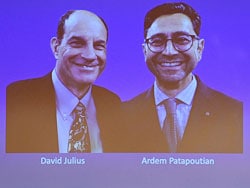
Physiologist David Julius, PhD, University of California San Francisco, and neuroscientist Ardem Patapoutian, PhD, Scripps Research in La Jolla, California, have jointly been awarded the 2021 Nobel Prize in Physiology or Medicine for their discoveries of receptors for temperature and touch.

Their discoveries paved the way for new treatments for a wide range of disease conditions, including chronic pain.

"Our ability to sense heat, cold, and touch is essential for survival and underpins our interaction with the world around us," the Nobel committee, in Stockholm, Sweden, said in a news release. "In our daily lives we take these sensations for granted, but how are nerve impulses initiated so that temperature and pressure can be perceived? This question has been solved by this year's Nobel Prize laureates."/.../

From: Quanta Magazine
d Science News from Quanta Magazine
View this email in your browser
My Bookmarks

NEURAL NETWORKS | ALL TOPICS


A New Link to an Old Model Could Crack the Mystery of Deep Learning

By ANIL ANANTHASWAMY

To help them explain the shocking success of deep neural networks, researchers are turning to older but better-understood models of machine learning.

Read the article

NEUROSCIENCE


How Animals Map 3D Spaces Surprises Brain Researchers

By JORDANA CEPELEWICZ

When animals move through 3D spaces, the neat system of grid cell activity they use for navigating on flat surfaces gets more disorderly. That has implications for some ideas about memory and other processes.

Read the article

Related: 
The Brain Maps Out Ideas
and Memories Like Spaces

by Jordana Cepelewicz (2019)

APPLIED MATH


How Wavelets Allow Researchers to Transform, and Understand, Data

By ALEXANDER HELLEMANS

Built upon the ubiquitous Fourier transform, the mathematical tools known as wavelets allow unprecedented analysis and understanding of continuous signals.

Read the explainer

Related: 
Yves Meyer, Wavelet Expert,
Wins Abel Prize

by Natalie Wolchover (2017)

Q&A


The Astronomer Who’s About to See the Skies of Other Earths

Interview by THOMAS LEWTON;
Video by EMILY BUDER

After the ultra-powerful James Webb Space Telescope launches later this year, Laura Kreidberg will lead two efforts to check the weather on rocky planets orbiting other stars.

Read the interview

Watch the video


Related: 
Exoplanet Puzzle Cracked
by Jazz Musicians

by Joshua Sokol (2017)

QUANTA SCIENCE PODCAST


Eternal Change for No Energy: A Time Crystal Finally Made Real

Podcast hosted by SUSAN VALOT;
Story by NATALIE WOLCHOVER

Like a perpetual motion machine, a time crystal forever cycles between states without consuming energy. Physicists claim to have built this new phase of matter inside a quantum computer.

Listen to the podcast

Read the article


Related: 
What Makes Quantum Computing
So Hard to Explain?

by Scott Aaronson

Around the Web

Crocodiles Are Enduringly Nosey
Crocodiles have repeatedly evolved the same snout over the eons. Today’s crocodile is a “revival of one of evolution’s greatest hits,” Riley Black writes for Smithsonian Magazine. Nature often reinvents the wheel: Researchers studying the strange neural system of comb jellies have even wondered whether neurons evolved more than once, as Emily Singer reported for Quanta in 2015.

Our Machines, Our Learning
A handful of researchers, including one artist, told Nature how artificial intelligence has helped them accelerate scientific research. Scientists are increasingly turning to artificial intelligence algorithms to find patterns in datasets too massive to comprehend, as Dan Falk reported for Quanta in 2019. 


#From: Medium
Não temos nenhuma teoria definitiva sobre origem do universo, nem da vida em nosso mundo. Entretanto o modelo se repete, conforme dizia Valderês: "nada de novo é inventado, pode ser descoberto, mas já aí estava..."
O modelo do ciclo vital deve ser aplicável ao universo: tudo tem um fim e se renova. Tentamos negar a morte, mas ela faz parte da existência. Nosso mundo também deverá ter um fim...


#From: The Washington Post
On the Nobel Peace Prize