Translate AMICOR contents if you like

Showing posts with label physics. Show all posts

Friday, September 11, 2020

Quanta Magazine


My Bookmarks

NUMBER THEORY | ALL TOPICS


Mathematicians Open a New Front on an Ancient Number Problem

By STEVE NADIS

For millennia, mathematicians have wondered whether odd perfect numbers exist, establishing an extraordinary list of restrictions for the hypothetical objects in the process. Insight on this question could come from studying the next best things.

Read the article

ShareShare
TweetTweet
ForwardForward

EVOLUTION


How Two Became One: Origins of a Mysterious Symbiosis Found

By VIVIANE CALLIER

Carpenter ants need endosymbiotic bacteria to guide the early development of their embryos. New work has reconstructed how this deep partnership evolved.

Read the article

ShareShare
TweetTweet
ForwardForward

ABSTRACTIONS BLOG


A New Cosmic Tension: The Universe Might Be Too Thin

By CHARLIE WOOD

Cosmologists have concluded that the universe doesn’t appear to clump as much as it should. Could both of cosmology’s big puzzles share a single fix?

Read the blog

Sunday, August 30, 2020

5th Dimension


Combining the best of many worlds and consistent histories, the 5th dimension may resolve a 100 year old…

Light And Gravitational Waves

Best of Starts With A Bang! for you
There was less than a 2 second delay between gravitational waves and light, but that’s incredibly meaningful.
Ethan SiegelMember only content9 min read

Saturday, August 29, 2020

Consciousness


Does Quantum Mechanics Explain Self-Awareness and Free Will?

Wednesday, August 12, 2020

Erwin Schrödinger

Erwin Schrödinger
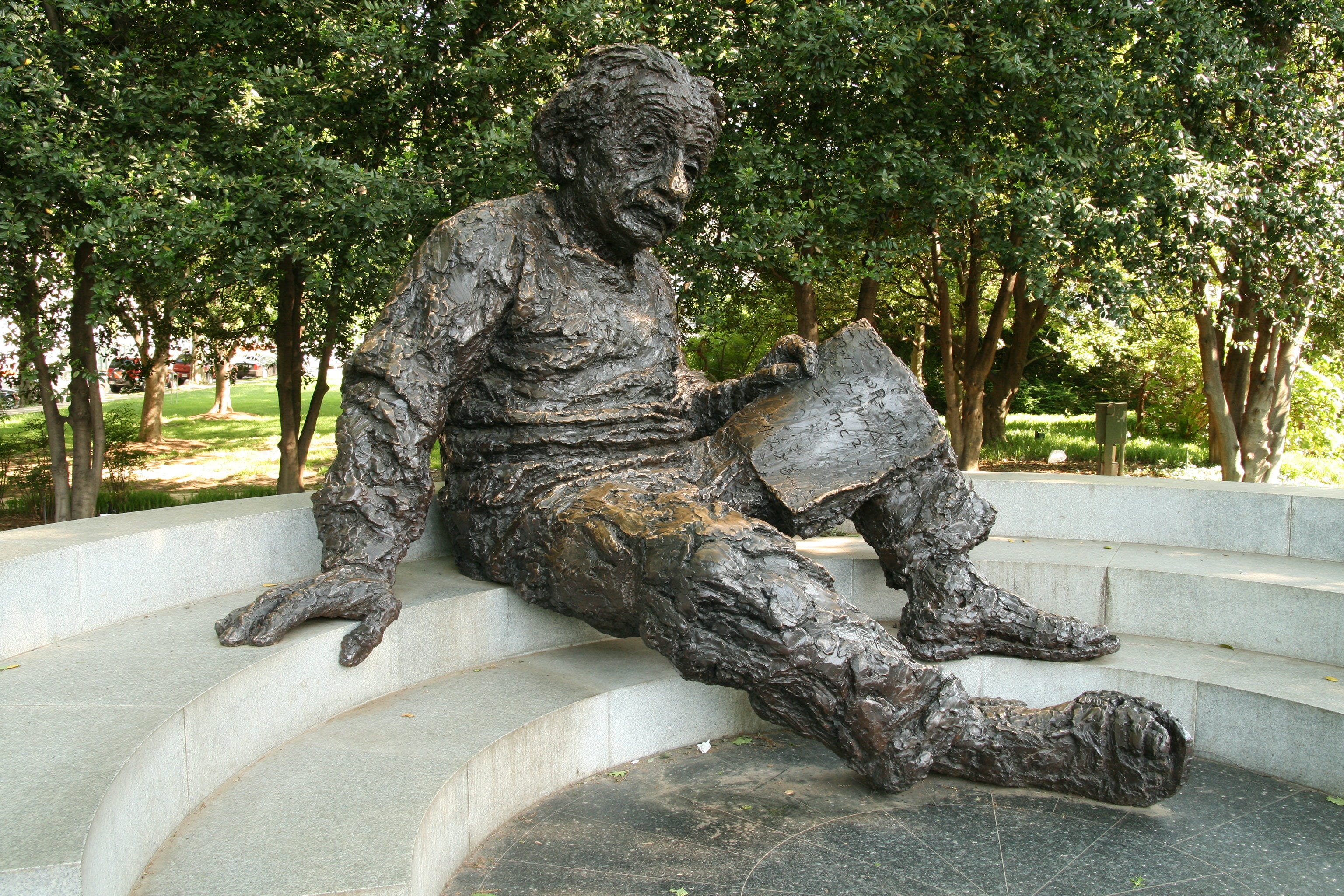
1887: Austrian theoretical physicist Erwin Schrödinger, who shared the 1933 Nobel Prize for Physics for his contributions to the wave theory of matter and to other fundamentals of quantum mechanics, was born in Vienna. [How much do you know about physics?]

Friday, August 07, 2020

Quantum particles

Physicists watch quantum particles tunnel through solid barriers. Here's what they found.

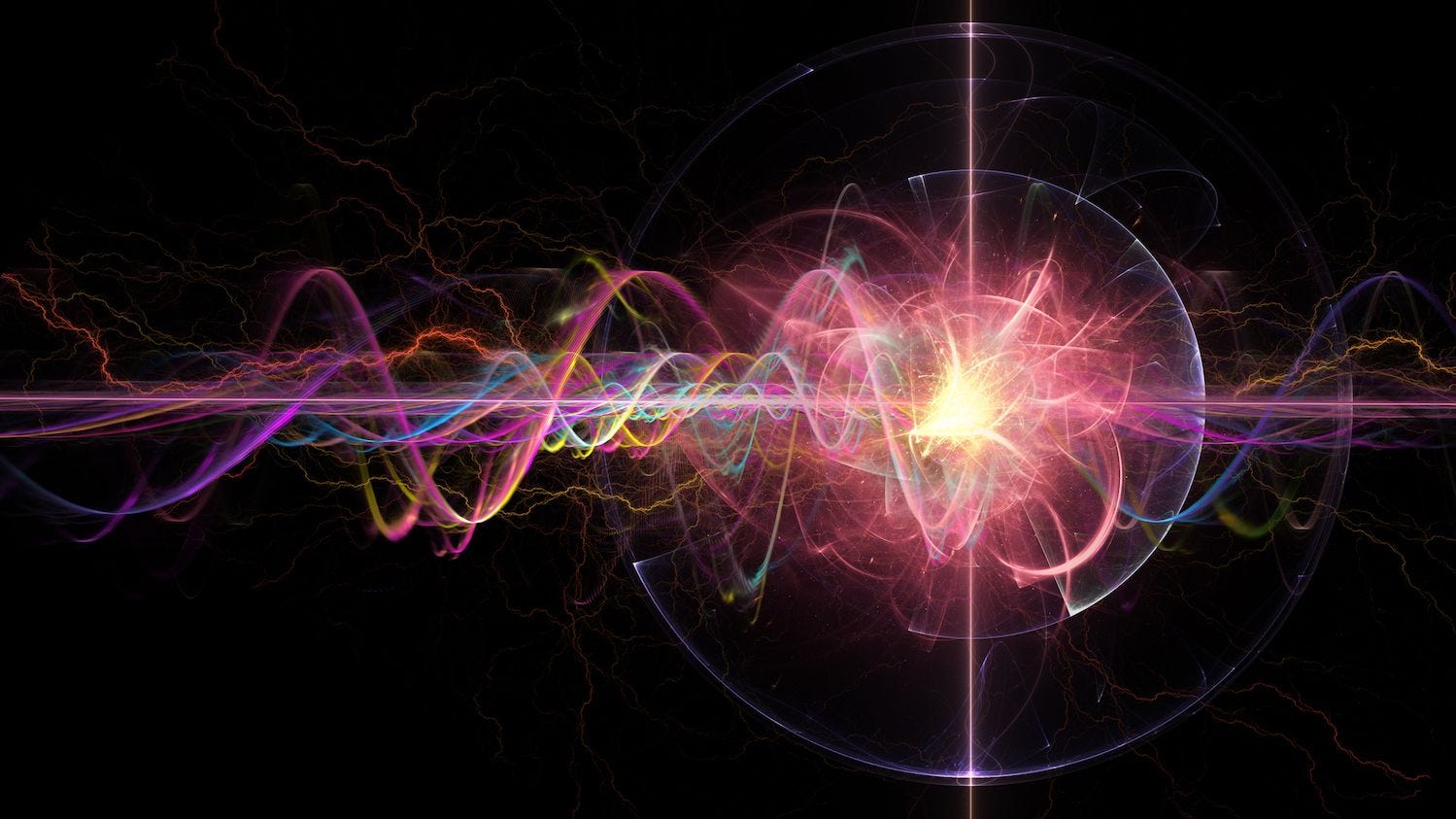
Abstract image of quantum tunneling or space-time wormholes.
(Image: © Shutterstock)
The quantum world is a pretty wild one, where the seemingly impossible happens all the time: Teensy objects separated by miles are tied to one another, and particles can even be in two places at once. But one of the most perplexing quantum superpowers is the movement of particles through seemingly impenetrable barriers.
Now, a team of physicists has devised a simple way to measure the duration of this bizarre phenomenon, called quantum tunneling. And they figured out how long the tunneling takes from start to finish — from the moment a particle enters the barrier, tunnels through and comes out the other side, they reported online July 22 in the journal Nature

Friday, July 24, 2020

General Relativity


Einstein’s theory of General Relativity that explains both the force of gravity and the shape of our universe…

Wednesday, July 08, 2020

Pentadiamonds

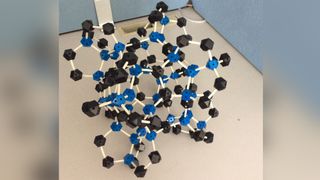
Weird new 'pentadiamonds' could be ultrahard, ultralight and conduct electricity

a ball and stick model of a pentadiamond
(Image: © Susumu Okada)
What's lighter than a diamond, almost as hard and could zip with electricity? A pentadiamond — a crystalline arrangement of carbon atoms that is made up mostly of pentagons. 

Thursday, June 18, 2020

Axions

BREAKING: Physicists announce first direct evidence for 'axions'


Axions are unconfirmed, hypothetical ultralight particles from beyond the Standard Model of particle physics, which describes the behavior of subatomic particles. Theoretical physicists first proposed the existence of axions in the 1970s in order to resolve problems in the math governing the strong force, which binds particles called quarks together. But axions have since become a popular explanation for dark matter, the mysterious substance that makes up 85% of the mass of the universe, yet emits no light.


If confirmed, it's not yet certain whether these axions would in fact fix the asymmetries in the strong force. And they wouldn't explain most of the missing mass in the universe, said Kai Martens, a physicist at the University of Tokyo who worked on the experiment. These axions, which appear to be streaming out of the sun, don't act like the "cold dark matter" that physicists believe fills halos around galaxies. And they would be particles newly brought into being inside the sun, while the bulk of the cold dark matter out there appears to have existed unchanged for billions of years since the early universe./.../

Wednesday, June 17, 2020

Fifth Dimension


Kick a cube across the floor. Hard. In the few seconds it’s in motion for, you’re seeing four dimensions in…