Translate AMICOR contents if you like

Saturday, September 26, 2015

2015–16 State of the Future

2015–16 State of the Future

September 23, 2015
author |
 
Jerome C. Glenn, Elizabeth Florescu
year published |
 
2015
The 2015-16 State of the Future is a compelling overview of humanity’s present situation, challenges and opportunities, potentials for the future, and actions and policies that could improve humanity’s outlook — in clear, precise, and readable text with unparalleled breadth and depth.
This is the 18th and best edition of the State of the Future produced by The Millennium Project with its 56 Nodes around the world and two regional networks (Europe and Latin America).
It clearly documents humanity’s present situation; its challenges and opportunities; potentials for the future; and actions and policies that could improve humanity’s outlook with unparalleled breadth and depth.
“It is time for intolerance of irrelevant speeches and non-actions by leaders. The stakes are too high to tolerate business as usual,” declares Jerome Glenn, lead author of the report and CEO of The Millennium Project — referring to issues like future impacts of artificial intelligence, synthetic biology, organized crime, asymmetric warfare, and how to produce enough food, water, and energy for another 2.3 billion people in just 35 years.
289 pages; 53 Figures, and 11 tables. Price: electronic (pdf) $29.95; paperback: $39.95 US dollars + shipping
— Publisher

Thursday, September 24, 2015

Maps

18 Maps That Will Change How You See The World

Including some disturbing news for America.

Franklin D. Roosevelt

5 FDR Quotes On Poverty That Still Totally Hold Up

It’s really quite surprising that Franklin D. Roosevelt was only considered important enough for the tiniest of American currency, because he was one hell of a President. Not only did he battle polio — POLIO — he also was a crusader for what he called “the forgotten man,” i.e. the poor.
Like waaaaaay before it was cool.
And get this — he didn’t even grow up poor! He just knew that poor people needed care and then talked about it and tried to help them.
As the Presidential race heats up (bye, Scott Walker! See you in Hell!) and New York City and other locations around the country fight for a higher minimum wage (with which even the current President is on board), it’s important to remember that:
a.) the idea of raising up the poor is neither new nor radical, and
b.) there’s a lot of really respected leadership that spoke on it decades ago.
********************
We cannot be content, no matter how high that general standard of living may be, if some fraction of our people — whether it be one-third or one-fifth or one-tenth — is ill-fed, ill-clothed, ill-housed, and insecure. [Source]
True individual freedom cannot exist without economic security and independence. People who are hungry and out of a job are the stuff of which dictatorships are made. [Source]

Second Bill of Rights

Second Bill of Rights

File:Second Bill of Rights Speech.ogv

President Franklin D. Roosevelt announced the plan for a bill of social and economic rights in the State of the Union address of January 11, 1944 (filmed excerpt)
During President Roosevelt's January 11, 1944 message to the Congress of the United States on the State of the Union, he said the following:[2]
It is our duty now to begin to lay the plans and determine the strategy for the winning of a lasting peace and the establishment of an American standard of living higher than ever before known. We cannot be content, no matter how high that general standard of living may be, if some fraction of our people—whether it be one-third or one-fifth or one-tenth—is ill-fed, ill-clothed, ill-housed, and insecure.
This Republic had its beginning, and grew to its present strength, under the protection of certain inalienable political rights—among them the right of free speech, free press, free worship, trial by jury, freedom from unreasonable searches and seizures. They were our rights to life and liberty.
As our nation has grown in size and stature, however—as our industrial economy expanded—these political rights proved inadequate to assure us equality in the pursuit of happiness.
We have come to a clear realization of the fact that true individual freedom cannot exist without economic security and independence. “Necessitous men are not free men.”[3] People who are hungry and out of a job are the stuff of which dictatorships are made.
In our day these economic truths have become accepted as self-evident. We have accepted, so to speak, a second Bill of Rights under which a new basis of security and prosperity can be established for all—regardless of station, race, or creed.
Among these are:
  • The right to a useful and remunerative job in the industries or shops or farms or mines of the nation;
  • The right to earn enough to provide adequate food and clothing and recreation;
  • The right of every farmer to raise and sell his products at a return which will give him and his family a decent living;
  • The right of every businessman, large and small, to trade in an atmosphere of freedom from unfair competition and domination by monopolies at home or abroad;
  • The right of every family to a decent home;
  • The right to adequate medical care and the opportunity to achieve and enjoy good health;
  • The right to adequate protection from the economic fears of old age, sickness, accident, and unemployment;
  • The right to a good education.
All of these rights spell security. And after this war is won we must be prepared to move forward, in the implementation of these rights, to new goals of human happiness and well-being.
America's own rightful place in the world depends in large part upon how fully these and similar rights have been carried into practice for all our citizens. For unless there is security here at home there cannot be lasting peace in the world.

World Conference on Health Promotion 2016


Inscrição temporária e informações

Wednesday, September 23, 2015

Human Brain Project

Why the Human Brain Project Went Wrong--and How to Fix It

Two years in, a $1-billion-plus effort to simulate the human brain is in disarray. Was it poor management, or is something fundamentally wrong with Big Science?


Mario Wagner

In Brief

  • In 2013 the European Commission awarded neuroscientist Henry Markram $1.3 billion to pursue an audacious goal: building a simulation of the human brain.
  • Markram's initiative, the Human Brain Project (HBP), is now in disarray. Critics blame HBP management and the project's unreasonably ambitious goals.
  • Yet plenty of blame for the HBP's woes rests with the project's funders in Brussels, who put politics ahead of science and exercised poor oversight.
  • The American BRAIN Initiative has shown that big neuroscience projects can succeed. The HBP is now being reorganized to help it do just that.
For decades Henry Markram has dreamed of reverse engineering the human brain. In 1994, as a postdoctoral researcher then at the Max Planck Institute for Medical Research in Heidelberg, Germany, he became the first scientist to “patch” two living neurons simultaneously—to apply microscopic pipettes to freshly harvested rat neurons to measure the electrical signals fired between them. The work demonstrated the process by which synapses are strengthened and weakened, making it possible to study and model how the brain learns. His work landed him a position as senior scientist at the prestigious Weizmann Institute of Science in Rehovot, Israel, and by the time he was promoted to professor in 1998, he was one of the most esteemed researchers in the field.
Then he began to get frustrated. Although researchers worldwide were publishing tens of thousands of neuroscience studies every year, neither our understanding of basic brain functions nor our ability to treat brain disorders seemed to be progressing much. Markram's consternation was also deeply personal. While he was still in Germany, his son Kai had been diagnosed with autism. As he told The Guardian in 2013, he wanted “to be able to step inside a simulation of my son's brain and see the world as he sees it.” The only way to do that, he reasoned, was to go beyond individual experiments with behaviors, diseases and brain anatomy and instead model the circuitry of the entire human brain./.../

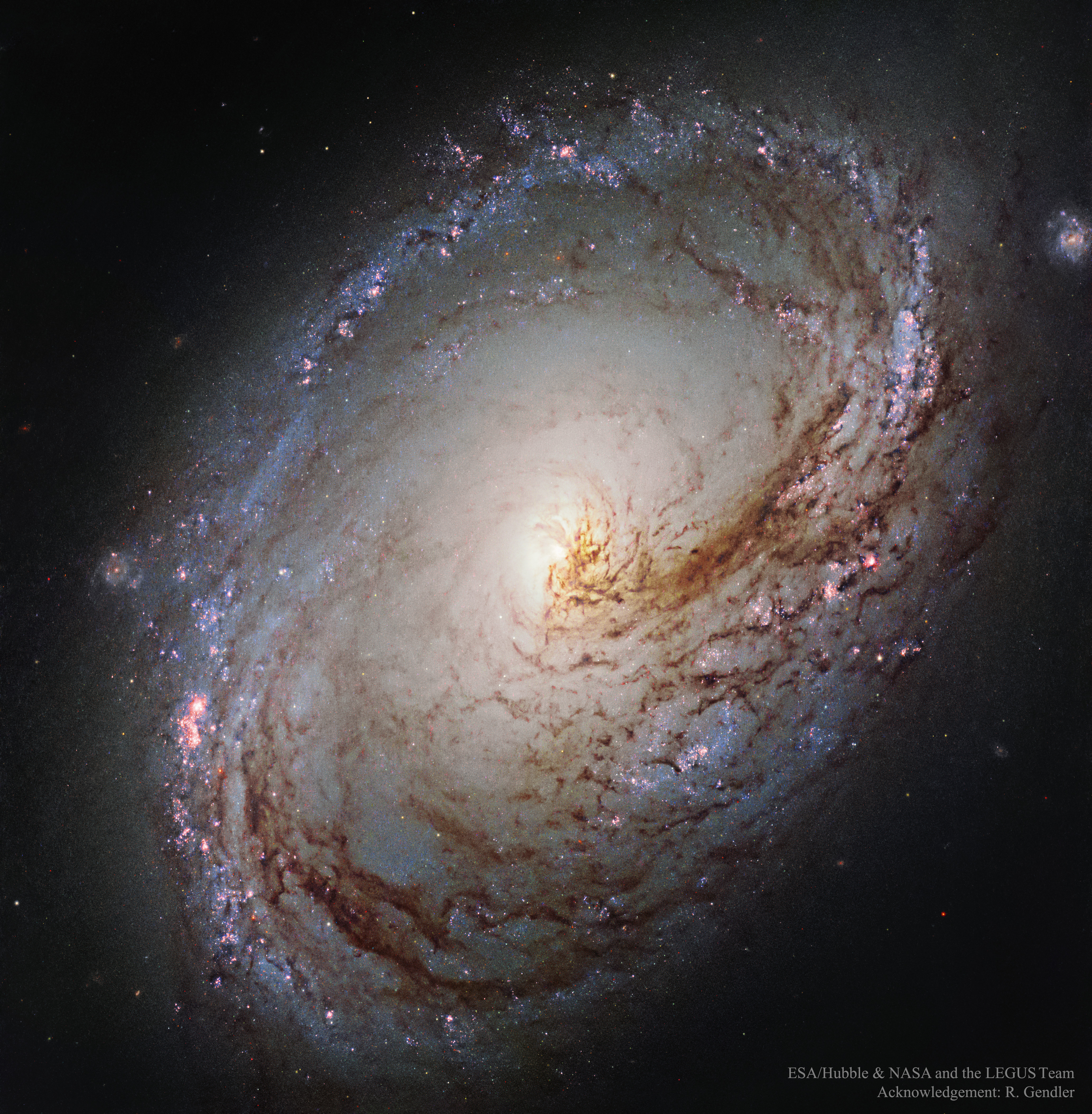
Spiral Galaxy M96

Astronomy Picture of the Day

Discover the cosmos! Each day a different image or photograph of our fascinating universe is featured, along with a brief explanation written by a professional astronomer.
2015 September 21
See Explanation.  Clicking on the picture will download
 the highest resolution version available.
Spiral Galaxy M96 from Hubble 
Image Credit: ESA/Hubble & NASA and the LEGUS TeamAcknowledgement: R. Gendler
Explanation: Dust lanes seem to swirl around the core of Messier 96 in this colorful, detailed portrait of the center of a beautiful island universe. Of course M96 is a spiral galaxy, and counting the faint arms extending beyond the brighter central region, it spans 100 thousand light-years or so, making it about the size of our own Milky Way. M96, also known as NGC 3368, is known to be about 35 million light-years distant and a dominant member of the Leo I galaxy group. The featured image was taken by the Hubble Space Telescope. The reason for M96's asymmetry is unclear -- it could have arisen from gravitational interactions with other Leo I group galaxies, but the lack of an intra-group diffuse glow seems to indicate few recent interactions. Galaxies far in the background can be found by examining the edges of the picture.

Explore your Universe: Random APOD Generator 

Tree of Life


'Tree of life' for 2.3 million species released

A first draft of the "tree of life" for the roughly 2.3 million named species of animals, plants, fungi and microbes—from platypuses to puffballs—has been released.
dateSep 19, 2015 in Plants & Animals
shares21637 comments 97
Posted: 22 Sep 2015 07:50 PM PDT

Com base em dados de centenas de estudos previamente divulgados, cientistas compilaram uma gigantesca árvore da vida com 2,3 milhões de espéciesContinua...
 
********************************************************

‘Tree of life’ for 2.3 million species released

A “Wikipedia” for evolutionary trees
September 21, 2015

This circular family tree of Earth’s lifeforms is considered a first draft of the 3.5-billion-year history of how life evolved and diverged (credit: Duke University)
A first draft of the “tree of life” for the roughly 2.3 million named species of animals, plants, fungi and microbes — from platypuses to puffballs — has been released.
A collaborative effort among eleven institutions, the tree depicts the relationships among living things as they diverged from one another over time, tracing back to the beginning of life on Earth more than 3.5 billion years ago.
Tens of thousands of smaller trees have been published over the years for select branches of the tree of life — some containing upwards of 100,000 species — but this is the first time those results have been combined into a single tree that encompasses all of life.
“This is the first real attempt to connect the dots and put it all together,” said principal investigator Karen Cranston ofDuke University. “Think of it as Version 1.0.” The current version of the tree — along with the underlying data and source code — is available to browse, edit, and download free at https://tree.opentreeoflife.org — a sort of “Wikipedia” for the evolutionary trees.
It is also described in an open-access article appearing Sept. 18 in the Proceedings of the National Academy of Sciences.
Uses of evolutionary trees

Open Tree of Life workflow (credit: Cody E. Hinchliff et al./PNAS)
Understanding how the millions of species on Earth are related to one another helps scientists discover new drugs, increase crop and livestock yields, and trace the origins and spread of infectious diseases such as HIV, Ebola and influenza, the scientists say.
The researchers pieced it together by compiling thousands of smaller chunks that had already been published online and merging them together into a gigantic “supertree” that encompasses all named species. The initial draft is based on nearly 500 smaller trees from previously published studies.
To map trees from different sources to the branches and twigs of a single supertree, one of the biggest challenges was simply accounting for the name changes, alternate names, common misspellings and abbreviations for each species. The eastern red bat, for example, is often listed under two scientific names, Lasiurus borealis and Nycteris borealis. Spiny anteaters once shared their scientific name with a group of moray eels.
“Although a massive undertaking in its own right, this draft tree of life represents only a first step,” the researchers wrote. For one, only a tiny fraction of published trees are digitally available.
A survey of more than 7,500 phylogenetic studies published between 2000 and 2012 in more than 100 journals found that only one out of six studies had deposited their data in a digital, downloadable format that the researchers could use.
The vast majority of evolutionary trees are published as PDFs and other image files that are impossible to enter into a database or merge with other trees.
As a result, the relationships depicted in some parts of the tree, such as the branches representing the pea and sunflower families, don’t always agree with expert opinion.
Other parts of the tree, particularly insects and microbes, remain elusive. That’s because even the most popular online archive of raw genetic sequences — from which many evolutionary trees are built — contains DNA data for less than five percent of the tens of millions species estimated to exist on Earth.
“As important as showing what we do know about relationships, this first tree of life is also important in revealing what we don’t know,” said co-author Douglas Soltis of the University of Florida.
To help fill in the gaps, the team is also developing software that will enable researchers to log on and update and revise the tree as new data come in for the millions of species still being named or discovered.
“It’s by no means finished,” Cranston said. “It’s critically important to share data for already-published and newly-published work if we want to improve the tree.”
“Twenty five years ago people said this goal of huge trees was impossible,” Soltis said. “The Open Tree of Life is an important starting point that other investigators can now refine and improve for decades to come.”

Abstract of Synthesis of phylogeny and taxonomy into a comprehensive tree of life
Reconstructing the phylogenetic relationships that unite all lineages (the tree of life) is a grand challenge. The paucity of homologous character data across disparately related lineages currently renders direct phylogenetic inference untenable. To reconstruct a comprehensive tree of life, we therefore synthesized published phylogenies, together with taxonomic classifications for taxa never incorporated into a phylogeny. We present a draft tree containing 2.3 million tips—the Open Tree of Life. Realization of this tree required the assembly of two additional community resources: (i) a comprehensive global reference taxonomy and (ii) a database of published phylogenetic trees mapped to this taxonomy. Our open source framework facilitates community comment and contribution, enabling the tree to be continuously updated when new phylogenetic and taxonomic data become digitally available. Although data coverage and phylogenetic conflict across the Open Tree of Life illuminate gaps in both the underlying data available for phylogenetic reconstruction and the publication of trees as digital objects, the tree provides a compelling starting point for community contribution. This comprehensive tree will fuel fundamental research on the nature of biological diversity, ultimately providing up-to-date phylogenies for downstream applications in comparative biology, ecology, conservation biology, climate change, agriculture, and genomics.
(see Science, 2003, 300:1692-1697)
This file can be printed as a wall poster. Printing at least 54" wide is recommended.

(If you would prefer a simplified version with common names, please see below.)
Blueprint shops and other places with large format printers can print this file for you.
You are welcome to use it for non-commercial educational purposes.
Please cite the source as David M. Hillis, Derrick Zwickl, and Robin Gutell, University of Texas. 
About this Tree: This tree is from an analysis of small subunit rRNA sequences sampled
from about 3,000 species from throughout the Tree of Life. The species were chosen based
on their availability, but we attempted to include most of the major groups, sampled
very roughly in proportion to the number of known species in each group (although many
groups remain over- or under-represented). The number of species
represented is approximately the square-root of the number of species thought to exist on Earth
(i.e., three thousand out of an estimated nine million species), or about 0.18% of the 1.7 million
species that have been formally described and named. This tree has been used
in many museum displays and other educational exhibits, and its use for educational purposes
is welcomed. Below are several adaptations of this figure; my favorites are the two stunning back tattoos
from Clare D'Alberto and Monica Quast. They individually adapted their tattoos
from another version of the tree that I used as a book cover, 
which is shown below the tattoos. Below the book cover is a photo of the tree as it was used in an exhibit on 
"Massive Change:The Future of Global Design" (which first opened in the Vancouver Art Gallery, 
and has since appearedin Toronto and Chicago, and is scheduled to be displayed in various venues
around the world). Then, below that is an artist's commisioned work for a hospital, and links
to an interactive version of the Tree of Life diagram with common names.

http://www.stumbleupon.com/su/2AeZae/:1URzotiCD:6pEqxChc/www.zo.utexas.edu/faculty/antisense/DownloadfilesToL.html


Tuesday, September 22, 2015

médecine personnalisée

RECHERCHE Mardi 22 septembre 2015

Bienvenue dans l’ère de la médecine personnalisée

La médecine personnalisée combine profil génétique et médicaments thérapeutiques de manière ciblée. (Getty Images)
Un programme a été lancé en juin aux Etats-Unis pour faire progresser les thérapies ciblées sur le profil génétique. Les grandes pharmaceutiques, en particulier Roche et Novartis, sont à la pointe
Début juillet a commencé, dans 2400 hôpitaux américains, une vaste opération de dépistage de patients atteints d’une forme ou d’une autre de cancer.
Contrairement aux études cliniques traditionnelles, l’objectif n’est pas de recruter des malades souffrant d’un même type de cancer, du sein, des poumons, ou de la prostate par exemple, pour tester l’efficacité d’un seul nouveau médicament. Il s’agit, au contraire, de rassembler les patients selon le profil génétique de leur tumeur, toutes catégories confondues./.../

Child malnutrition: global estimates

22 September 2015

WHO, UNICEF and the World Bank Group release new joint reporton child malnutrition estimates.

View the key findings

Monday, September 21, 2015

XV Semana Estadual da Água


Enviado pelo Luiz Antonio Grassi

CONVITE

 A Associação Brasileira de Engenharia Sanitária e Ambiental - Seção Rio Grande do Sul (Abes-RS) – com a parceria do Sindicato dos Engenheiros do Rio Grande do Sul (Senge-RS) convida para o lançamento da campanha da XXII Semana Interamericana da Água e XV Semana Estadual da Água , que ocorrerá de 26 de setembro a 3 de outubro com a participação de  órgãos estaduais, municipais, não governamentais e entidades privadas.  
Data: 23 de setembro de 2015, quarta-feira.
Horário: 11 h
Local: Espaço Senge
Av. Érico Veríssimo, 960, Menino Deus, Porto Alegre.
Informações : (51) 3212-1375 / 9971-4987 ou imprensa@abes-rs.org.br

Dia da árvore

Dia da Árvore

Alzheimer coûte

Une femme atteinte de la maladie d'Alzheimer le 19 Janvier 2005 aux Heliades, une structure du centre hospitalier de Beauvais
afp.com - Philippe Huguen
dans
Les coûts médicaux et paramédicaux de la prise en charge des plus de 850.000 personnes atteintes de la maladie d'Alzheimer en France, s'élèvent à quelque 5,3 milliards d'euros par an, selon une étude de la Fondation Médéric Alzheimer.
Ces coûts correspondent à l'établissement du diagnostic, aux soins des malades à leur domicile, à leur prise en charge en établissements de santé, précise cette étude publiée à l'occasion de la Journée mondiale de la maladie d'Alzheimer, le 21 septembre.
Le nombre de malades devrait augmenter de 60% d'ici 2040.
L'hospitalisation en médecine et en chirurgie représente 53% de ces 5,3 milliards d'euros, les soins paramédicaux libéraux en ville (infirmiers, orthophonistes, ergothérapeutes, psychologues, kinésithérapeutes) 27%, les médicaments "anti-Alzheimer" (non curatifs) 13% et l'établissement du diagnostic, en libéral et en hospitalier, 6%.
Le poste le plus lourd est représenté par les hospitalisations, non pas la prise en charge directe de la maladie, mais les complications qu'elle génère (chutes, troubles du comportement, malnutrition, dépression...).
L'aide informelle prodiguée par l'entourage du malade est, elle, estimée à 14 milliards d'euros par an, en moyenne: soins d'hygiène corporelle, aide à l'habillage, à la marche, au ménage, gestion du budget...
Si on additionne coûts médicaux et paramédicaux du secteur sanitaire et aide informelle, on obtient donc un montant de 19,3 milliards d’euros par an, résume l'étude.
Il faudrait y ajouter les coûts du secteur médico-social, bien supérieurs aux 9 milliards d’euros estimés en 2004 par l’Office parlementaire d'évaluation des politiques de santé car de nouveaux dispositifs ont été mis en place suite aux différents plans Alzheimer, souligne la Fondation.
Le coût unitaire du diagnostic en parcours hospitalier est de 1.394 euros par personne, celui établi en ville de 796 euros. Si le premier est plus coûteux, il permet d’établir le diagnostic en une seule journée et de réaliser tous les examens sur place.
En France, 37% des personnes atteintes de la maladie d'Alzheimer ou apparentée résident en institution (294.000 en EHPAD, 21.000 en unité de soins de longue durée), 63% vivent à leur domicile ou équivalent (résidences services…) soit 535.500 personnes.
Sur les 8.000 établissements d’hébergement pour personnes âgées dépendantes (600.000 places), 3.000 sont dotés d'hébergements spécifiques pour les personnes présentant des troubles cognitifs. On compte environ 52.000 places dans les unités spécifiques Alzheimer et 2.500 dans les unités d’hébergement renforcé.
En outre, 134 établissements sont entièrement dédiés à la prise en charge d’Alzheimer, soit 7.000 places. 81% appartiennent au secteur privé contre 52% pour les autres établissements.


Sunday, September 20, 2015

Microbioma

Your Microbiome and You: What Clinicians Need to Know

Scott Peterson, PhD
December 20, 2013
01 of 13
Slide 1.
http://www.medscape.com/features/slideshow/microbiome?src=wnl_edit_specol&impID=829265&faf=1#13?src=sttwit

More on the Microbiome
Connecting the Microbiome and Antibiotics to Obesity

The Gut Microbiome in Health and in Disease

Use of the Microbiome in the Practice of Epidemiology: A Primer

Your Microbiome and You: What Clinicians Need to Know