This Blog AMICOR is a communication instrument of a group of friends primarily interested in health promotion, with a focus on cardiovascular diseases prevention.
To contact send a message to
achutti@gmail.com
http://achutti.blogspot.com
Hoje tentando compreender a importância da Inveja, lembrei-me dos Pecados Capitais e encontrei este quadro do Hieronymus Bosch. Como eu não lembrava mais quais eram, achei que poderia interessar a meus amigos também lembra-los... Os sete Pecados Capitais
Among the ideas we inherited from Rome, none has had a more pernicious power than the division of the world into civilized and barbarian, argues historian Douglas Boin
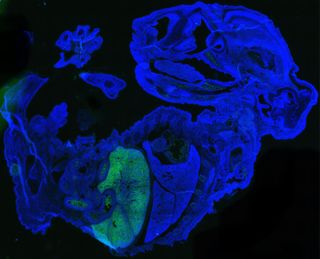
The mouse-human embryo contains up to 4% human cells.
This mouse-human chimera shows human cells (green) in a 17-day-old mouse embryo (blue) that are mostly red blood cells accumulated in the mouse's liver.
A newly-created mouse-human embryo contains up to 4% human cells — the most human cells yet of any chimera, or an organism made of two different sets of DNA.
Surprisingly, those human cells could learn from the mouse cells and develop faster — at the pace of a mouse embryo rather than a more slowly developing human embryo. That finding was "very serendipitous… We did not really foresee that," said senior author Jian Feng, a professor in the department of physiology and biophysics at the State University of New York at Buffalo. /.../
Thank you for signing up for Future of Democracy e-mail alerts! You will be among the first to know when The New Yorker publishes new pieces on the crisis facing American democracy. This limited series will run through November and the Presidential election.
Many institutions of our government are dysfunctional and getting worse. Our electoral system has produced, in a single generation, two Presidents who received fewer votes than their opponents. A changed media landscape has loosened our collective grasp on reality. Technology is enriching some and leaving many others behind; meanwhile, as the country’s demography shifts, a nativist far-right is resurgent. Although President Donald Trump is undeniably a leading actor in this crisis, it precedes him and seems certain to persist after his departure, whenever that may be.
Throughout the course of this project, a wide range of New Yorker writers will explore the past, present, and future of American democracy: tallying our problems, reckoning with their implications, and inspecting proposed solutions.
Is there a specific topic you want the series to explore? Write to us at democracy@newyorker.com and let us know! Feel free to e-mail us with feedback on the project, too. We’d love to hear from you.
To make sure this e-mail always lands in your in-box, please add newyorker@newsletter.newyorker.com to your address book. If this e-mail lands in your Gmail promotions folder, just drag it to your primary folder and click “yes” when it asks if you want to do the same for future messages.
SYDNEY and KUALA LUMPUR, Jan 07 (IPS) - The latest November 2019 UBS/PwC Billionaires Report counted 2,101 billionaires globally, or 589 more than five years before. Earlier, Farhad Manjoo had seriously recommended, ‘Abolish Billionaires', presenting a moral case against the super-rich as they have and get far, far more than what they might reasonably claim to deserve.
Manjoo also argues that unless billionaires' economic and political power is cut, and their legitimacy cast in doubt, they will continue to abuse power to further augment their fortunes and influence, in ways detrimental to the economic, social and public good.
How we can protect truth in the age of misinformation
15:03 minutes · TEDxCERN
Fake news can sway elections, tank economies and sow discord in everyday life. Data scientist Sinan Aral demystifies how and why it spreads so quickly -- citing one of the largest studies on misinformation -- and identifies five strategies to help us unweave the tangled web between true and false.
Google defende suas atividades em saúde, que preocupam EUA
Associação entre Google e Ascension, uma organização de saúde, suscitou uma onda de preocupação nos Estados Unidos - AFP/Arquivos Uma parceria entre o Google e a Ascension, uma empresa de serviços de saúde, levantou preocupações nos Estados Unidos, um sinal de que a coleta em larga escala de dados pessoais pelos gigantes do Vale do Silício tem cada vez mais obstáculos. De acordo com um artigo do Wall Street Journal publicado na terça-feira, um regulador americano abriu uma investigação sobre esse projeto conjunto, chamado Nightingale, inspirado em uma enfermeira britânica do século XIX, conhecida por usar estatísticas para melhorar os cuidados médicos. O projeto conjunto permitirá a coleta e análise dos dados médicos de dezenas de milhões de pacientes para ajudar os médicos a estabelecer melhor o tratamento e garantir um melhor acompanhamento administrativo. Nada de novo, segundo a Google. “Nosso trabalho na Ascension é fornecer as mais recentes tecnologias para um serviço de saúde, como fazemos para dezenas de outras organizações de assistência médica”, disse Tariq Shaukat, presidente da Google Cloud Products and Solutions. Os dados em questão vão da identificação (nomes, datas de nascimento, endereço, família) aos antecedentes e análises laboratoriais, passando pelos medicamentos administrados. “Nossos parceiros usam a Google para gerenciar os dados de seus pacientes, respeitando a privacidade de maneira segura e estrita”, afirmou a gigante da Internet em comunicado divulgado após o primeiro artigo publicado no jornal americano na segunda-feira. As críticas, entretanto, sugerem que a Google não notificou as pessoas envolvidas de que suas informações seriam compartilhadas. – “Nada secreto” – “Nosso trabalho com a Google não tem nada de secreto”, disse Eduardo Conrado, vice-presidente executivo da Ascension. “A Google anunciou isso em julho (em uma conferência para analistas). Os gerentes da Ascension foram informados, foram realizadas sessões informativas em toda a empresa e os enfermeiros e médicos na linha de frente não foram apenas informados, mas também participaram ativamente no projeto”. A Ascension gerencia 2.600 estabelecimentos, incluindo 150 hospitais e 50 residências geriátricas em 20 estados dos Estados Unidos. Ambas as empresas garantem que seu projeto respeita a lei de saúde e de seguro médico dos Estados Unidos de 1996, a HIPAA, que é a referência nessa área. A legislação permite que os hospitais compartilhem dados com parceiros privados sem necessariamente informar os pacientes, desde que essas informações sejam usadas exclusivamente para auxiliar a organização em sua missão de saúde. De acordo com o contrato, o Google permitirá que a Ascension transfira informações digitalizadas sobre seus pacientes de seus data centers nos estabelecimentos para “seu próprio ambiente do Google Cloud, privado e seguro”. É essa transferência que preocupa. O jornal New York Times, por exemplo, garante que “dezenas” de funcionários da Google terão acesso a essas informações confidenciais, de acordo com documentos internos. A Google, principal subsidiária da Alphabet, obtém a maior parte de sua lucrativa receita com publicidade direcionada à Internet, graças aos dados que coleta sobre seus usuários. A empresa foi multada várias vezes pelo gerenciamento dessas informações pessoais. – Inteligência artificial – “Para ser claro: os dados da Ascension não podem ser usados para outros fins que não os serviços incluídos neste contrato. Os dados do paciente não podem ser combinados ou combinados com os dados do consumidor do Google”, disse Tariq Shaukat. O grupo fornecerá aos médicos e enfermeiros da Ascension ferramentas que usam inteligência artificial para “melhorar a qualidade dos tratamentos”. A Google não é a única que investe na nuvem (serviços de computador e armazenamento remoto) e na inteligência artificial para a saúde. Amazon e Microsoft, como Dell e IBM, mudaram seus chips neste mercado que potencialmente valerá bilhões de dólares em 3 ou 4 anos, dizem especialistas. “Cada uma dessas empresas tem seu próprio enfoque”, diz o analista Rob Enderle. Segundo ele, a nuvem é crucial na evolução do setor de saúde, pois os dados dos pacientes são armazenados separadamente, o que não facilita o acesso dos profissionais às informações vitais de que precisam. “É uma pena que essa explosão de desconfiança sobre a Google”, diz. “Estão tentando fazer algo bem, e o Projeto Nightingale é essencialmente projetado para melhorar a qualidade dos cuidados médicos”.
His room was no more than 75 square feet, complete with white concrete walls, peeling and faded from the Iraqi sun. Black tally marks scribbled above his cot indicated the weaponry he used for each shot. A .50 caliber sniper rifle, M24, or a modified M16 with an adjustable gas block each carried the death warrant of an Iraqi man, woman, or sometimes a child carrying an IED./.../
********************
n one of his famous works from the 1800s, Democracy in America, French diplomat and political scientist Alexis de Tocqueville explains a process similar to the one we’re seeing today. In de Tocqueville’s words, here is how democracy becomes tyranny:
Tyranny in democratic republics does not proceed in the same way, however. It ignores the body and goes straight for the soul. The master no longer says: You will think as I do or die. He says: You are free not to think as I do. You may keep your life, your property, and everything else. But from this day forth you shall be as a stranger among us. You will retain your civic privileges, but they will be of no use to you. For if you seek the votes of your fellow citizens, they will withhold them, and if you seek only their esteem, they will feign to refuse even that. You will remain among men, but you will forfeit your rights to humanity. When you approach your fellow creatures, they will shun you as one who is impure. And even those who believe in your innocence will abandon you, lest they, too, be shunned in turn. Go in peace, I will not take your life, but the life I leave you with is worse than death.
De Tocqueville’s statement is prophetic. Today, because Big Brother is always watching, we warp footage however we deem fit — as in January’s face-off between Covington students and a Native elder at the Lincoln Memorial — to tell a false narrative while powerful tech giants reap the benefits. We shout at companies like Facebook and Amazon that something has to change and read books like 1984, scared that it is becoming reality.
***************************
At the height of the Peloponnesian War, a 37-year-old hoplite distinguished himself in battle, even earning praise from an Athenian general. The soldier’s name was Socrates.
Historians credit Socrates as being one of the founders of Western and moral philosophy, but what most people don’t know is that he wrote nothing. His pupil, Plato — who also served as a soldier — collected all his musings. Both philosophers are widely known for the way they challenged system of governments, injustice, and the city-state. Influenced by Socrates, Plato wrote The Republic in 380 B.C. to explore themes we still consider relevant in modern democratic institutions.
In one of his more famous musings from the book, Plato asks what would happen if someone picked the captain of their ship based on their accumulated wealth, instead of a poor man who would make a better captain. He concludes it would doom the voyage, and thus the same is true of ruling a city. His concept later formed the ideals of what’s known as a plutocracy — a society governed by the wealthy. Later, Plato’s understudy, Aristotle, expanded on that idea and pioneered the term oligarchy — in which power rests with a small group of elites linked via wealth, family, education, corporations, or religious/political affiliation.
As a veteran and American, this is the conundrum I feel many of us now face: love of country but disappointment in its government.
An anxious recognition is dawning: the latest scientific and technological developments are so consequential they can’t be left in the hands of scientists alone. Philosophers, artists and others who think outside the algorithm need to be engaged to fathom what it all means for the human condition. That was a key theme that emerged from a panel on science and art at Frieze Los Angeles last week.
“We are entering an age where we can build our own DNA from scratch. We will create a series of beings that are natural but do not exist in nature,” anthropologist Tobias Rees observed. “What then happens to the distinction between nature and technology when we enter post-human land?”/.../
Especialistas da Universidade de New Castle, vem desenvolvendo experiências, e em abril do ano passado, anunciaram ter conseguido converter células-tronco
Unless you are too stoned or enlightened to care, you are probably dissatisfied with the world as it is. In that case, you should have a vision of the world as you would like it to be. This better world is your utopia. That, at any rate, is the premise of a question I’ve been asking scientists and other thinkers lately: What’s your utopia?
I presented students’ responses to this question last year. This final column for 2018 (if aliens land in Central Park or CERN discovers a portal to a parallel universe, I’ll let major media handle it) offers responses from scientists and others I’ve interviewed lately. My hope is that these visions will cheer up readers bummed out by my previous post, “Dark Days.” See the end of the post for my utopia.