This Blog AMICOR is a communication instrument of a group of friends primarily interested in health promotion, with a focus on cardiovascular diseases prevention.
To contact send a message to
achutti@gmail.com
http://achutti.blogspot.com
A new Nature Communications study reveals increased calcium levels in brain cells may play a significant role in the development of Parkinson's disease.
Brains receive input from the outside world, their neurons do somethingto that input, and create an output. That output may be a thought (I want curry for dinner); it may be an action (make curry); it may be a change in mood (yay curry!). Whatever the output, that “something” is a transformation of some form of input (a menu) to output (“chicken dansak, please”). And if we think of a brain as a device that transforms inputs to outputs then, inexorably, the computer becomes our analogy of choice.
The prevalence and incidence of cardiovascular disease are known to vary among different countries,1 most probably depending on income, culture, and healthcare systems, but precise data have been lacking so far. The novel ‘European Society of Cardiology: Cardiovascular Disease Statistics 2017’2 by the Atlas Writing Group compiled cardiovascular disease statistics of the 56 ESC member countries and compared high-income and middle-income ESC member states.
Também chamada la dansarina, gripe pneumônica, peste pneumônica ou simplesmente pneumônica, a gripe espanhola foi uma violenta pandemia que atingiu o mundo em 1918-1919, provocando milhões de mortes, especialmente entre os setores jovens da população. Considerada a mais severa pandemia da história da humanidade, foi causada pela virulência incomum de uma estirpe do vírus Influenza A, do subtipo H1N1.
A denominação “gripe espanhola” foi cunhada devido ao fato de muitas das informações a respeito da doença terem sido transmitidas pela imprensa da Espanha. Os jornais desse país, que se manteve neutro durante a Primeira Guerra Mundial (1914-1918), não sofriam censura quanto às notícias sobre a epidemia, o que não era o caso da imprensa dos países beligerantes. Por isso, assim que a gripe chegava a algum país, era logo chamada de “espanhola”.
In a pioneering study, researchers at the University of Luxembourg used fMRI technology to show that a person’s ability to reinterpret negative events and to control feelings influences how strongly a placebo will work to reduce pain. Dr Marian van der Meulen gave us additional input.
“Brain scans showed researchers that specific regions in the brain react when a person receives a placebo and as a result experiences less pain,” explains Dr Marian van der Meulen, neuropsychologist at the University of Luxembourg. “The regions in the brain that process pain become less active, which demonstrates that the placebo effect is real. But the psychological mechanism is still very little understood, and it is unclear why some people show a much stronger placebo response than others. We suspected that the way we can regulate our emotions plays a role and set out to investigate this.”/.../
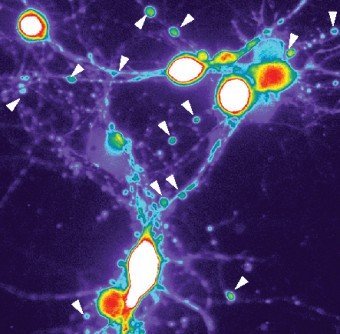
In the brains of people with Alzheimer’s disease, there are abnormal deposits of amyloid beta protein and tau protein, and swarms of activated immune cells. But scientists do not fully understand how these three major factors combine to drive the disease. Now, UNC School of Medicine and National Institutes of Health researchers have untangled the mystery in lab experiments to reveal why one Alzheimer’s drug currently in development shows promise and how other therapies might reverse the disease process.
(Image caption: Neurons treated with Alzheimer’s-associated proteins exhibit drastic calcium increases (blue, green, yellow, red to white), and the cells form tau-filled beaded structures (shown with arrows) identical to neurons seen in Alzheimer’s patients. Credit: Cohen Lab, UNC School of Medicine)
Convenience is the most underestimated and least understood force in the world today. As a driver of human decisions, it may not offer the illicit thrill of Freud’s unconscious sexual desires or the mathematical elegance of the economist’s incentives. Convenience is boring. But boring is not the same thing as trivial.
In the developed nations of the 21st century, convenience — that is, more efficient and easier ways of doing personal tasks — has emerged as perhaps the most powerful force shaping our individual lives and our economies. This is particularly true in America, where, despite all the paeans to freedom and individuality, one sometimes wonders whether convenience is in fact the supreme value.
As Evan Williams, a co-founder of Twitter, recently put it, “Convenience decides everything.” Convenience seems to make our decisions for us, trumping what we like to imagine are our true preferences. (I prefer to brew my coffee, but Starbucks instant is so convenient I hardly ever do what I “prefer.”) Easy is better, easiest is best./.../
JoAnn Wooding is staring intently at the clear liquid dripping from a dark brown IV bag into her husband Peter’s arm. “Please be the drug, please be the drug,” she says. Married for more than 50 years, the Woodings are among the more than 5 million Americans who are facing Alzheimer’s disease, one of the most devastating diagnoses today.
But instead of accepting the slow descent into memory loss, confusion and dementia, Peter–who has the disease–could be among the first to successfully stop that decline from happening.
************************** Neuroscientists reverse Alzheimer’s disease in mice
February 19, 2018
Researchers from the Cleveland Clinic Lerner Research Institute have completely reversed the formation of amyloid plaques in the brains of mice with Alzheimer’s disease by gradually depleting an enzyme called BACE1. The procedure also improved the animals’ cognitive function. The study, published February 14 in the Journal of Experimental Medicine, raises hopes that drugs targeting this …more…
Reciclador de aterros até cirurgião remoto robotizado. Artista francês cria desenhos de possíveis profissões baseado nas discussões do Fórum Econômico Mundial
ode parecer ficção científica, mas são desenhos baseados em tendências e predições para um futuro próximo. Durante o Fórum Econômico Mundial, realizado em Davos, em janeiro deste ano, um equipe de profissionais ouviu os painéis, conferências e rodas de conversa que envolviam o tema sobre o futuro do trabalho.