Translate AMICOR contents if you like

Showing posts with label evolution. Show all posts

Friday, September 18, 2020

Steven Pinker


Steven Pinker

Canadian-American psychologist
Alternative Title: Steven Arthur Pinker

Steven Pinker, in full Steven Arthur Pinker, (born September 18, 1954, MontrealQuebec, Canada), Canadian-born American psychologist who advocated evolutionary explanations for the functions of the brain and thus for language and behaviour.

Pinker was raised in a largely Jewish neighbourhood of Montreal. He studied cognitive science at McGill University, where he received a bachelor’s degree in psychology in 1976. He earned a doctorate in experimental psychology at Harvard University in 1979. After stints as an assistant professor at Harvard (1980–81) and at Stanford University (1981–82), he joined the Department of Brain and Cognitive Sciences at the Massachusetts Institute of Technology (MIT). There he served as codirector of the Center of Cognitive Science (1985–94) and, having been made full professor in 1989, as director of the McDonnell-Pew Center for Cognitive Neuroscience (1994–99). Pinker returned to Harvard in 2003 as a full professor.
Wednesday, September 16, 2020

"Universe 25"


The Horrifying Study That Predicted Human Extinction
How utopia went to hell

Saturday, August 08, 2020

Human Ancestors

Mystery ancestor mated with ancient humans. And its 'nested' DNA was just found.

Homo erectus skull.
An unidentified ancestor that interbred with humans may have been Homo erectus (skull shown here).
(Image: © Shutterstock)
Today's humans carry the genes of an ancient, unknown ancestor, left there by hominin species intermingling perhaps a million years ago. 
The ancestor may have been Homo erectus, but no one knows for sure — the genome of that extinct species of human has never been sequenced, said Adam Siepel, a computational biologist at Cold Spring Harbor Laboratory and one of the authors of a new paper examining the relationships of ancient human ancestors. 

Saturday, June 27, 2020

We’re the Only Humans on Earth

Scientists Present a Theory Explaining Why We’re the Only Humans on Earth
Sarah Sloat, Inverse
It’s easy to forget that we’re a single species within the genus Homo because everyone else is dead.
Save to Pocket

Friday, May 15, 2020

Buckminsterfullerenes

Reconstruction of the Cretaceous marine animal Marsupites testudinarius.
(Image: © J. Hoyal Cuthill)
Weird, multisided geometric shapes called buckyballs have been discovered in an unexpected place: marine animals that lived 80 million years ago. 
Microscopic forms of buckyballs have been found in molecules within cosmic dust, in gases and in some types of rocks. But researchers were surprised to find them at a much larger scale in fossils of two species of Cretaceous crinoids, which are relatives of modern starfish and sea urchins. The plates on the crinoids' bodies created multifaceted, hollow structures that the scientists identified as buckyballs.
Their discovery is the first evidence that the bizarre buckyball shape occurs naturally at such a large scale, the scientists reported in a new study.
PUBLICIDADE

Friday, May 08, 2020

COVID-19 phylogeny


May 8, 2020

Tracking COVID-19 outbreaks with evolution

Earlier this month, an autopsy revealed that COVID-19 began killing people in the United States weeks before we noticed. The newly discovered coronavirus victims had not traveled recently and probably caught it from someone in the community. This suggests that the virus was spreading person-to-person in the U.S. earlier than previously believed. The revised timeline also fits well with new evidence collected by scientists who use evolutionary techniques to unveil the sources and course of COVID-19 outbreaks. Get the whole story here.
-----------------------------
Evolutionary trees: A primer
by the Understanding Evolution team
Confused by a tree diagram in a textbook, webpage, or museum exhibit? Need a quick review of tree-reading before delving into a more difficult topic? This short primer is the place to start. It provides the basic facts you need to know to interpret trees. You can explore the following topics:

Or click "next" to get started!

Saturday, May 02, 2020

Turtle shell


How the turtle got its shell: Amazing fossils are solving the mystery

For years, the oldest turtle fossils we could find had fully formed
shells. Now, more primitive fossils are revealing the strange
tale of how turtle shells evolved
FE 29 April 2020


New Scientist Default Image
Dorling Kindersley Ltd/Alamy

CONSIDER the floating fortress that is a sea turtle. It seems to fly gracefully through the water even though it is encased in heavy armour. This combination of poise and protection evolved like any wonder of the animal kingdom, yet until recently the fossils we had found made it seem as if they emerged fully formed hundreds of millions of years ago. In fact, scientists who study the evolution of these animals have a running joke: turtles might as well have come from space.
In the past few years, however, truly ancient fossils have been discovered and they are helping to unravel this real-life just-so story. As we uncover fresh clues, we are learning that the tale of how the turtle got its shell reads nothing like we had previously guessed.
In the UK, the word “turtle” usually refers to the reptiles that swim in the sea, but these are just one branch of a larger group that includes species that burrow in desert sand and slog through swamps. Whether we are talking about a Galapagos tortoise, green sea turtle or red-eared terrapin at the pet shop, they all belong to an order called Testudines – which zoologists tend to call the turtles or chelonians.


Read more: https://www.newscientist.com/article/mg24632800-800-how-the-turtle-got-its-shell-amazing-fossils-are-solving-the-mystery/#ixzz6LKXU1lbZ

Monday, April 20, 2020

TED on Health

An evolutionary perspective on human health and disease

15:27 minutes · TEDxTufts
How does your genetic inheritance, culture and history influence your health? Biological anthropologist Lara Durgavich discusses the field of evolutionary medicine as a gateway to understanding the quirks of human biology -- including why a genetic mutation can sometimes have beneficial effects -- and emphasizes how unraveling your own evolutionary past could glean insights into your current and future health.
Watch now »

PLAYLIST OF THE DAY

Get into your genes

Get into your genes

Try on these talks about the traits that make you who you are. Watch »
6 talks · Total run time 1:14:58

WORKLIFE WITH ADAM GRANT, A TED ORIGINAL PODCAST

We don't have to fight loneliness alone

Many workplaces have become increasingly lonely, even before the coronavirus pandemic made more of us literally remote. Find out how it might take less than a minute to start building real connections. Listen to WorkLife on Apple podcasts.
Listen now »

Friday, April 17, 2020

Dinosaur DNA

Possible Dinosaur DNA Has Been Found

New discoveries have raised the possibility of exploring dino genetics, but controversy surrounds the results
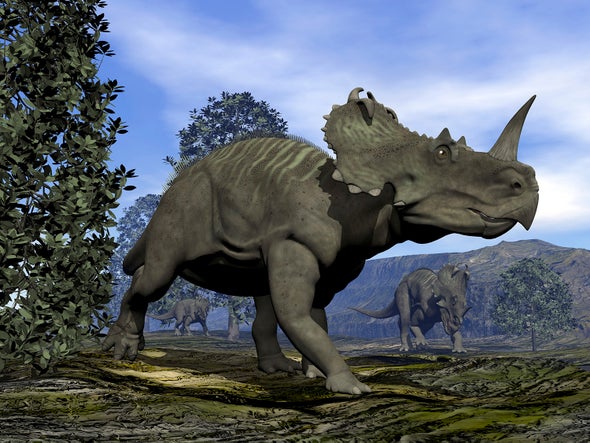
Centrosaurus. Credit: Elena Duvernay Getty Images
The tiny fossil is unassuming, as dinosaur remains go. It is not as big as an Apatosaurus femur or as impressive as a Tyrannosaurus jaw. The object is a just a scant shard of cartilage from the skull of a baby hadrosaur called Hypacrosaurus that perished more than 70 million years ago. But it may contain something never before seen from the depths of the Mesozoic era: degraded remnants of dinosaur DNA.
Genetic material is not supposed to last over such time periods—not by a long shot. DNA begins to decay at death. Findings from a 2012 study on moa bones show an organism’s genetic material deteriorates at such a rate that it halves itself every 521 years. This speed would mean paleontologists can only hope to recover recognizable DNA sequences from creatures that lived and died within the past 6.8 million years—far short of even the last nonavian dinosaurs.