Translate AMICOR contents if you like

Showing posts with label library. Show all posts

Monday, May 11, 2020

The British Library

Saturday, May 09, 2020

NEW YORK PUBLIC LIBRARY


GENERAL OVERVIEW OF THE NEW YORK PUBLIC LIBRARY

The Library established as The New York Public Library, Lenox, Astor, and Tilden Foundations. 
New York Public Library developed in the 19th century and was founded from social libraries of bibliophiles, an amalgamation of grass-roots libraries and the wealthy, aided by the philanthropy of the wealthiest Americans.

NYPL as Historic Landmark

The current library name is also referred to as the Main Branch. New York Public Library is designed with lion statues named Fortitude and Patience that sit on both sides of the main entrance.

In 1965, the main branch was declared as 'National Historic Landmark.' Hence, a year later, in 1966, the Library was listed on the 'National Register of Historic Places,' and designated a 'New York City Landmark' in 1967.

Branch Libraries

The NYPL has branches in Staten Island, the boroughs of the Bronx, Manhattan, and besides, it has affiliations with professional and academic libraries in the NY metropolitan area.

The NY city has two other boroughs, namely Queens and Brooklyn, but those two are not operated by the NYPL system, but instead by the Queens Public Library and the Brooklyn Public Library.


Library Card


Any person who attends school works or pays property taxes in the New York State is eligible to receive the library card free of charge.

To gain the library card, adults can present only one form of valid NY States identification or City IDs:

  • Current driver's license.
  • Current non-driver's ID (includes IDNYC).
  • Current photo learner's permit.
For young adults aged between 13-17, can provide the same ID as adults. Besides, young adults can provide the full name and postal address, along with the following documentation:
  • Current school ID with photo/
  • Current program card or report.
  • Working papers.

Library Services

New York Public Library includes 92 locations along with four research centers. NYPL research centers focus on the social sciences and humanities, arts, culture, and black history, focusing on the humanities and social sciences, the performing arts, black history, and culture, as well as business and industry fields.

Throughout the New York Public Library system, the Library offers many available services for everyone. There is open and free access to its materials, both physical and electronic collections.

The Library has no restrictions for its users. People of all ages, including adults and even young adults from toddlers to teens, can get access to the primary and neighborhood branch libraries in the New York State.

NYPL Research and Circulating collections overall combine more than 51 million items, including materials for the Hard of Hearing, Deaf, Visually Impaired, and for other individuals need occasions.

Besides, New York Public Library presents hundred and thousands of exhibitions, arts, and public programs, such as technology classes, literacy groups, researching classes, and groups for English for Speakers of Other Languages. These kinds of activities are held annually and are accessible to everyone who wants to join and participate.

In total, NYPL serves around 18 million library customers each year, who come through its doors annually. Concerning, the Library's website, it receives approximately 32 million visits from more than 200 countries worldwide, per year.

NYPL Accessibility 

The New York Public Library aims to ensure that everyone has access to the full range of programs, information, and services that are provided in library branches, as well as at the research libraries.
NYPL and other neighborhood branch libraries provide the following accommodation and assistive technologies for library visitors with individual needs:
Visual Impairment / Print Disabilities:
  • Talking Books.
  • DVDs / Videos with descriptive text.
  • JAWs screen-reading software, personal reading machines (e.g., SIBL's Da Vinci video magnifier with an "Eye-Pal Solo" and Text-to-Speech reading device), and MAGic screen magnification software.
  • Technology workshops, etc.
Learning, Developmental, or Cognitive Disabilities:
  • Movie screenings, computer classes, art workshops.
  • Sensory-friendly story-time, play-time for children.
  • Online resources for video story-books, animated picture books.
  • Talking books, players, etc.
  

NYPL Bookmobile

The New York Public Library provides the first Bookmobile Service debuted in 2019. It is planned to add two additional vehicles soon. The service is available in the Bronx, Manhattan, and Staten Island areas.

Besides, the Bookmobile makes stops at various making stops at multiple locations in the city and provides dedicated service in neighborhoods, where the local NYPL branch libraries are closed for a while for renovation or other purposes.

The service with more than 1000 books for all age customers, and two employees on board, people in NY can browse books at curb-side, checking, returning, or renew books. Furthermore, Bookmobile helps you to sign up for an NYPL card, right from the board.

To find out more about where the Bookmobiles will be available, check the schedule on the website, contact at 917-226-3793, or follow @NYPLBookmobile on Twitter. The Bookmobile schedule and locations are subject to change based on parking availability, weather, and other factors.

Monday, November 19, 2018

E-books

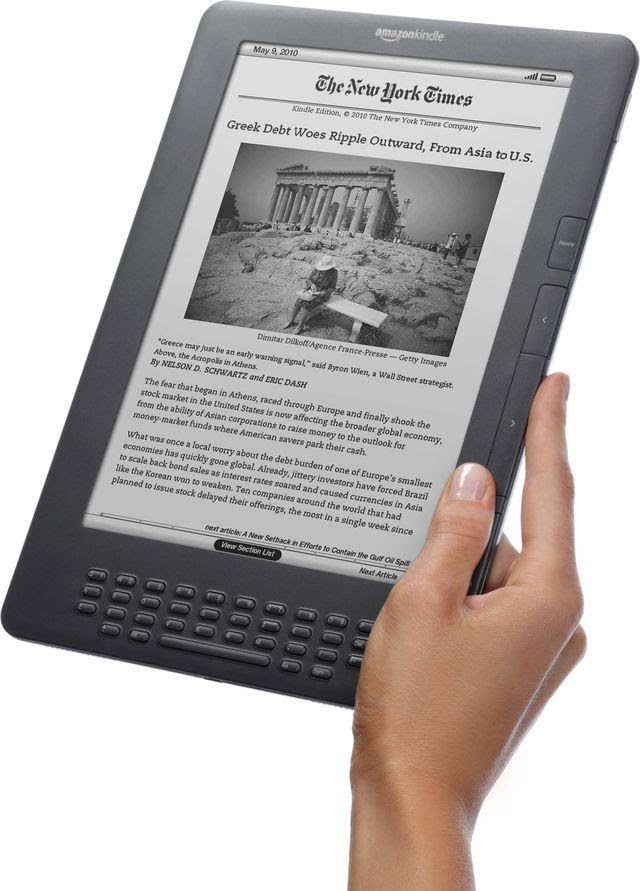
A Kindle DX e-book reader, 2009.

Saturday, March 17, 2018

World Digital Library

Nosso filho nos enviou o link da Biblioteca Digital Mundial.

Já está disponível na Internet, através do site  www.wdl.org

Reúne mapas, textos, fotos, gravações e filmes de todos os tempos e explica em sete idiomas as jóias e relíquias culturais de todas as bibliotecas do planeta.

Tem, sobretudo, caráter patrimonial" , antecipou em LA NACION Abdelaziz Abid, coordenador do projecto impulsionado pela UNESCO e outras 32 instituições. A BDM não oferecerá documentos correntes, a não ser "com valor de  patrimônio, que permitirão apreciar e conhecer melhor as culturas do mundo em idiomas diferentes:árabe, chinês, inglês, francês, russo, espanhol e português. Mas há documentos em linha em mais de 50 idiomas".

Entre os documentos mais antigos há alguns códices precolombianos, graças à contribuição do México, e os primeiros mapas da América, desenhados por Diego Gutiérrez para o rei de Espanha em 1562", explicou Abid.

Os tesouros incluem o Hyakumanto darani , um documento em japonês publicado no ano 764 e considerado o primeiro texto impresso da história; um relato dos azetecas que constitui a primeira menção do Menino Jesus no Novo Mundo; trabalhos de cientistas árabes desvelando o mistério da álgebra; ossos utilizados como oráculos e esteiras chinesas; a Bíblia de Gutenberg; antigas fotos latino-americanas da Biblioteca Nacional do Brasil e a célebre Bíblia do Diabo, do século XIII, da Biblioteca Nacional da Suécia.
 
Fácil de navegar:

Cada jóia da cultura universal aparece acompanhada de uma breve explicação do seu conteúdo e seu significado.. Os documentos foram passados por scanners e incorporados no seu idioma original, mas as explicações aparecem em sete línguas, entre elas O PORTUGUÊS. A biblioteca começa com 1200 documentos, mas foi pensada para receber um número ilimitado de textos, gravados, mapas, fotografias e ilustrações.

Como se acede ao sítio global?

Embora seja apresentado oficialmente  na sede da UNESCO, em Paris, a Biblioteca Digital Mundial já está disponível na Internet, através do sítio:


O acesso é gratuito e os usuários podem ingressar directamente pela Web , sem necessidade de se registrarem..

Permite ao internauta orientar a sua busca por épocas, zonas geográficas, tipo de documento e instituição. O sistema propõe as explicações em sete idiomas (árabe, chinês, inglês, francês, russo, espanhol e português), embora os originas existam na sua língua original.

Desse modo, é possível, por exemplo, estudar em detalhe o Evangelho de São Mateus traduzido em aleutiano pelo missionário russo Ioann Veniamiov, em 1840. Com um simples clique, podem-se passar as páginas um livro, aproximar ou afastar os textos e movê-los em todos os sentidos. A excelente definição das imagens permite uma leitura cômoda e minuciosa.

Entre as jóias que contem no momento a BDM está a Declaração de Independência dos Estados Unidos, assim como as Constituições de numerosos países; um texto japonês do século XVI considerado a primeira impressão da história; o jornal de um estudioso veneziano que acompanhou Fernão de Magalhães na sua viagem ao redor do mundo; o original das "Fábulas" de La Fontaine , o primeiro livro publicado nas Filipinas em espanhol e tagalog, a Bíblia de Gutemberg, e umas pinturas rupestres africanas que datam de 8.000 A .C.

Duas regiões do mundo estão particularmente bem representadas:

América Latina e Médio Oriente. Isso deve-se à activa participação da Biblioteca Nacional do Brasil, à biblioteca de Alexandria no Egipto e à Universidade Rei Abdulá da Arábia Saudita.

A estrutura da BDM foi decalcada do projecto de digitalização da Biblioteca do Congresso dos Estados Unidos, que começou em 1991 e atualmente contém 11 milhões de documentos em linha.

Os seus responsáveis afirmam que a BDM está sobretudo destinada a investigadores, professores e alunos. Mas a importância que reveste esse sítio vai muito além da incitação ao estudo das novas gerações que vivem num mundo áudio-visual.

Friday, December 01, 2017

Best Books - Nature

5 best science books this week

Barbara Kiser’s pick of the top 5 science books to read this week includes a survey of the vast challenges facing India’s mighty Ganges river and a study on how ‘huh?’ and ‘um’ drives verbal communication worldwide.
Five book covers

Tuesday, January 24, 2017

Geriatrics 2016

From: Wiley Geriatrics
JAGS’ Top 15 Most Talked About Articles in 2016
Here are the top 15 articles published in the Journal of the American Geriatrics Society (JAGS) in 2016 as measured by Altmetric, which provides a measure of the quality and quantity of online attention each article receives in traditional news outlets and on social media. Click the @AGSJournal twitter summaries to learn more.
Can a Healthy Lifestyle Compress the Disabled Period in Older Adults?
@AGSJournal: Walking greater distances and having a better diet is associated with a compression of the period spent disabled
Mediation of Cognitive Function Improvements by Strength Gains After Resistance Training in Older Adults with Mild Cognitive Impairment: Outcomes of the Study of Mental and Resistance Training
@AGSJournal: Strength training has clinically relevant benefits for cognitive function, muscle strength, and aerobic capacity
Driving Cessation and Health Outcomes in Older Adults
@AGSJournal: Stopping driving for older adults may contribute to a variety of health problems, particularly depression
Providing Acute Care at Home: Community Paramedics Enhance an Advanced Illness Management Program-Preliminary Data
@AGSJournal: The Community Paramedicine model may enhance care for homebound individuals with advanced illness
High Dose Monthly Vitamin D for Prevention of Acute Respiratory Infection in Older Long-Term Care Residents: A Randomized Clinical Trial
@AGSJournal: High-dose vitamin D3 reduced acute respiratory infections in older long-term care residents but also increased falls
Compression of Morbidity Is Observed Across Cohorts with Exceptional Longevity
@AGSJournal: There is a compression of morbidity at oldest ages that is generalizable to longevity in ethnically diverse groups
Willingness and Ability of Older Adults in the Emergency Department to Provide Clinical Information Using a Tablet Computer
@AGSJournal: Half of older adults in the ED are willing to give health info via tablets, but most can’t enter the info correctly
Effect of Reproductive History and Exogenous Hormone Use on Cognitive Function in Mid- and Late Life
@AGSJournal: Reproductive life events related to sex hormones are positively related to aspects of cognition in later life
Antipsychotic Medication for Prevention and Treatment of Delirium in Hospitalized Adults: A Systematic Review and Meta-Analysis
@AGSJournal: Use of antipsychotic meds are not associated with delirium duration, severity, or hospital/ICU length-of-stay
Global Sensory Impairment in Older Adults in the United States
@AGSJournal:Two-thirds of community-dwelling U.S. adults aged 57 to 85 have two or more sensory deficits
High-Risk Medications in Hospitalized Elderly Adults: Are We Making It Easy to Do the Wrong Thing?
@AGSJournal: Default doses in electronic medical records are often greater than what is recommended for high-risk medications
Effects of Home Based Tai Chi and Lower Extremity Training and Self Practice on Falls and Functional Outcomes in Older Fallers from the Emergency Department Randomized Controlled Trial
@AGSJournal: Tai chi reduces falls more than conventional lower extremity training, with effects lasting for at least 1 year
Potentially Unsafe Activities and Living Conditions of Older Adults with Dementia
@AGSJournal: Older adults with dementia who are not aware of the diagnosis are more likely to engage in unsafe behaviors
How U.S. Doctors Die: A Cohort Study of Healthcare Use at the End of Life
@AGSJournal: Despite what we might think, doctors don’t die that differently than the rest of the U.S. population
Prevalence and Predictors of Fatigue in Middle-aged and Older Adults: Evidence From the Health and Retirement Study
@AGSJournal: The prevalence of fatigue in men and women was much higher than that reported in literature