Translate AMICOR contents if you like

Showing posts with label pandemia. Show all posts

Wednesday, May 13, 2020

The Great Influenza by John M. Barry

The Great Influenza by John M. Barry. A description of the virus:
"No one will ever know with absolute certainty whether the 1918-19 influenza pandemic actually did originate in Haskell County, Kansas. There are other theories of origin, including France, Vietnam, and China. But Frank Macfarlane Burnet, a Nobel laureate who lived through the pandemic and spent most of his scientific career studying influenza, later concluded that the evidence was 'strongly suggestive' that the 1918 influenza pandemic began in the United States, and that its spread was 'intimately related to war conditions and especially the arrival of American troops in France.' Numerous other scientists agree with him. And the evidence does strongly suggest that Camp Funston experienced the first major outbreak of influenza in America; if so, the movement of men from an influenza-infested Haskell to Funston also strongly suggests Haskell as the site of origin.
"Regardless of where it began, to understand what happened next, one must first understand viruses and the concept of the mutant swarm. Viruses are themselves an enigma that exist on the edges of life. They are not simply small bacteria. Bacteria consist of only one cell, but they are fully alive. Each has a metabolism, requires food, produces waste, and reproduces by division.
"Viruses do not eat or burn oxygen for energy. They do not engage in any process that could be considered metabolic. They do not produce waste. They do not have sex. They make no side products, by accident or design. They do not even reproduce independently. They are less than a fully living organism but more than an inert collection of chemicals.
"Several theories of their origin exist, and these theories are not mutually exclusive. Evidence exists to support all of them, and different viruses may have developed in different ways. A minority view suggests that viruses originated independently as the most primitive molecules capable of replicating themselves. If this is so, more advanced life forms could have evolved from them.
"More virologists think the opposite: that viruses began as more complex living cells and evolved -- or, more accurately, devolved -- into simpler organisms. This theory does seem to fit some organisms, such as the 'rickettsia' family of pathogens. Rickettsia used to be considered viruses but are now thought of as halfway between bacteria and viruses; researchers believe they once possessed but lost activities necessary for independent life. The leprosy bacillus also seems to have moved from complexity -- doing many things -- toward simplicity -- doing fewer. A third theory argues that viruses were once part of a cell, an organelle, but broke away and began to evolve independently.
"Whatever the origin, a virus has only one function: to replicate itself.
"But unlike other life forms (if a virus is considered a life form), a virus does not even do that itself. It invades cells that have energy and then, like some alien puppet master, it subverts them, takes them over, forces them to make thousands, and in some cases hundreds of thousands, of new viruses. The power to do this lies in their genes.

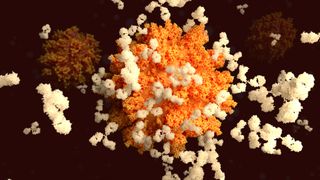
A digitally-colorized, negative-stained transmission electron
microscopic image of recreated 1918 influenza viruses.
"In most life forms, genes are stretched out along the length of a filament-like molecule of DNA, deoxyribonucleic acid. But many viruses -- including influenza, HIV, and the coronavirus that causes SARS (severe acute respiratory syndrome) -- encode their genes in RNA, ribonucleic acid, an even simpler but less stable molecule.
"Genes resemble software; just as a sequence of bits in a computer code tells the computer what to do -- whether to run a word processing program, a computer game, or an Internet search -- genes tell the cell what to do.
"Computer code is a binary language: it has only two letters. The genetic code uses a language of four letters, each representing the chemicals adenine, guanine, cytosine, and thymine (in some cases uracil substitutes for thymine).
"DNA and RNA are strings of these chemicals. In effect they are very long sequences of letters. Sometimes these letters do not form words or sentences that make any known sense: 97 percent of human DNA contains no genes; called 'nonsense' or 'junk' DNA, its function is still unknown.
"But when the letters spell out words and sentences that do make sense, then that sequence is by definition a gene. When a gene in a cell is activated, it orders the cell to make particular proteins. Proteins can be used like bricks as building blocks of tissue. (The proteins that one eats generally do end up building tissue.) But proteins also play crucial roles in most chemical reactions within the body, as well as in carrying messages to start and stop different processes. Insulin, for example, is a hormone but also a protein; it helps regulate the metabolism and it particularly affects blood glucose levels.
"When a virus successfully invades a cell, it inserts its own genes into the cell's genome, and the viral genes seize control from the cell's own genes. The cell's internal machinery then begins producing what the viral genes demand instead of what the cell needs for itself. So the cell turns out hundreds of thousands of viral proteins, which bind together with copies of the viral genome to form new viruses. Then the new viruses escape. In this process the host cell almost always dies, usually when the new viral particles burst through the cell surface to invade other cells.
"But if viruses perform only one task, they are not simple. Nor are they primitive. Highly evolved, elegant in their focus, more efficient at what they do than any fully living being, they have become nearly perfect infectious organisms. And the influenza virus is among the most perfect of these perfect organisms."
The Great Influenza
 
author: John M. Barry 
title: The Great Influenza 
publisher: Penguin Group 
date: Copyright John M. Barry, 2004, 2005 
page(s): 98-100

Monday, May 11, 2020

Coronavirus blood-clot

Coronavirus blood-clot mystery

Purple rashes, swollen legs, clogged catheters and sudden death — all are signs of blood clots, large and small, that are a frequent complication of COVID-19, and researchers are just beginning to untangle why. It’s not just the presence of blood clots that has scientists puzzled: it’s how they show up. “There are so many things about the presentations that are a little bit unusual,” says vascular biologist James O’Donnell.
Nature | 6 min read

Saturday, May 09, 2020

Imuno-inflamação e trombose

Autópsias de Bergamo: O problema principal não era o coronavírusAutópsias de Bergamo: O problema principal não era o coronavírus


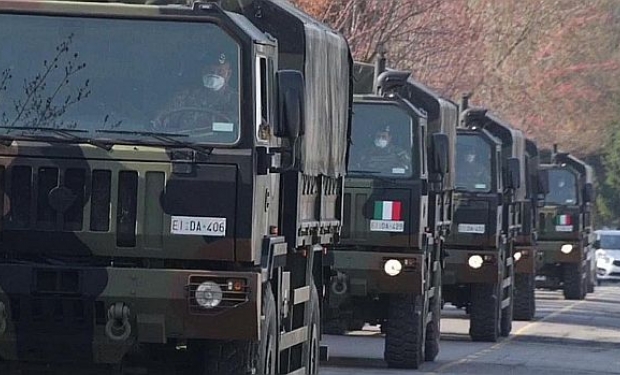
Caminhões militares transportando cadáveres, em Bergamo Fonte: Youtube 

 Conhecendo a linha de pesquisa da AMICOR Maria Inês Reinert Azambuja com quem trabalhei na SSMA nas décadas de 70-80 perguntei para ela se havia visto a referência que está sendo divulgada

Ela respondeu
Sim... tinha visto... pena a politicagem...
Eu escrevi um artigo em 2008 sugerindo imuno-inflamação e trombose como causa da mortalidade em 1918. 

Tuesday, April 21, 2020

CIVID-19 and Genetics

Could genetics explain why some COVID-19 patients fare worse than others?

antibodies attaching to sars-cov-2
(Image: © Shutterstock)
Certain genetic differences might separate people who fall severely ill with COVID-19 from those who contract the infection but hardly develop a cough, a new preliminary study suggests. 
The research is still in its early days, though, experts say.
The immune system can react to viruses thanks, in part, to specific genes that help cells spot unfamiliar bugs when they enter the body. The genes, known as human leukocyte antigen (HLA) genes, contain instructions to build proteins that bind to bits of a pathogen; those proteins serve as warning flags to alert immune cells. The immune cells, once trained to recognize these bits, jumpstart the process of building antibodies to target and destroy the invasive germ. 

Thursday, April 16, 2020

COVID-19 no RS

COVID-19 no RS 
Da Academia Sul Riograndense de Medicina:
Estamos enviando importante estudo epidemiológico sobre a epidemia do Coronavírus no RS,
realizado na UFPEL, sob a coordenação do Prof. Pedro Curi Hallal e dos Acadêmicos
César Victora e Ana Menezes,
a quem cumprimentamos pelo êxito alcançado.
Saudações
Carlos Henrique Menke
Presidente da Academia
Área de anexos

Wednesday, April 15, 2020

Dr. Li Wenliang

Requiem for a whistle-blower

Agence France-Presse — Getty Images
Dr. Li Wenliang tried to warn China about the coronavirus but was silenced by the government authorities. He became a hero in the country when his warnings proved true, then a martyr when he died from the virus in February.
Today, people gather, virtually, at his last post on Weibo, the Chinese social media platform, to grieve and seek solace in the comments section.
Our columnist Li Yuan writes: “In a largely atheist yet spiritual nation with little tradition of praying, the digital Wailing Wall allows the Chinese people to share their sadness, frustration and aspirations with someone they trusted and loved.”

Tuesday, April 14, 2020

Ventilador - COVID-19

COVID 19 GEPEC-VENT
O marido da Profa. Maria Inês Reinert Azambuja, principal colaboradora do AMICOR -  José Azambuja, professor da Engenharia da UFRGS, está coordenando um projeto de desenvolvimento de um ventilador. 
Ela estou participando como liason para a área da saúde.
Até agora trabalham meio quietos mas ontem fizemos este ppt de divulgação pois chegou o momento em que precisam de apoio institucional e dinheiro para fazer os protótipos e os testes. E correm contra o tempo.

Torçam, divulguem e podem contribuir... Há uma conta na FEENGE...
Colegas,

Olá!
Em nosso site, na página com informações sobre o novo Coronavírus e COVID-19 (https://www.ufrgs.br/saudeurbana/coronavirus/), manifestamos o apoio do Programa Saúde Urbana ao Projeto de Ventilador Hospitalar da Escola de Engenharia da UFRGS. A profa. Maria Inês tem sido o ponto de contato.
Abraços,
Roger

Área de anexos
Área de anexos
Área de anexos
orage de cytokines

CORONAVIRUS

Un phénomène d’hyper-inflammation de l’organisme, appelé «orage de cytokines», pourrait jouer un rôle important dans les cas sévères de Covid-19. Des pistes thérapeutiques sont à l’étude

Comment expliquer, dans l’épidémie actuelle de Covid-19, que certaines personnes infectées par le SARS-CoV-2 ne présentent pas ou peu de symptômes, alors que d’autres développent une forme aiguë de la maladie, y compris des individus en apparente bonne santé?
La réponse pourrait bien se trouver au sein de notre système immunitaire, et plus particulièrement dans sa façon de répondre aux infections. L’une des particularités du nouveau coronavirus étant sa capacité à engendrer un phénomène appelé «orage de cytokines», à savoir la libération massive de molécules impliquées dans le contrôle de l’immunité. Cette forme d’hyper-inflammation serait ainsi pointée, selon un article publié mi-mars dans The Lancet par une équipe anglaise, comme un facteur pouvant non seulement expliquer la sévérité mais aussi la mortalité liées au nouveau coronavirus.

Thursday, April 02, 2020

COVID-19 worldwide

World coronavirus cases pass 1 million mark

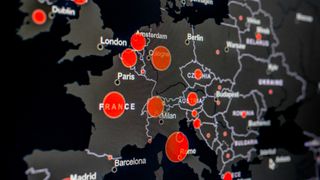
World map of COVID-19 cases
(Image: © Shutterstock)
More than 1 million confirmed cases of COVID-19 have now been reported worldwide.
As of today (April 2), the novel coronavirus SARS-CoV-2 has spread to 204 countries and regions, sickened 1,001,079 and killed 51,385, according to Worldometer, which relies on multiple data sources to track the virus spread. Roughly a month ago, on March 5, the worldwide case count came in at 96,888, Live Science reported

Tuesday, March 31, 2020

Pandemia

NOTA CONJUNTA AO GOVERNADOR E AOS PREFEITOS DO RS
As entidades que assinam este documento manifestam, em conjunto, apoio às
orientações da Organização Mundial da Saúde (OMS) e do Ministério da Saúde, assim
como das principais entidades médicas, sanitárias e científicas do país e do mundo, de
manutenção do isolamento social como fundamental medida para o enfrentamento à
Covid-19.
É necessário respeitar todas as recomendações técnicas pelos próximos dias para
analisar o crescimento da curva no Brasil e o impacto das medidas já adotadas. Para isso,
é imperativo intensificar as estratégias de isolamento para conter o aumento da
pandemia, assim como garantir tempo para organização e redimensionamento do nosso
sistema de saúde.
No Rio Grande do Sul, por exemplo, a grande maioria dos municípios ainda
aguarda a chegada de equipamentos de proteção individual, como máscaras, luvas e
aventais, além de aparelhos hospitalares, como respiradores mecânicos. Precisamos da
firmeza das autoridades das esferas municipal, estadual e federal para manter o
comércio fechado e as aulas suspensas. Mesmo os serviços reconhecidos legalmente
como essenciais, e que precisam seguir em atividade, devem atender meticulosamente
todas as orientações de prevenção e proteção.
O mundo está nos mostrando a gravidade do problema que enfrentamos. Mais
de 30 mil vidas já foram perdidas. As grandes potências sofrem para vencer o novo
Coronavírus. É hora de tomar as medidas necessárias, mesmo sendo duras. Estamos
conscientes com relação a grave crise econômica que enfrentaremos, mas precisamos
lutar em defesa do bem maior de cada ser humano, que é a vida. O momento
recomenda ouvir a voz lúcida da comunidade científica mundial.
Fiquem em casa. A vida não tem preço. Todas as vidas valem.

AJURIS

Presidente Des. Orlando Faccini Neto

CREMERS

Presidente Dr. Eduardo Neubarth Trindade.
Academia Sul-Riograndense de Medicina
Presidente Dr. Carlos Henrique Menke

UFRGS
Reitor Prof. Dr. Ruy Opermam

UFSM

Reitor Prof. Dr. Paulo Burmam

UFPEL

Prof. Dr. Pedro Rodrigues Curi Hallal

FURG

Profa. Dra. Cleuza Sobral Dias
UNIPAMPA

Reitor Prof. Dr. Roberlaine Ribeiro Jorge.

UFCSPA

Reitora Profa. Dra. Lucia Campos Pellanda

IFRS

Reitor Prof. Dr. Julio Xandro Heck

IFSUL

Reitor Prof. Flávio Barbosa Nunes

IFFAR

Reitora Prof. Dra. Carla Jardim

Associação Brasileira de Municípios
Presidente Ary Vanazzi
Federação das Santas Casas e Hospitais
Beneficentes e Filantrópicos do RS
Presidente Dr. André Emilio Lagemann
Assoc. dos Defensores Públicos do Estado
Presidenta Dra. Juliana Coelho Lavigne

CPERS

Presidenta Prof. Helenir Aguiar Schurer

COREN

Presidente Daniel Menezes de Souza.

FAMURS

Presidente Eduardo Russomano Freire.

CSB Brasil
Presidente Antônio Neto
FESSERGS
Presidente Sérgio Arnoud
AJUFERGS

Dra. Rafaela Santos Martins da Rosa

SINDJORS
Presidenta Vera Daisy Barcellos
Associação Riograndense de Imprensa
Presidente Luiz Adolfo Lino de Souza
Federação dos Trabalhadores em Saúde
Presidente Milton Francisco Kempfer
Sindicato dos Enfermeiros
Presidenta Claudia da Cunha Franco

CODIC
Presidente Evandro Soares
Sindiperícias RS
Presidente Carla Perin
AMATRA
Dra. Carolina Gralha
CAU/RS

Presidente Arq. Tiago Holzmann da Silva

IAB/RS

Presidente Rafael Pavan dos Passos.

UGEIRM - Sindicato dos Agentes
de Polícia do RS
Presidente Isaac Ortiz
FECOSUL E CTB
Presidente Guiomar Vidor
SAERGS

Presidente Arq. Evandro Babu Medeiros

AAI BRASIL/RS
Presidente Arq. Gislaine Saibro
Conselho de Psicologia RS
Ana Luiza de Souza Castro
Conselho Regional de Educação Física
Presidente José Edgar Meurer
Conselho Regional de Fonoaudiologia
Presidenta Nadia Lima e Silva
Conselho Regional de Nutricionistas
Presidenta Ivete Barbisan
Conselho Regional de Farmácia
Presidenta Silvana de Vargas Furquim
Conselho Regional de Biologia
Presidente Jackson Muller
Cons. Regional de Repres. Comerciais
Presidente Roberto Salvo
Conselho Regional de Biomedicina
Presidente Renato Minozzo
Conselho Regional de Fisioterapia
Presidente Jair Camargo Lemos

SEASOP

Vice Pres. Valdir Bandeira Fiorentin
Conselho Reg. de Medicina Veterinária
Presidenta Lisandra Dorneles

IBDU

Diretora Betânia de Moraes Alfonsin
Conselho Regional Serviço Social
Pres. Agnaldo Engel Knevi
Conselho Regional de Biblioteconomia
Presidenta Luciana Kramer Pereira Muller

União Gaúcha em Defesa da Previdência
Des. Cláudio Martinewaki
SINDIÁGUA
Pres. Arilson Wunsch

Movimento Nacional de Direitos Humanos
Coordenação Colegiada.
UNDIME

Pres. Marcelo Augusto Malmann

UNCME

Coord. Estadual Fabiane Bitello Pedro.

COSEMS
Pres. Diego Espíndola
IPEATRA

Presidenta Margaret Matos de Carvalho
Associação Pais e Mães pela Democracia
Presidenta Aline Kerber
SINDIGERAL
Presidenta Terezinha Arnoud