The Great Influenza by John M. Barry. A description of the virus:
"No one will ever know with absolute certainty whether the 1918-19 influenza pandemic actually did originate in Haskell County, Kansas. There are other theories of origin, including France, Vietnam, and China. But Frank Macfarlane Burnet, a Nobel laureate who lived through the pandemic and spent most of his scientific career studying influenza, later concluded that the evidence was 'strongly suggestive' that the 1918 influenza pandemic began in the United States, and that its spread was 'intimately related to war conditions and especially the arrival of American troops in France.' Numerous other scientists agree with him. And the evidence does strongly suggest that Camp Funston experienced the first major outbreak of influenza in America; if so, the movement of men from an influenza-infested Haskell to Funston also strongly suggests Haskell as the site of origin.
"Regardless of where it began, to understand what happened next, one must first understand viruses and the concept of the mutant swarm. Viruses are themselves an enigma that exist on the edges of life. They are not simply small bacteria. Bacteria consist of only one cell, but they are fully alive. Each has a metabolism, requires food, produces waste, and reproduces by division.
"Viruses do not eat or burn oxygen for energy. They do not engage in any process that could be considered metabolic. They do not produce waste. They do not have sex. They make no side products, by accident or design. They do not even reproduce independently. They are less than a fully living organism but more than an inert collection of chemicals.
"Several theories of their origin exist, and these theories are not mutually exclusive. Evidence exists to support all of them, and different viruses may have developed in different ways. A minority view suggests that viruses originated independently as the most primitive molecules capable of replicating themselves. If this is so, more advanced life forms could have evolved from them.
"More virologists think the opposite: that viruses began as more complex living cells and evolved -- or, more accurately, devolved -- into simpler organisms. This theory does seem to fit some organisms, such as the 'rickettsia' family of pathogens. Rickettsia used to be considered viruses but are now thought of as halfway between bacteria and viruses; researchers believe they once possessed but lost activities necessary for independent life. The leprosy bacillus also seems to have moved from complexity -- doing many things -- toward simplicity -- doing fewer. A third theory argues that viruses were once part of a cell, an organelle, but broke away and began to evolve independently.
"Whatever the origin, a virus has only one function: to replicate itself.
"But unlike other life forms (if a virus is considered a life form), a virus does not even do that itself. It invades cells that have energy and then, like some alien puppet master, it subverts them, takes them over, forces them to make thousands, and in some cases hundreds of thousands, of new viruses. The power to do this lies in their genes.
 |
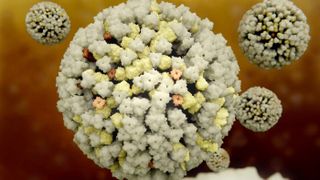
A digitally-colorized, negative-stained transmission electron
microscopic image of recreated 1918 influenza viruses.
|
"In most life forms, genes are stretched out along the length of a filament-like molecule of DNA, deoxyribonucleic acid. But many viruses -- including influenza, HIV, and the coronavirus that causes SARS (severe acute respiratory syndrome) -- encode their genes in RNA, ribonucleic acid, an even simpler but less stable molecule.
"Genes resemble software; just as a sequence of bits in a computer code tells the computer what to do -- whether to run a word processing program, a computer game, or an Internet search -- genes tell the cell what to do.
"Computer code is a binary language: it has only two letters. The genetic code uses a language of four letters, each representing the chemicals adenine, guanine, cytosine, and thymine (in some cases uracil substitutes for thymine).
"DNA and RNA are strings of these chemicals. In effect they are very long sequences of letters. Sometimes these letters do not form words or sentences that make any known sense: 97 percent of human DNA contains no genes; called 'nonsense' or 'junk' DNA, its function is still unknown.
"But when the letters spell out words and sentences that do make sense, then that sequence is by definition a gene. When a gene in a cell is activated, it orders the cell to make particular proteins. Proteins can be used like bricks as building blocks of tissue. (The proteins that one eats generally do end up building tissue.) But proteins also play crucial roles in most chemical reactions within the body, as well as in carrying messages to start and stop different processes. Insulin, for example, is a hormone but also a protein; it helps regulate the metabolism and it particularly affects blood glucose levels.
"When a virus successfully invades a cell, it inserts its own genes into the cell's genome, and the viral genes seize control from the cell's own genes. The cell's internal machinery then begins producing what the viral genes demand instead of what the cell needs for itself. So the cell turns out hundreds of thousands of viral proteins, which bind together with copies of the viral genome to form new viruses. Then the new viruses escape. In this process the host cell almost always dies, usually when the new viral particles burst through the cell surface to invade other cells.
"But if viruses perform only one task, they are not simple. Nor are they primitive. Highly evolved, elegant in their focus, more efficient at what they do than any fully living being, they have become nearly perfect infectious organisms. And the influenza virus is among the most perfect of these perfect organisms."
|
| |
| author: John M. Barry | |
| title: The Great Influenza | |
| publisher: Penguin Group | |
| date: Copyright John M. Barry, 2004, 2005 | |
| page(s): 98-100 |


 President Wilson never uttered a single public statement about the pandemic, which killed about 675,000 Americans
 Today's selection -- from The Great Influenza by John M. Barry. In 1919, when President Woodrow Wilson was in Paris singlehandedly masterminding the direction of post-war treaty negotiations toward the new ideals he had established, he fell ill. That illness may very well have been the Spanish Flu, which had as a side effect an unexpected debilitation of the brain. Whatever it was, after he recovered, Wilson was not the same. The outcome of the talks turned darker, conforming much less to his ideals, and resulted in the acrimony that helped lead to a second world war:
 “Men died like flies, in the street one moment, then three days later, dead,” said nursing orderly Nina Last. “It was more like a plague than influenza.”