Translate AMICOR contents if you like

Showing posts with label virus. Show all posts

Saturday, August 22, 2020

The Viral Universe

Recomendado pela AMICOR Maria InĂªs Reinert Azambuja


The viral universe

Viruses have big impacts on ecology and evolution as well as human health

They are ubiquitous, diverse and very powerful


I The outsiders inside
Humans are lucky to live a hundred years. Oak trees may live a thousand; mayflies, in their adult form, a single day. But they are all alive in the same way. They are made up of cells which embody flows of energy and stores of information. Their metabolisms make use of that energy, be it from sunlight or food, to build new molecules and break down old ones, using mechanisms described in the genes they i nherited and may, or may not, pass on.

It is this endlessly repeated, never quite perfect reproduction which explains why oak trees, humans, and every other plant, fungus or single-celled organism you have ever seen or felt the presence of are all alive in the same way. It is the most fundamental of all family resemblances. Go far enough up any creature’s family tree and you will find an ancestor that sits in your family tree, too. Travel further and you will find what scientists call the last universal common ancestor, luca. It was not the first living thing. But it was the one which set the template for the life that exists today./.../

Thursday, August 20, 2020

The aliens among us


Our cover this week focuses on the universe of viruses , a form of life stripped down to the essentials of information and reproduction. Viruses have caused a litany of modern pandemics, from covid-19 and HIV/AIDS to the influenza outbreak of 1918-20. Before that, the colonisation of the Americas by Europeans was abetted by epidemics of smallpox, measles and influenza. Yet the influence of viruses on life on Earth goes far beyond the tragedies of a single species, however pressing SARS-CoV-2 is today. Recent research puts viruses at the heart of the strategies of genes. It is becoming clear how viruses represent the blind, pitiless power of natural selection at its most dramatic. They have shaped the evolution of organisms of all types since the very beginnings of life.  For humanity they present a heady mix of threat and opportunity.

Friday, August 14, 2020

Tansmition

Friday, July 10, 2020

Covid mutations

A new coronavirus mutation is taking over the world. Here's what that means.

The novel coronavirus uses its spike protein (dark blue) to infiltrate host cells, whose machinery it uses to replicate its RNA (yellow).
(Image: © selvanegra/iStock/Getty Images Plus)
A mutation in the protein that allows SARS-CoV-2 to enter cells might make it easier for the virus to spread — or it might not make a difference at all.
That's the crux of a debate over a mutation known as D614G, which affects the spike protein on the virus' surface. The mutation is not new. It appears in low levels in samples taken from COVID-19 patients as far back as February. But this variation of the virus (nicknamed the "G" variation) seems to show up in more and more of the virus samples taken from people infected recently compared to early in the pandemic.

Wednesday, May 27, 2020

HIV 1966

Oldest 'nearly complete' HIV genome found in forgotten tissue sample from 1966

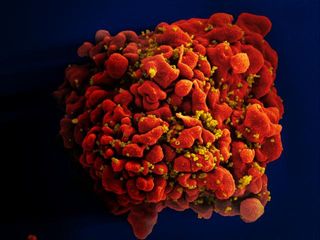
A scanning electron microscope image of an HIV-infected T cell.
A scanning electron microscope image of a T cell infected with HIV.
(Image: © NIAID)

The oldest known nearly complete gene sequence from the HIV strain that spread across the world has been found in a tissue sample from the Democratic Republic of the Congo (DRC), a new study finds.
The tissue sample was taken and preserved in 1966, making this HIV sequence 10 years older than the previous oldest genome, which came from a blood sample taken in 1976 in the DRC. Gene sequences like these – which come from before the virus that causes AIDS was discovered in 1983 – help pinpoint the timing of genetic mutations in the virus. Those mutations, in turn, help scientists track the spread of the virus and the timing of when transmission of HIV took hold in humans./.../

Thursday, April 09, 2020

covid 19 evolution

The deep evolutionary history of the new coronavirus

For the past two months, news of the pandemic coronavirus, known as COVID-19, has rattled people across the U.S. and around the globe. Our last Evo in the News story explained how evolutionary theory helps answer important questions about the origin of the pandemic.  This month we’ll dig even deeper into the virus’s evolutionary history and how those deep relationships relate to prospects for a vaccine. Get the whole story here.
https://mailchi.mp/57acbecb5351/92pt44ko2a-2711184?e=b1842884a0

Monday, April 06, 2020

SARS 2007

Received from (My( friend since ProCOR, Bernard Lown):
Catherine Coleman
Whoa...
JoĂ£o Correia
Check out the date of this paper and the highlighted text...

Tuesday, March 31, 2020

Coronavirus

No, the coronavirus wasn't made in a lab. A genetic analysis shows it's from nature
MAR 26 2020 6:00 AM
Scientists took conspiracy theories seriously and analyzed the coronavirus to reveal its natural origins.
READ MORE  

newsletter image

Social distancing comes with psychological fallout

Mar 29 2020 6:00 AM
Keeping people apart can help slow the new coronavirus' spread. But such social distancing may cause or worsen mental health problems.
READ MORE  
newsletter image

How antibody tests work and could help fight the coronavirus

Mar 27 2020 3:03 PM
Coronavirus antibody tests look for signs in the blood that someone has had an infection and recovered, and could take only a finger prick.
READ MORE  

Friday, March 27, 2020

Viral Load

Does a high viral load 

or infectious dose
make covid-19 worse?

HEALTH 27 March 2020
An illustration of coronavirus particles
MAURIZIO DE ANGELIS/SCIENCE PHOTO LIBRARY
Does being exposed to more coronavirus particles mean you will develop a more severe illness? Rumours circulating on social media suggest that hospital workers or their household members exposed to a higher “viral load” become sicker than the general population. But emerging research indicates the relationship between infection and covid-19 severity may be more complex – and differ from that of other respiratory illnesses.
The average number of viral particles needed to establish an infection is known as the infectious dose. We don’t know what this is for covid-19 yet, but given how rapidly the disease is spreading, it is likely to be relatively low – in the region of a few hundred or thousand particles, says Willem van Schaik at the University of Birmingham, UK.
Viral load, on the other hand, relates to the number of viral particles being carried by an infected individual and shed into their environment. “The viral load is a measure of how bright the fire is burning in an individual, whereas the infectious dose is the spark that gets that fire going,” says Edward Parker at the London School of Hygiene and Tropical Medicine.


Read more: https://www.newscientist.com/article/2238819-does-a-high-viral-load-or-infectious-dose-make-covid-19-worse/#ixzz6HtpIx7Qg