Translate AMICOR contents if you like

Sunday, February 05, 2012

Dsigning Out Medical Error DOME


The Problem

Aims


The ProblemDOME from DOME project on Vimeo.

One in ten hospital patients in the UK suffers unintended harm as a result of medical error - a key contributing factor is that clinical processes continue to evolve but the design of much ward-based equipment remains largely unchanged.

Aims

The Designing Out Medical Error (DOME) project aimed to better understand and map healthcare processes on surgical wards, establishing an evidence base to design equipment and products which better supports these processes and therefore reduce instances of medical error.

See below for the chat box. Join us each Thursday at 3 p.m. EST for a live conversation with leading scientists and expert reporters.
TODAY'S TOPIC
What’s the key to living a long life? Is it all in the genes, or are there antiaging strategies that might make a difference? This week onScienceLive, we’ll chat with experts on the science of aging. They’ll answer your questions on a variety of topics, including whether the human lifespan will continue to increase, what impact antiaging research could have on global demographics, and what the latest research says about what you can do to combat the ill effects of growing older
Join us at 3 p.m. EST on Thursday, 26 January, for a live chat on this page. You can leave your questions in the comment box below before the chat starts.
Save to my calendar
ADDITIONAL READING
:

HealthTap ???


You've heard the buzz. Now, check out what industry experts and professional journalists have been saying.
Times_logo
HealthTap 'just might make you raise both eyebrows in surprise'Read...
Wsj
A company that is defying the oddsRead...
Forbes-logo
Doctors can build up reputation..and ultimately drive patients to their offline real-world practicesRead...
Fortune_logo

You tube : Education


How YouTube is part of a global economic transformation

February 2, 2012
[+]oecdeducation
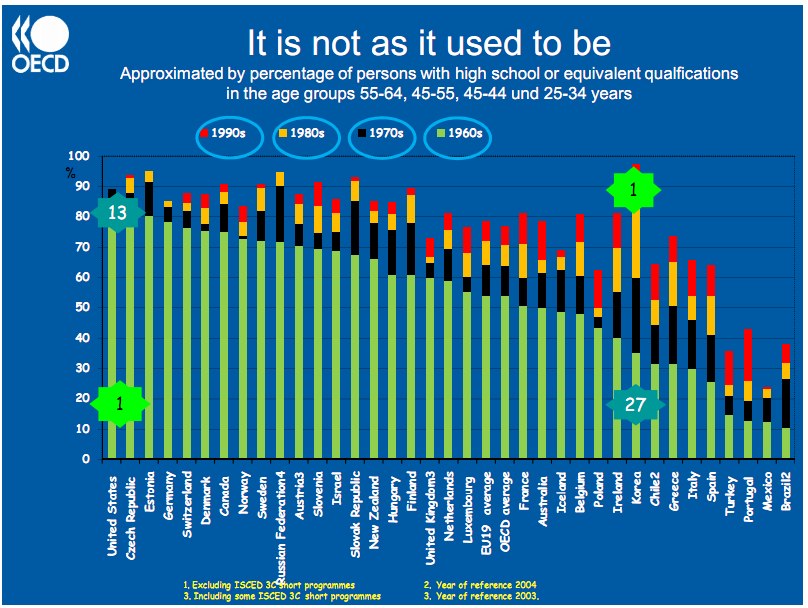
The United States used to be the most educated society in the world. That's no longer true. (Credit: OECD)
Life in this world is not like it used to be just a few decades ago, and the availability of world-class education on-demand, at almost no cost, is likely to help things change all the more as this century unfolds.
YouTube now hosts more than 500,000 educational videos, on a wide variety of topics. The new mobile-friendly iTunes U also offers 500,000 educational resources and says that 60% of its viewership comes from outside the United States. This global consumption of U.S.-created online educational content may be the newest chapter in a radical transformation of global education over the past 50 years.
During the past 50 years, the expansion of education has contributed to a fundamental transformation of societies in Organization for Economic Co-operation and Development (OECD) countries,” wrote the authors of this year’s lengthy report, Education at a Glance 2011: OECD Indicators. (500 page PDF).

Friday, February 03, 2012

Siblings Brain: Addiction


Siblings Brain Study Sheds Light on the Roots of Addiction

Ashley Jouhar / Getty Images
ASHLEY JOUHAR / GETTY IMAGES
Why do some people get addicted while others remain immune to the lure of drugs? Neuroscientists have been studying this question for years, asking whether the difference arises from particular variations in brain structure. But until now the research has not been clear on whether the brain changes seen in addiction are a cause or the result of excessive drug use.
A new study of siblings published Thursday in Science suggests that at least some of the brain differences come first. The study compared cognitive function and brain structure of 47 people with addiction, with 49 of their nonaddicted siblings and 50 healthy unrelated and drug-free volunteers./.../

Precision Medicine ?


Perspective

Preparing for Precision Medicine

Reza Mirnezami, M.R.C.S., Jeremy Nicholson, Ph.D., and Ara Darzi, M.D.
January 18, 2012 (10.1056/NEJMp1114866)
Article
References
Ms. H. is a 35-year-old woman from Japan who has had a cough for 3 weeks. Her physician sends her for an x-ray and CT scan that reveal an advanced lesion, which a biopsy confirms to be non–small-cell lung cancer. She has never smoked. Can anything be done for her?
Had Ms. H.'s cancer been diagnosed before 2004, her oncologist might have offered her a treatment to which about 10% of patients have a response, with the remainder gaining a negligible survival benefit and experiencing clinically significant side effects. But her diagnosis was made in 2011, when her biopsy tissue could be analyzed for a panel of genetic variants that can reliably predict whether the disease will respond to treatment. Her tumor was shown to be responsive to a specific targeted agent, whose administration led to a remission lasting almost a year; her only side effect was a rash.
This scenario illustrates the fundamental idea behind personalized medicine: coupling established clinical–pathological indexes with state-of-the-art molecular profiling to create diagnostic, prognostic, and therapeutic strategies precisely tailored to each patient's requirements — hence the term “precision medicine.” Recent biotechnological advances have led to an explosion of disease-relevant molecular information, with the potential for greatly advancing patient care. However, progress brings new challenges, and the success of precision medicine will depend on establishing frameworks for regulating, compiling, and interpreting the influx of information that can keep pace with rapid scientific developments. In addition, we must make health care stakeholders aware that precision medicine is no longer just a blip on the horizon — and ensure that it lives up to its promise./.../

Memory Loss from Dementia


Questions Help Tell Memory Loss from Dementia

A simple questionnaire can help differentiate individuals experiencing normal age-related memory loss from those at risk for developing dementia, most notably by their orientation to time and patterns of repetitive speech, researchers found.
On the 21-item Alzheimer's Questionnaire, patients having trouble remembering the day, month, year, and time of day were almost 18 times more likely to have amnestic mild cognitive impairment, a precursor to dementia (OR 17.97, 95% CI 2.63 to 122.77, P=0.003), according to Michael Malek-Ahmadi, MSPH, and colleagues from the Banner Sun Health Research Institute in Sun City, Ariz.
Those who often repeated questions, statements, and stories on the same day also were at very high risk (OR 13.12, 95% CI 3.02 to 57.66, P=0.001), the researchers reported online in BMC Geriatrics./.../

Spread of Alzheimer’s


Path Is Found for the Spread of Alzheimer’s

Chang W. Lee/The New York Times
From left, Li Liu, Scott A. Small and Karen Duff examining a mouse brain. Dr. Small and Dr. Duff used mice to study Alzheimer's.
Alzheimer’s disease seems to spread like an infection from brain cell to brain cell, two new studies in mice have found. But instead of viruses or bacteria, what is being spread is a distorted protein known as tau.
Multimedia

Related

The surprising finding answers a longstanding question and has immediate implications for developing treatments, researchers said. And they suspect that other degenerative brain diseases like Parkinson’s may spread in a similar way./.../

Thursday, February 02, 2012

Social Justice

From Dennis Raphael:
Social Justice

Based on   


200TH ANNIVERSARY ARTICLE
The Perpetual Challenge of Infectious Diseases
Anthony S. Fauci, M.D., and David M. Morens, M.D.
N Engl J Med 2012; 366:454-461February 2, 2012
 Interactive Timeline

The Perpetual Challenge of Infectious Diseases.
Among the many challenges to health, infectious diseases stand out for their ability to have a profound impact on the human species. Great pandemics and local epidemics alike have influenced the course of wars, determined the fates of nations and empires, and affected the progress of civilization, making infections compelling actors in the drama of human history.1-11 For 200 years, the Journal has captured the backdrop to this human drama in thousands of articles about infectious diseases and about biomedical research and public health efforts to understand, treat, control, and prevent them./../

Wednesday, February 01, 2012

sustainable development


RESILIENT PEOPLE 
RESILIENT PLANET
A   F u t u r e   Wo r t h   C h o o s i n g

Report

The High-level Panel on Global Sustainability presents its report to the Secretary-General on 30 January 2012 in Addis Ababa.
The 22-member Panel, established by the Secretary-General in August 2010 to formulate a new blueprint for sustainable development and low-carbon prosperity, was co-chaired by Finnish President Tarja Halonen and South African President Jacob Zuma. The Panel's final report, "Resilient People, Resilient Planet: A Future Worth Choosing", contains 56 recommendations to put sustainable development into practice and to mainstream it into economic policy as quickly as possible.
Please click here to view the Press Release of the launch of the report.