Translate AMICOR contents if you like

Saturday, September 05, 2015

Closing the Gap

How can we create economic opportunity for all?
How can we avoid technology-fueled unemployment tomorrow?

<h5>Tom Friedman</h5>Pulitzer Prize-Winning Columnist
Tom Friedman
Pulitzer Prize-Winning Columnist
<h5>Robert Reich</h5>Former U.S. Labor Secretary
Robert Reich
Former U.S. Labor Secretary
<h5>Dr. Henry Kissinger</h5>Nobel Peace Prize Winner
Dr. Henry Kissinger
Nobel Peace Prize Winner
<h5>Nouriel Roubini</h5>Economist, NYU Stern School of Business
Nouriel Roubini
Economist, NYU Stern School of Business
<h5>Chrystia Freeland</h5>Member of Parliament, Canada
Chrystia Freeland
Member of Parliament, Canada
<h5>Niall Ferguson</h5>Harvard University
Niall Ferguson
Harvard University
<h5>Dan Ariely</h5>Behaviorial Economist @ Duke
Dan Ariely
Behaviorial Economist @ Duke
<h5>Andrew McAfee</h5>Author @ MIT
Andrew McAfee
Author @ MIT
<h5>Salim Ismail</h5>Global Ambassador for Singularity University
Salim Ismail
Global Ambassador for Singularity University
<h5>Clara Miller</h5>President, Heron Foundation
Clara Miller
President, Heron Foundation
<h5>Vivek Wadhwa</h5>Stanford University
Vivek Wadhwa
Stanford University
<h5>Philip Zelikow</h5>University of Virginia
Philip Zelikow
University of Virginia
<h5>Gerald Huff</h5>Tesla Motors
Gerald Huff
Tesla Motors
“The defining issue of our time.” - Nouriel Roubini

Age and fittness

Older people in Germany and England getting smarter, but not fitter
September 1, 2015

smarter not fitter People over age 50 are scoring better on cognitive tests than people of the same age did in the past — a trend that could be linked to higher education rates and increased use of technology in our daily lives, according to a new study published in an open-access paper in the journal PLOS ONE. But the … more…

37 billion stars and galaxies

World’s most powerful, largest digital camera: 37 billion stars and galaxies

3.2-gigapixel digital camera will take digital images of the entire visible southern sky every few nights, producing 15 Terabytes of data
September 1, 2015

The LSST’s camera will include a filter-changing mechanism and shutter. This animation shows that mechanism at work, which allows the camera to view different wavelengths; the camera is capable of viewing light from near-ultraviolet to near-infrared (0.3-1 μm) wavelengths. (credit: SLAC National Accelerator Laboratory)
The Department of Energy has approved the start of construction for a 3.2-gigapixel digital camera — the world’s largest — at the heart of the Large Synoptic Survey Telescope (LSST), revealing unprecedented details of the universe and helping unravel some of its greatest mysteries.

DALYs and HALEs 1990-2013

Life expectancy climbs worldwide but people spend more years living with illness and disability
September 2, 2015

Life expectancy at birth, both sexes, 2013 (credit: Institute for Health Metrics and Evaluation) 
Global life expectancy has risen by more than six years since 1990
The good news: as for 2013, global life expectancy for people in 188 countries has risen 6.2 years since 1990 (65.3 to 71.5). The bad news: healthy life expectancy (HALE) at birth rose by only 5.4 years (56.9 to 62.3), due to fatal and nonfatal ailments (interactive visualization by country here). In other words, people … more…

Parkinson's D

Treatement with noninvasive focused ultrasound for Parkinson’s disease
September 2, 2015

University of Maryland medical doctors monitor focused ultrasound treatment for essential tremor, guided by magnetic resonance imaging (MRI) (credit: University of Maryland School of Medicine) Researchers at the University of Maryland have performed the first focused ultrasound treatments on a deep structure within the brain related to Parkinson’s disease* called the globus pallidus. These treatments are part of international pilot studies of 40 patients assessing the feasibility, safety, and preliminary efficacy of focused ultrasound treatments for Parkinson’s disease, guided by … more…

Wednesday, September 02, 2015

Happiness

World Happiness Report 2015 Ranks Happiest Countries

quantum motion

Seeing quantum motion

August 28, 2015 by Jessica Stoller-Conrad
Seeing quantum motion
Credit: Chan Lei and Keith Schwab/Caltech
Consider the pendulum of a grandfather clock. If you forget to wind it, you will eventually find the pendulum at rest, unmoving. However, this simple observation is only valid at the level of classical physics—the laws and principles that appear to explain the physics of relatively large objects at human scale. However, quantum mechanics, the underlying physical rules that govern the fundamental behavior of matter and light at the atomic scale, state that nothing can quite be completely at rest./.../


Read more at: http://phys.org/news/2015-08-quantum-motion.html#jCp

Tuesday, September 01, 2015

New Drugs

Last week I experienced a tumultuous interface with the pharmaceutical industry. In the space of a few hours, three representatives came bearing information on the compounds formerly known as S-16257, REGN727, and LCZ696. They've been awarded the clumsy generic names of ivabradine, alirocumab, and sacubitril/valsartan, respectively. After spinning in the marketing bin, they tumbled out as Corlanor (Amgen), for tachycardia, angina, and heart failure; Praluent (Sanofi/Regeneron), an injection for cholesterol lowering; and Entresto (Novartis), a molecule that has been piggybacked onto our familiar and much-beloved valsartan for heart-failure management.
The side effects of these new meds were probed, argued, and discussed long before they could travel along conveyor belts, plop into bottles, and slide onto my sample cabinet. I'm not resistant to new meds, but I'm always suspicious that we don't know everything about side effects or efficacy until they have burst onto the scene of a tell-all American market. Despite adequate trials, wider use of these potentially life-changing drugs directed by healthcare providers is still nothing more than a well-vetted leap of faith. I'm cautiously optimistic, though, about all of them. Here are some specific thoughts I've mulled regarding these three new compounds and how they might affect our office day:/.../

Metrics

Our obsession with metrics is corrupting science

 Not everything that can be counted counts, and not everything that counts can be counted. – William Bruce Cameron

Plebiscito

01 de setembro de 2015 | N° 18281

ARTIGOS

SAÍDA DA CRISE: POR QUE NÃO UM PLEBISCITO? 

POR ANTONIO DOMINGOS PADULA*

Os acontecimentos dos últimos meses revelam uma realidade quase incontestável: o governo do RS está próximo da insolvência. Em agosto, houve parcelamento nos pagamentos e estratificação nas faixas salariais. Agora, em setembro, está-se novamente diante da necessidade de parcelamento do pagamento e com redução na estratificação salarial. Como será outubro?

Como se chegou a essa situação é uma longa história. No entanto, parece que estamos diante de uma grande oportunidade. Diz-se que é na crise que se constroem as soluções ousadas. Em diferentes momentos, vertentes ideológicas que apregoam uma maior participação do Estado ou aquelas que defendem um Estado mínimo tiveram a oportunidade de governar nosso Estado. A rea- lidade aí está: precariedade dos serviços e insolvência. Iniciativas tempestivas do governo atual para enxugar a máquina pública mostram que este está capturado pelas corporações de ofício.

Não estaríamos no momento oportuno de revisitarmos o papel e as responsabilidades do Estado? Quais seriam as responsabilidades do Estado (segurança, infraestrutura, educação, saúde, moradia, emprego, zoológico, armazéns, postos de pedágio...) e até quanto a sociedade gaúcha está disposta pagar por esses serviços prestados (20%, 25%, 30%, 35%... do PIB gaúcho)? Como legitimar e obter a adesão da sociedade gaúcha em torno dos grandes sacrifícios que inevitavelmente estão se delineando em nosso horizonte? Parece que engajar a sociedade nessas escolhas será fundamental para enfrentarmos a dura realidade que se apresenta e construirmos um futuro melhor para nossos filhos.

Assim, parece oportuno que se discuta nos diferentes fóruns da sociedade e se tome a iniciativa de se realizar um plebiscito no qual a sociedade seja chamada a definir quais serão as atividades, funções e responsabilidades do Estado e até quanto a sociedade está disposta a pagar por esses serviços. Propõe-se uma lista extensa das atividades e funções a serem delegadas ao Estado, com um número limitado de escolha (cinco, por exemplo), e uma lista do nível de contribuição (% do PIB) que os indivíduos estão dispostos a pagar para terem aqueles serviços prestados pelo Estado. Ao final, tem-se uma lista de prioridades e uma disponibilidade de recursos (% do PIB) que guiarão, de forma legítima, a travessia dos momentos de grandes desafios que teremos pela frente.

*Professor titular na Escola de Administração da Universidade Federal do Rio Grande do Sul (UFRGS)

Monday, August 31, 2015

Human Super-Predators


REPORT: The unique ecology of human predators

Abstract: Paradigms of sustainable exploitation focus on population dynamics of prey and yields to humanity but ignore the behavior of humans as predators. We compared patterns of predation by contemporary hunters and fishers with those of other predators that compete over shared prey (terrestrial mammals and marine fishes). Our global survey (2125 estimates of annual finite exploitation rate) revealed that humans kill adult prey, the reproductive capital of populations, at much higher median rates than other predators (up to 14 times higher), with particularly intense exploitation of terrestrial carnivores and fishes. Given this competitive dominance, impacts on predators, and other unique predatory behavior, we suggest that humans function as an unsustainable “super predator,” which—unless additionally constrained by managers—will continue to alter ecological and evolutionary processes globally.
Supporting online material

............

REPORT: A general consumer-resource population model
Abstract: Food-web dynamics arise from predator-prey, parasite-host, and herbivore-plant interactions. Models for such interactions include up to three consumer activity states (questing, attacking, consuming) and up to four resource response states (susceptible, exposed, ingested, resistant). Articulating these states into a general model allows for dissecting, comparing, and deriving consumer-resource models. We specify this general model for 11 generic consumer strategies that group mathematically into predators, parasites, and micropredators and then derive conditions for consumer success, including a universal saturating functional response. We further show how to use this framework to create simple models with a common mathematical lineage and transparent assumptions. Underlying assumptions, missing elements, and composite parameters are revealed when classic consumer-resource models are derived from the general model.
Supporting online material

Exercise and atherosclerosis

ESC 2015
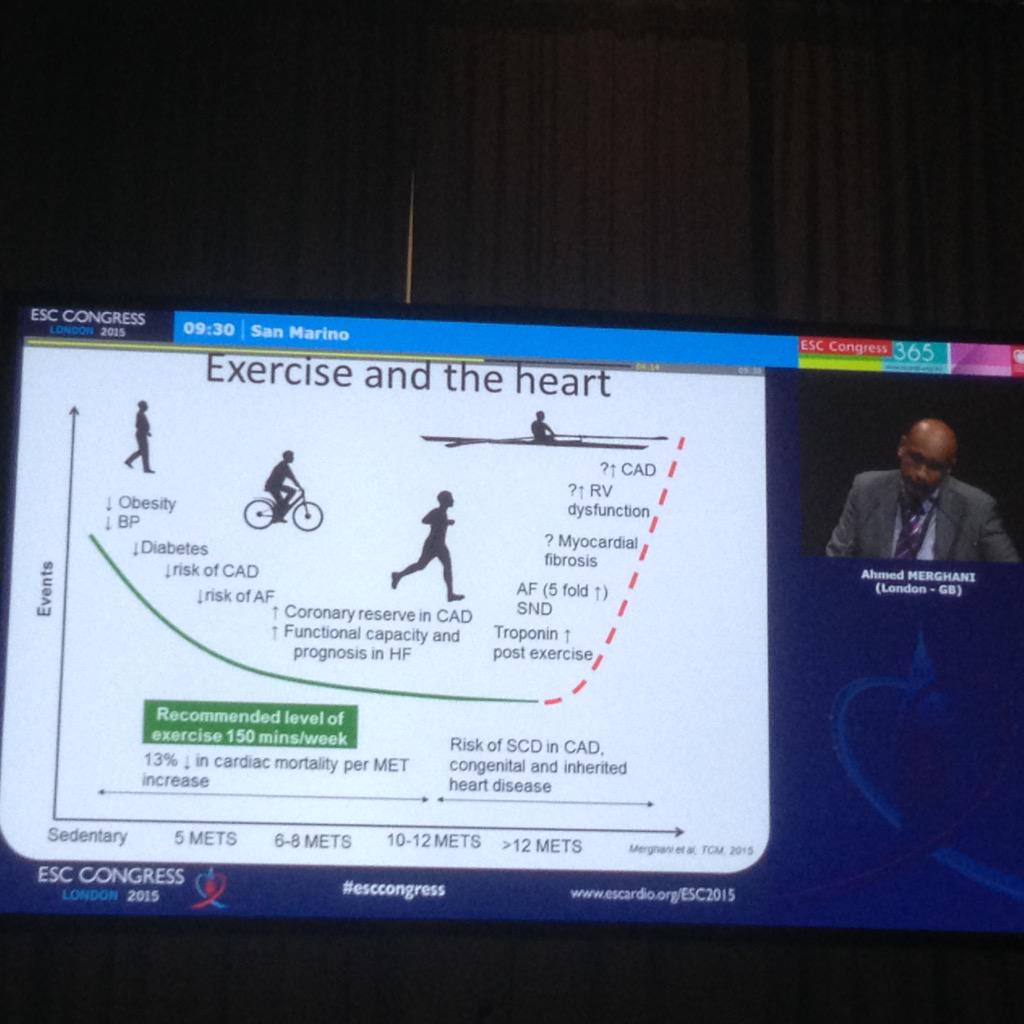
Impressive results in veteran athletes study presented by Dr Merghani
Impressive results in veteran athletes study presented by Dr Merghani pic.twitter.com/v69jCGxIGw

Sunday, August 30, 2015

microvascular disease


The science of microvascular disease

ESC Congress News 2015 - London


IN THIS MORNING’S William Harvey lecture Axel Pries will challenge basic scientists to explore the ‘black box’ of the microcirculation. ‘To my mind, the coronary microcirculation, the business end of the circulation where oxygen diffuses into cells, represents one of the contemporary frontiers in cardiology research,’ says Pries, from the Charité University of Medicine, Berlin. ‘We still know extraordinarily little about what’s going on here.’
Basic Sciences, Pharmacology, Genomics and Cardiovascular Pathology

Axel Pries will deliver today’s William Harvey lecture  on basic science, describing microcircular networks as ‘the business end of the circulation’.
Axel Pries will deliver today’s William Harvey lecture on basic science, describing microcircular networks as ‘the business end of the circulation’.
Recent studies show that a substantial number of patients with suspected coronary artery disease examined by coronary angiography have apparently normal arteries, suggesting they suffer from microvascular disease. Such pathologies can be attributed to spasm, coagulation, micro-obstruction by leucocytes, adverse microvascular remodelling, and endothelial dysfunction among other potential mechanisms.
Although there has been an increase in clinical papers addressing the coronary microcirculation, says Pries, the amount of basic science research has declined over the past few decades. ‘What’s needed,’ he adds, ‘is a greater understanding before we can move on to develop treatments.’
Since the microcirculation lies beyond the domain of catheter investigation and intravascular imaging, much of Pries’s work has involved mathematical modelling collaborations with the mathematician Timothy Secomb from the University of Tucson. Adequate function of terminal vascular beds, they suggest, depends on exact adjustment of vessel diameters by adaptive processes. Here they believe a ‘feedback’ system operates through the conduction of electrical signals upstream along arterioles within vascular network, preventing generation of functional arterio-veneous shunts. This conduction relies on the adequate function of connexins forming gap junctions between cells in the vessel wall. ‘The system provides the arteriole with information about the capillaries it is serving,’ explains Pries.
Another focus has been the ‘endothelial surface layer’ or ‘glycocalyx’, a gel like layer around 0.5 μm thick influencing flow resistance, inflammation and permeability. Conditions such as inflammation, diabetes mellitus and hypertension, they believe, have a negative effect on this layer.
Since graduating from the University of Cologne in 1980 Pries has exclusively focused on basic science. While he does not deny there are frustrations, the rewards of the scientific life are worthwhile. ‘Scientists need to be really determined with a thick skin because it can take years to achieve breakthroughs,’ he says. ‘But each morning you’re like a pioneer exploring new territory and don’t know where your journey will take you.’
His advice to young colleagues is to ‘cherish’ the time before administration catches up. For Pries such freedom is now gone. In December 2014 he was appointed Dean of the Charité with shared responsibility for an overall budget of €1.5 billion and 13,000 staff.
To relax he spends time with his wife and two daughters and enjoys wood turning bowls. ‘In a matter of hours you create from scratch something that is beautiful and useful. It’s a refreshing antidote to the irritants of the scientific and administrative processes,’ he says.

ESC William Harvey Lecture on Basic Science  30 Aug  9:20-10:00, Regents Park – The Hub.

Oliver Sachs (Londres, 9 de julho de 1933- Nova Iorque, 30 de agosto de 2015)

New post on Mind Hacks

Oliver Sacks has left the building

by vaughanbell
CC Licensed Photo from Wikipedia. Click for source.Neurologist and author Oliver Sacks has died at the age of 82.
It's hard to overestimate the impact of Oliver Sacks on the public's understanding of the brain, its disorders and our diversity as humans.
Sacks's wrote what he called 'romantic science'. Not romance in the sense of romantic love, but romantic in the sense of the romantic poets, who used narrative to describe the subtitles of human nature, often in contrast to the enlightenment values of quantification and rationalism.
In this light, romantic science would seem to be a contradiction, but Sacks used narrative and science not as opponents, but as complementary partners to illustrate new forms of human nature that many at the time found hard to see: in people with brain injury, in alterations or differences in experience and behaviour, or in seemingly minor changes in perception that had striking implications./.../

*************************************************

The Silent Music of the Mind: Remembering Oliver Sacks

by 
“I had no room now for this fear, or for any other fear, because I was filled to the brim with music.”
I was a relative latecomer to the work of Oliver Sacks (July 9, 1933–August 30, 2015), that great enchanter of storytelling who spent his life bridging science and the human spirit — partly because I was not yet born when he first bewitched the reading public with his writing, and partly because those early books never made it past the Iron Curtain and into the Bulgaria of my childhood. It was only in my twenties, having made my way to America, that I fell in love with Dr. Sacks’s writing and the mind from which it sprang — a mind absolutely magnificent, buoyed by a full heart and a radiant spirit.
His intellectual elegance bowled me over, and I felt a strange kinship with many of his peculiarities, from the youthful affair with iron — although the 300-pound squats of my bodybuilding days paled before his 600 pounds, which set a state record and earned him the moniker Dr. Squat — to our shared love of Beethoven and Mendelssohn.
Indeed, it was his uncommon insight into the role of music in the human experience that first drew me to Dr. Sacks’s writing. I landed into Musicophiliaand soon devoured his older writings. Both his science and his life were undergirded by a profound reverence for music — music seemed to be this intellectual giant’s greatest form of spirituality. He knew that the life of the mind and the life of the body were one, and understood that music married the two — an understanding he carried in his synapses and his sinews.
Nowhere did this embodied awareness, nor his luminous soul, come more vibrantly alive than in the remarkable story of how he once saved his own life by song and literature while running from a raging bull in a Norwegian fjord, told in his 1974 memoir A Leg to Stand On (public library) — the story by which I shall always remember him.
To commemorate this irreplaceable man, I asked artist Debbie Millman to create a piece of art illustrating the passage that captures not only the heart of that heartening story, but the spirit in which Dr. Sacks inhabited and exited our world.
The artwork is available as a print and I am donating all proceeds to the Oliver Sacks Foundation.
As the broken instrument of his body is buried motionless and mute into the earth, may the symphony of his spirit live on in his writing with the same eternally resounding vigor as what Dr. Sacks called “one of the world’s great musical treasures” in his final communication with the world:
What a privilege for this world to have been graced with this extraordinary human animal and his fully embodied mind. The only thing left to say is what Dr. Sacks himself wrote to his beloved aunt Lennie, who shaped his life, as she lay dying: “Thank you, once again, and for the last time, for living — for being you.”