This Blog AMICOR is a communication instrument of a group of friends primarily interested in health promotion, with a focus on cardiovascular diseases prevention. To contact send a message to achutti@gmail.com http://achutti.blogspot.com
Translate AMICOR contents if you like
Friday, March 30, 2012
Brain & Ethics
3D Brain Structure
The brain is wired in a 3D grid structure, landmark study finds
March 30, 2012
(Vejam video da Science ao final)
[+]
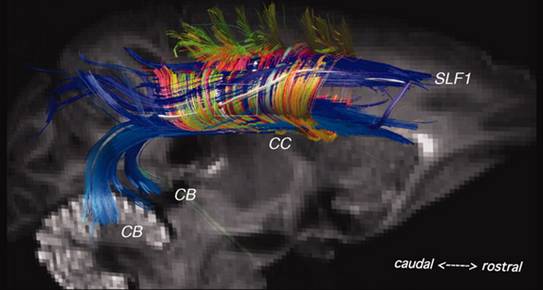
Neighborhood structure of cerebral pathways. A curved sheet of interwoven orthogonal pathways (Credit: Van J. Wedeen, et al./Science)
The brain appears to be wired in a rectangular 3D grid structure, suggests a new brain imaging study funded by the National Institutes of Health.
“Far from being just a tangle of wires, the brain’s connections turn out to be more like ribbon cables — folding 2D sheets of parallel neuronal fibers that cross paths at right angles, like the warp and weft of a fabric,” explained Van Wedeen, M.D., of Massachusetts General Hospital (MGH), A.A. Martinos Center for Biomedical Imaging and the Harvard Medical School.
“This grid structure is continuous and consistent at all scales and across humans and other primate species.”/.../
New Genetic Discovery
New layer of genetic information discovered
March 30, 2012
[+]
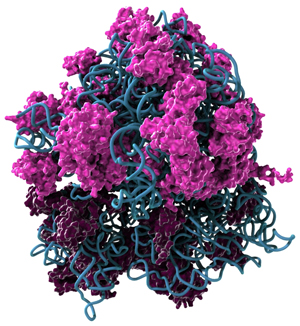
The structure of a ribosome (credit: Dale Muzzey/UCSF)
A hidden, never-before-recognized layer of information in the genetic code has been uncovered by a team of scientists at the University of California, San Francisco (UCSF) thanks to a technique developed at UCSF called ribosome profiling, which enables the measurement of gene activity inside living cells — including the speed with which proteins are made.
By measuring the rate of protein production in bacteria, the team discovered that slight genetic alterations could have a dramatic effect. This was true even for seemingly insignificant genetic changes known as “silent mutations,” which swap out a single DNA letter without changing the ultimate gene product.
To their surprise, the scientists found these changes can slow the protein production process to one-tenth of its normal speed or less./.../
Contaminantes Ambientais
Boletim ALERTA DO VIGIAR/RS do dia 28/03/2012, com
alterações na Qualidade do Ar da Grande Porto Alegre.
*Contaminantes* *Ambientais*
Núcleo de Vigilância dos Riscos e Agravos Ambientais não Biológicos
Centro Estadual de Vigilância em Saúde / SES - RS
Fone: (51) 3901-1081
Objetivo do Boletim
Informar/alertar a comunidade gaúcha sobre as condições atmosféricas atuais no RS, disponibilizar informações do Instituto Nacional de Pesquisas Espaciais – INPE e recomendar ações para a proteção/promoção da saúde e prevenção de agravos e doenças ocasionadas ou agravadas por impactos atmosféricos, além de veicular, outras notícias de interesse à Vigilância em Saúde.
Billion of Planets
Life on Billions of Planets? Could Be
By MICHAEL D. LEMONICK Friday, Mar. 30, 2012
This artist's impression shows a sunset seen from the super-Earth Gliese 667 Cc.
"The Creator must have an inordinate fondness for beetles," the early 20th-century biologist J.B.S. Haldane once said. "He made so many of them." If Haldane had been an astronomer, he might have said the same about the nondescript red stars known as M-dwarfs. As the name implies, they're small, no more than half the size of our Sun at most. They're so dim that not a single one, not even the closest, is visible to the naked eye. And they vastly outnumber any other type of star in the Milky Way: our galaxy has maybe ten or 20 billion Sun-like G stars, but is home to 150 billion M-dwarfs, and maybe more, adding up to some 80% of the galaxy's stellar population./.../
Thursday, March 29, 2012
Pharmageddon
Q&A: Psychiatrist Dr. David Healy Defines ‘Pharmageddon’
A Q&A with the author of Pharmageddon about how the pharmaceutical industry has co-opted medicine.
PHIL ASHLEY / GETTY IMAGES
Dr. David Healy has spent decades delving into the dark corners of the pharmaceutical industry, where, for instance, drug companies have tried to hide the worrisome connection between antidepressant drugs and suicide. In the psychiatrist’s best-known previous books, The Antidepressant Era and Let Them Eat Prozac, Healy explored the often vexing history of the mental health field and its troubled relationship with Big Pharma. In his latest book, Pharmageddon, he presents an even bleaker picture of the way industry has co-opted medicine in general — not just mental health. Healthland spoke with Healy about his findings./.../
Saúde - Urbana / Observatório das Metrópoles / Georgetown University
Em 19 março p.p. aconteceu a apresentação do nosso grupo Saúde - Urbana / Observatório das Metrópoles para os representantes da Georgetown University - Washington, interessados particularmente nas Desigualdades em Saúde.
Medicine & Humanity
"US health system reform--what's missing?" Humanity
POSTED MAR 25, 2012 AT 05:44 PM, EDT BY MELISSA WALTON-SHIRLEY
I don't know the identity of the physician that stood at the microphone at the end of this presentation, but he hit the nail on the head. "Healthcare is a basic human right," he said; which raises the question, "If the right to healthcare is so basic, why is it so problematic?" When there's trouble in any country, it most usually has to do with the age-old struggle to balance the supply of cash with the demand for services, but that is a woefully inadequate summation. Like any complicated and dying patient whose symptom complex is driven by not just one, but two or even three different disease processes, so are the maladies of healthcare reform in our country. Following suit like a successfully metastatic cancer, those who seek to destroy the good things about our system are attacking simultaneously, at every vulnerable site, repeatedly and efficiently. Make no mistake, as a group of individuals, we as healthcare providers are vulnerable.
I read every page of the healthcare reform bill and posted on that issue a few years ago. I lamented that the word "cardiologist," the gatekeeper of the our country's most expensive DRGs, congestive heart failure the most damning, was never mentioned one single time in the entire diatribe. Congestive heart failure was never mentioned as an entity, period. Although trauma networks were addressed, PCI networking, a smoke-free America, and effective strategies for heart-failure prevention and readmissions were never mentioned. Behind what door were we all sleeping? Or more precisely, who was holding the door shut?/.../
Viação Férrea: Fotos LEAchutti
Tema Viação Férrea Fotógrafo: Luiz Eduardo Robinson Achutti
(nosso filho)
Tuesday, March 27, 2012
Digital Data & Human Brain
Supercomputer An IBM Blue Gene/P supercomputer rack. Wikimedia Commons
If you could put all the data in the world onto CDs and stack them up, the pile would stretch from the Earth to beyond the moon, according to a new study. The world’s technological infrastructure has a staggering capacity to store and process information, reaching 295 exabytes in 2007, a reflection of the world’s almost complete transition into the digital realm. That's a number with 20 zeroes behind it, in case you're wondering.
Martin Hilbert and Priscila López took on the unenviable task of figuring out how much information is out there, and how its storage and processing have changed over time. Some of their findings seem obvious, like the fact that Internet and phone networks have grown at quite a clip (28 percent per year), while TV and radio grew much more slowly. But others are more surprising, like the nugget that 75 percent of the world’s stored information was still in analog format in 2000, mostly in the form of video cassettes. By 2007, 94 percent of the world’s info was digital./.../
FLU
TOM GRILL / GETTY IMAGES
During the 2009-10 H1N1 or “swine flu” pandemic, the same virus that caused mild coughing and sneezing in some patients proved fatal for others. It highlighted a medical mystery: why are some people more fit to handle the flu than others?
British and American researchers think they have a clue. Reporting on Sunday in the journal Nature, researchers say they’ve found a gene that influences our susceptibility to flu illness. The gene, called IFITM3, is the “crucial first line of defense” against the flu, researcher Paul Kellam of Britain’s Sanger Institute toldReuters.
Subscribe to:
Posts (Atom)