
Translate AMICOR contents if you like

Sunday, September 06, 2015

2722 - AMICOR 18

Google

Aloyzio AchuttiemAMICOR - Há 52 minutos
[image: Google] *Doodles Archive*

Medida de Risco CV

Aloyzio AchuttiemAMICOR - Há 11 horas
Heart Age Tops Actual Age in United States, CDC Says Robert Lowes September 01, 2015 - - - Related Drugs & Diseases - Risk Factors for Coronary Artery Disease - Primary and Secondary Prevention of Coronary Artery Disease - Imaging in Coronary Artery Disease A new and simpler way to express a person's risk for a heart attack or stroke still shows the nation to be heart unhealthy on average, but this metric may provide more motivation for patients to adopt healthier lifestyles, the Centers for Disease Control and Prevention (CDC) said today. The metric is heart age... mais »

Sinusite Crônica JAMA

Aloyzio AchuttiemAMICOR - Há 11 horas
Medical Therapies for Adult Chronic SinusitisJAMAThis systematic review summarizes current evidence-based treatment of adult chronic sinusitis and proposes a treatment algorithm.

Visita a minhas irmãs em Santa Maria

Aloyzio AchuttiemAMICOR EXTENSION - Há 16 horas
No ultimo dia três, aniversário de uma de minhas irmãs - Maria Helena - fui a Santa Maria abraça-las. A viagem foi boa - 45 minutos num avião Azul, com retorno no dia seguinte. Transportou-me gentilmente do e para o aeroporto o Sr. Mauro. Passamos por uma ruas por onde eu nunca havia passado enquanto lá morava, onde vi de longe e externamente o estado lastimável das antigas oficinas da gloriosa VFRGS. O resto foi festa e festa e encontro com primos, muitas amigas de minhas irmãs e suas cuidadoras. Coloco a seguir *um pequeno filme* e algumas fotos.

Arte y Cerebro

Aloyzio AchuttiemAMICOR - Há 22 horas
*Nossa filha Lucia Helena enviou de Buenos Aires: sugestão para gauchos...*Arte y Cerebro en los MuseosContinúa el programa de visitas guiadas gratuitas para adultos mayores y pacientes con enfermedad de Alzheimer por los Museos de Buenos Aires. Primeros sábados de cada mes. Inscripción previo con cupos limitados. Programa de visitas guiadas a los museos porteños para personas con enfermedad de Alzheimer. Se continúan realizando en los Museos de Buenos Aires las visitas guiadas gratuitas para adultos mayores y pacientes con enfermedad de Alzheimer, que forman parte del programa "Arte... mais »

Closing the Gap

Aloyzio AchuttiemAMICOR - Há 22 horas
How can we create economic opportunity for all? How can we avoid technology-fueled unemployment tomorrow? [image:
Tom Friedman
Pulitzer Prize-Winning Columnist] Tom FriedmanPulitzer Prize-Winning Columnist [image:
Robert Reich
Former U.S. Labor Secretary] Robert ReichFormer U.S. Labor Secretary [image:
Dr. Henry Kissinger
Nobel Peace Prize Winner] Dr. Henry KissingerNobel Peace Prize Winner [image:
Nouriel Roubini
Economist, NYU Stern School of Business] Nouriel RoubiniEconomist, NYU Stern School of Business [image:
Chrystia Freeland
Member of Parliam...
 mais »

Age and fittness

Aloyzio AchuttiemAMICOR - Há 22 horas
Older people in Germany and England getting smarter, but not fitter September 1, 2015 [image: smarter not fitter] People over age 50 are scoring better on cognitive tests than people of the same age did in the past — a trend that could be linked to higher education rates and increased use of technology in our daily lives, according to a new study published in an open-access paper in the journal PLOS ONE. But the … more…

37 billion stars and galaxies

Aloyzio AchuttiemAMICOR - Há 22 horas
World’s most powerful, largest digital camera: 37 billion stars and galaxies 3.2-gigapixel digital camera will take digital images of the entire visible southern sky every few nights, producing 15 Terabytes of data September 1, 2015 The LSST’s camera will include a filter-changing mechanism and shutter. This animation shows that mechanism at work, which allows the camera to view different wavelengths; the camera is capable of viewing light from near-ultraviolet to near-infrared (0.3-1 μm) wavelengths. (credit: SLAC National Accelerator Laboratory) The Department of Energy has approved... mais »

DALYs and HALEs 1990-2013

Aloyzio AchuttiemAMICOR - Há 22 horas
Life expectancy climbs worldwide but people spend more years living with illness and disability September 2, 2015 [image: Life expectancy at birth, both sexes, 2013 (credit: Institute for Health Metrics and Evaluation)] Global life expectancy has risen by more than six years since 1990 The good news: as for 2013, global life expectancy for people in 188 countries has risen 6.2 years since 1990 (65.3 to 71.5). The bad news: healthy life expectancy (HALE) at birth rose by only 5.4 years (56.9 to 62.3), due to fatal and nonfatal ailments (interactive visualization by country here). In o... mais »

Parkinson's D

Aloyzio AchuttiemAMICOR - Há 22 horas
Treatement with noninvasive focused ultrasound for Parkinson’s disease September 2, 2015 [image: University of Maryland medical doctors monitor focused ultrasound treatment for essential tremor, guided by magnetic resonance imaging (MRI) (credit: University of Maryland School of Medicine)] Researchers at the University of Maryland have performed the first focused ultrasound treatments on a deep structure within the brain related to Parkinson’s disease* called the globus pallidus. These treatments are part of international pilot studies of 40 patients assessing the feasibility, safety... mais »

Happiness

Aloyzio AchuttiemAMICOR - Há 3 dias
World Happiness Report 2015 Ranks Happiest Countries APRIL 23, 2015 *World Happiness Report 2015 Ranks Happiest Countries* *Seen as source for world leaders as they set to adopt Sustainable Development Goals* NEW YORK, April 23 – Since it was first published in 2012, the *World Happiness Report*demonstrated that well-being and happiness are critical indicators of a nation’s economic and social development, and should be a key aim of policy. This year’s report looks at the changes in happiness levels in 158 countries, and examines the reasons behind the statistics. The *World Happine... mais »

quantum motion

Aloyzio AchuttiemAMICOR - Há 3 dias
Seeing quantum motionAugust 28, 2015 by Jessica Stoller-Conrad [image: Seeing quantum motion] Credit: Chan Lei and Keith Schwab/Caltech Consider the pendulum of a grandfather clock. If you forget to wind it, you will eventually find the pendulum at rest, unmoving. However, this simple observation is only valid at the level of classical physics—the laws and principles that appear to explain the physics of relatively large objects at human scale. However, quantum mechanics, the underlying physical rules that govern the fundamental behavior of matter and light at the atomic scale, state ... mais »

New Drugs

Aloyzio AchuttiemAMICOR - Há 4 dias
theheart.org on Medscape > Heartfelt with Dr Melissa Walton-Shirley COMMENTARYNew Cardio Drugs: Here's to Hopeful New Prescribing Melissa Walton-Shirley Disclosures|August 25, 2015 Last week I experienced a tumultuous interface with the pharmaceutical industry. In the space of a few hours, three representatives came bearing information on the compounds formerly known as S-16257, REGN727, and LCZ696. They've been awarded the clumsy generic names of ivabradine, alirocumab, and sacubitril/valsartan, respectively. After spinning in the marketing bin, they tumbled out as *Corlanor* (Amgen),... mais »

Metrics

Aloyzio AchuttiemAMICOR - Há 4 dias
Our obsession with metrics is corrupting science Andrew Beattie, Mike Calver | September 1, 2015 | 1 CommentDownload as PDF NessieNoodle | Flickr | CC BY-SA https://www.flickr.com/photos/glitch_nitch/645244048/ Not everything that can be counted counts, and not everything that counts can be counted. – William Bruce Cameron

Plebiscito

Aloyzio AchuttiemAMICOR - Há 5 dias
01 de setembro de 2015 | N° 18281 ARTIGOSSAÍDA DA CRISE: POR QUE NÃO UM PLEBISCITO? *POR ANTONIO DOMINGOS PADULA** Os acontecimentos dos últimos meses revelam uma realidade quase incontestável: o governo do RS está próximo da insolvência. Em agosto, houve parcelamento nos pagamentos e estratificação nas faixas salariais. Agora, em setembro, está-se novamente diante da necessidade de parcelamento do pagamento e com redução na estratificação salarial. Como será outubro? Como se chegou a essa situação é uma longa história. No entanto, parece que estamos diante de uma grande oportunidade... mais »

Human Super-Predators

Aloyzio AchuttiemAMICOR - Há 5 dias
*REPORT: The unique ecology of human predators* *Abstract: *Paradigms of sustainable exploitation focus on population dynamics of prey and yields to humanity but ignore the behavior of humans as predators. We compared patterns of predation by contemporary hunters and fishers with those of other predators that compete over shared prey (terrestrial mammals and marine fishes). Our global survey (2125 estimates of annual finite exploitation rate) revealed that humans kill adult prey, the reproductive capital of populations, at much higher median rates than other predators (up to 14 time... mais »

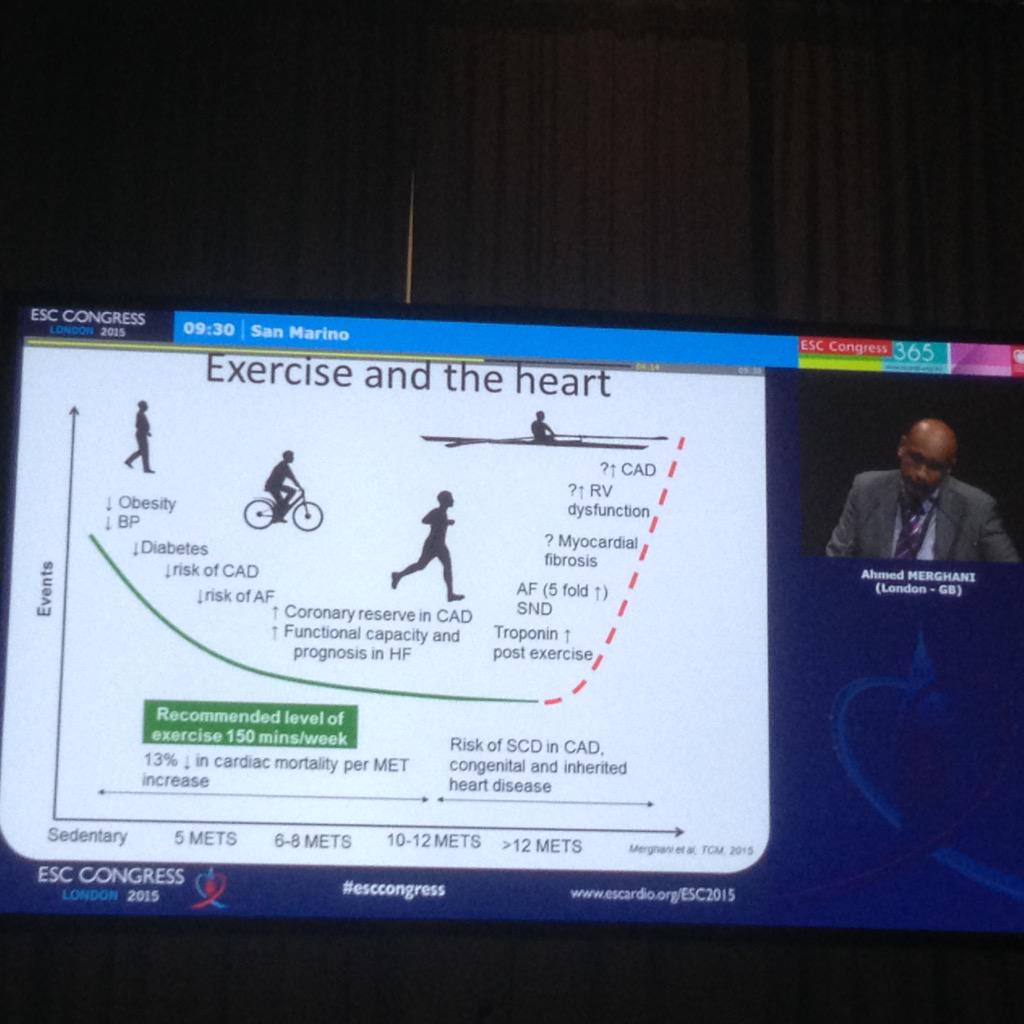
Exercise and atherosclerosis
Aloyzio AchuttiemAMICOR - Há 5 dias
ESC 2015 *Luis Serratosa* ‏@LSerratosa 1h1 hour ago Impressive results in veteran athletes study presented by Dr Merghani @ StGeorgesUni @SSharmacardio *Luis Serratosa* ‏@LSerratosa 1h1 hour ago Impressive results in veteran athletes study presented by Dr Merghani @ StGeorgesUni @SSharmacardio #ESCcongress pic.twitter.com/v69jCGxIGw

microvascular disease

Aloyzio AchuttiemAMICOR - Há 6 dias
The science of microvascular diseaseESC Congress News 2015 - London30 Aug 2015 IN THIS MORNING’S William Harvey lecture Axel Pries will challenge basic scientists to explore the ‘black box’ of the microcirculation. ‘To my mind, the coronary microcirculation, the business end of the circulation where oxygen diffuses into cells, represents one of the contemporary frontiers in cardiology research,’ says Pries, from the Charité University of Medicine, Berlin. ‘We still know extraordinarily little about what’s going on here.’ Basic Sciences, Pharmacology, Genomics and Cardiovascular Patho... mais »

Oliver Sachs (Londres, 9 de julho de 1933- Nova Iorque, 30 de agosto de 2015)

Aloyzio AchuttiemAMICOR - Há 6 dias
New post on *Mind Hacks*Oliver Sacks has left the buildingby vaughanbell [image: CC Licensed Photo from Wikipedia. Click for source.]Neurologist and author Oliver Sacks has died at the age of 82. It's hard to overestimate the impact of Oliver Sacks on the public's understanding of the brain, its disorders and our diversity as humans. Sacks's wrote what he called 'romantic science'. Not romance in the sense of romantic love, but romantic in the sense of the romantic poets, who used narrative to describe the subtitles of human nature, often in contrast to the enlightenment values of quan... mais »

Google

Google
Doodles Archive

Saturday, September 05, 2015

Medida de Risco CV


A new and simpler way to express a person's risk for a heart attack or stroke still shows the nation to be heart unhealthy on average, but this metric may provide more motivation for patients to adopt healthier lifestyles, the Centers for Disease Control and Prevention (CDC) said today.
The metric is heart age, defined as the predicted age of a person's vascular system based on their cardiovascular risk factor profile, according to a study published online September 1 in the most recent issue of the Morbidity and Mortality Weekly Report. The CDC derived heart age for roughly 236,000 men and 342,000 women aged 30 to 74 years from their individual Framingham Risk Score (FRS), which estimates the odds of developing cardiovascular disease in the next 10 years. A predicted heart age that tops a person's chronological age indicates a greater risk, whereas a heart age younger than chronological age indicates the opposite.
The study found that predicted heart age exceeds chronological age on average by 7.8 years for men and 5.4 years for women. Only 30% of Americans had heart ages equal to or below their chronological age.
In a news conference today, CDC Director Thomas Frieden, MD, MPH, said the good news amid all these glum statistics is that heart age is a more graspable expression of cardiovascular peril than the likes of the FRS. It is therefore more likely to motivate Americans to stop smoking, exercise regularly, control their cholesterol and blood pressure, and adopt healthier lifestyles in general.
"The heart age is an understandable, simple tool that helps people take more control over their health," said Dr Frieden. "It's never too late to turn back the clock on your heart age."
Recognizing the need to sharpen its patient education, the Framingham Heart Study introduced the heart-age metric in 2008. The web site for the project features a calculator that asks for a person's sex, age, systolic blood pressure, body mass index, and whether he or she smokes, has diabetes, or receives treatment for hypertension. The calculator then determines a heart age and converts it into the individual's 10-year risk for cardiovascular disease, expressed as a percentage. Also shown are both the normal and optimal 10-year risk.
A reporter at the news conference asked Dr Frieden whether the heart age metric was too simple to be taken seriously. In response, Dr Frieden pointed to a recent study published in the European Journal of Preventive Cardiology that proved the motivational power of heart age. In the study, a control group received standard medical advice about cardiovascular disease, another group of subjects was given its 10-year FRS, and a third group calculated their heart age. Afterward, the FRS and heart-age groups significantly lowered their risk for a heart attack or stroke through lifestyle changes compared with the control group. The group that knew its heart age, however, improved the most.
Wide Racial and Regional Disparities

1 of 2

Sinusite Crônica JAMA

Medical Therapies for Adult Chronic Sinusitis
JAMA
This systematic review summarizes current evidence-based treatment of adult chronic sinusitis and proposes a treatment algorithm.

Arte y Cerebro

Nossa filha Lucia Helena enviou de Buenos Aires: sugestão para gauchos...

Arte y Cerebro en los Museos

Continúa el programa de visitas guiadas gratuitas para adultos mayores y pacientes con enfermedad de Alzheimer por los Museos de Buenos Aires. Primeros sábados de cada mes. Inscripción previo con cupos limitados.

Programa de visitas guiadas a los museos porteños para personas con enfermedad de Alzheimer.
Se continúan realizando en los Museos de Buenos Aires las visitas guiadas gratuitas para adultos mayores y pacientes con enfermedad de Alzheimer, que forman parte del programa "Arte y Cerebro", organizado por el Ministerio de Cultura de la Ciudad de Buenos Aires y el Instituto de Neurología Cognitiva (INECO). El objetivo del proyecto es generar los recursos necesarios para que las personas con demencia puedan acceder a la experiencia cultural que ofrecen los museos.
Próximas visitas:
  • Museo de Artes Plásticas Eduardo Sívori (Av. Infanta Isabel 555) los terceros JUEVES de cada mes a las 11h.
  • Museo de Arte Español Enrique Larreta (Av. Juramento 2291) el último VIERNES de cada mes a las 11 h.
  • Museo de Esculturas Luis Perlotti (Pujol 644) los primeros LUNES de cada mes a las 11 h.
  • MuHu - Museo del Humor (Av. de los Italianos 851) los primeros SÁBADOS de cada mes a las 11 h.
  • Museo de Arte Popular José Hernández (Av. del Libertador 2373) los primeros JUEVES de cada mes a las 15h.
  • Museo del Cine Pablo Ducrós Hicken (Agustín R. Caffarena 51) los segundos JUEVES de cada mes a las 11h.
Las visitas son gratuitas, con inscripción previa, los cupos son limitados.
Para recibir más información e inscribirse, enviar un correo electrónico a: visitasarteycerebro@buenosaires.gob.ar, o comunicarse a los teléfonos 4516-0944/49 int. 222 y 4313-4082.

Closing the Gap

How can we create economic opportunity for all?
How can we avoid technology-fueled unemployment tomorrow?

<h5>Tom Friedman</h5>Pulitzer Prize-Winning Columnist
Tom Friedman
Pulitzer Prize-Winning Columnist
<h5>Robert Reich</h5>Former U.S. Labor Secretary
Robert Reich
Former U.S. Labor Secretary
<h5>Dr. Henry Kissinger</h5>Nobel Peace Prize Winner
Dr. Henry Kissinger
Nobel Peace Prize Winner
<h5>Nouriel Roubini</h5>Economist, NYU Stern School of Business
Nouriel Roubini
Economist, NYU Stern School of Business
<h5>Chrystia Freeland</h5>Member of Parliament, Canada
Chrystia Freeland
Member of Parliament, Canada
<h5>Niall Ferguson</h5>Harvard University
Niall Ferguson
Harvard University
<h5>Dan Ariely</h5>Behaviorial Economist @ Duke
Dan Ariely
Behaviorial Economist @ Duke
<h5>Andrew McAfee</h5>Author @ MIT
Andrew McAfee
Author @ MIT
<h5>Salim Ismail</h5>Global Ambassador for Singularity University
Salim Ismail
Global Ambassador for Singularity University
<h5>Clara Miller</h5>President, Heron Foundation
Clara Miller
President, Heron Foundation
<h5>Vivek Wadhwa</h5>Stanford University
Vivek Wadhwa
Stanford University
<h5>Philip Zelikow</h5>University of Virginia
Philip Zelikow
University of Virginia
<h5>Gerald Huff</h5>Tesla Motors
Gerald Huff
Tesla Motors
“The defining issue of our time.” - Nouriel Roubini

Age and fittness

Older people in Germany and England getting smarter, but not fitter
September 1, 2015

smarter not fitter People over age 50 are scoring better on cognitive tests than people of the same age did in the past — a trend that could be linked to higher education rates and increased use of technology in our daily lives, according to a new study published in an open-access paper in the journal PLOS ONE. But the … more…

37 billion stars and galaxies

World’s most powerful, largest digital camera: 37 billion stars and galaxies

3.2-gigapixel digital camera will take digital images of the entire visible southern sky every few nights, producing 15 Terabytes of data
September 1, 2015

The LSST’s camera will include a filter-changing mechanism and shutter. This animation shows that mechanism at work, which allows the camera to view different wavelengths; the camera is capable of viewing light from near-ultraviolet to near-infrared (0.3-1 μm) wavelengths. (credit: SLAC National Accelerator Laboratory)
The Department of Energy has approved the start of construction for a 3.2-gigapixel digital camera — the world’s largest — at the heart of the Large Synoptic Survey Telescope (LSST), revealing unprecedented details of the universe and helping unravel some of its greatest mysteries.

DALYs and HALEs 1990-2013

Life expectancy climbs worldwide but people spend more years living with illness and disability
September 2, 2015

Life expectancy at birth, both sexes, 2013 (credit: Institute for Health Metrics and Evaluation) 
Global life expectancy has risen by more than six years since 1990
The good news: as for 2013, global life expectancy for people in 188 countries has risen 6.2 years since 1990 (65.3 to 71.5). The bad news: healthy life expectancy (HALE) at birth rose by only 5.4 years (56.9 to 62.3), due to fatal and nonfatal ailments (interactive visualization by country here). In other words, people … more…

Parkinson's D

Treatement with noninvasive focused ultrasound for Parkinson’s disease
September 2, 2015

University of Maryland medical doctors monitor focused ultrasound treatment for essential tremor, guided by magnetic resonance imaging (MRI) (credit: University of Maryland School of Medicine) Researchers at the University of Maryland have performed the first focused ultrasound treatments on a deep structure within the brain related to Parkinson’s disease* called the globus pallidus. These treatments are part of international pilot studies of 40 patients assessing the feasibility, safety, and preliminary efficacy of focused ultrasound treatments for Parkinson’s disease, guided by … more…

Wednesday, September 02, 2015

Happiness

World Happiness Report 2015 Ranks Happiest Countries

quantum motion

Seeing quantum motion

August 28, 2015 by Jessica Stoller-Conrad
Seeing quantum motion
Credit: Chan Lei and Keith Schwab/Caltech
Consider the pendulum of a grandfather clock. If you forget to wind it, you will eventually find the pendulum at rest, unmoving. However, this simple observation is only valid at the level of classical physics—the laws and principles that appear to explain the physics of relatively large objects at human scale. However, quantum mechanics, the underlying physical rules that govern the fundamental behavior of matter and light at the atomic scale, state that nothing can quite be completely at rest./.../


Read more at: http://phys.org/news/2015-08-quantum-motion.html#jCp

Tuesday, September 01, 2015

New Drugs

Last week I experienced a tumultuous interface with the pharmaceutical industry. In the space of a few hours, three representatives came bearing information on the compounds formerly known as S-16257, REGN727, and LCZ696. They've been awarded the clumsy generic names of ivabradine, alirocumab, and sacubitril/valsartan, respectively. After spinning in the marketing bin, they tumbled out as Corlanor (Amgen), for tachycardia, angina, and heart failure; Praluent (Sanofi/Regeneron), an injection for cholesterol lowering; and Entresto (Novartis), a molecule that has been piggybacked onto our familiar and much-beloved valsartan for heart-failure management.
The side effects of these new meds were probed, argued, and discussed long before they could travel along conveyor belts, plop into bottles, and slide onto my sample cabinet. I'm not resistant to new meds, but I'm always suspicious that we don't know everything about side effects or efficacy until they have burst onto the scene of a tell-all American market. Despite adequate trials, wider use of these potentially life-changing drugs directed by healthcare providers is still nothing more than a well-vetted leap of faith. I'm cautiously optimistic, though, about all of them. Here are some specific thoughts I've mulled regarding these three new compounds and how they might affect our office day:/.../

Metrics

Our obsession with metrics is corrupting science

 Not everything that can be counted counts, and not everything that counts can be counted. – William Bruce Cameron

Plebiscito

01 de setembro de 2015 | N° 18281

ARTIGOS

SAÍDA DA CRISE: POR QUE NÃO UM PLEBISCITO? 

POR ANTONIO DOMINGOS PADULA*

Os acontecimentos dos últimos meses revelam uma realidade quase incontestável: o governo do RS está próximo da insolvência. Em agosto, houve parcelamento nos pagamentos e estratificação nas faixas salariais. Agora, em setembro, está-se novamente diante da necessidade de parcelamento do pagamento e com redução na estratificação salarial. Como será outubro?

Como se chegou a essa situação é uma longa história. No entanto, parece que estamos diante de uma grande oportunidade. Diz-se que é na crise que se constroem as soluções ousadas. Em diferentes momentos, vertentes ideológicas que apregoam uma maior participação do Estado ou aquelas que defendem um Estado mínimo tiveram a oportunidade de governar nosso Estado. A rea- lidade aí está: precariedade dos serviços e insolvência. Iniciativas tempestivas do governo atual para enxugar a máquina pública mostram que este está capturado pelas corporações de ofício.

Não estaríamos no momento oportuno de revisitarmos o papel e as responsabilidades do Estado? Quais seriam as responsabilidades do Estado (segurança, infraestrutura, educação, saúde, moradia, emprego, zoológico, armazéns, postos de pedágio...) e até quanto a sociedade gaúcha está disposta pagar por esses serviços prestados (20%, 25%, 30%, 35%... do PIB gaúcho)? Como legitimar e obter a adesão da sociedade gaúcha em torno dos grandes sacrifícios que inevitavelmente estão se delineando em nosso horizonte? Parece que engajar a sociedade nessas escolhas será fundamental para enfrentarmos a dura realidade que se apresenta e construirmos um futuro melhor para nossos filhos.

Assim, parece oportuno que se discuta nos diferentes fóruns da sociedade e se tome a iniciativa de se realizar um plebiscito no qual a sociedade seja chamada a definir quais serão as atividades, funções e responsabilidades do Estado e até quanto a sociedade está disposta a pagar por esses serviços. Propõe-se uma lista extensa das atividades e funções a serem delegadas ao Estado, com um número limitado de escolha (cinco, por exemplo), e uma lista do nível de contribuição (% do PIB) que os indivíduos estão dispostos a pagar para terem aqueles serviços prestados pelo Estado. Ao final, tem-se uma lista de prioridades e uma disponibilidade de recursos (% do PIB) que guiarão, de forma legítima, a travessia dos momentos de grandes desafios que teremos pela frente.

*Professor titular na Escola de Administração da Universidade Federal do Rio Grande do Sul (UFRGS)